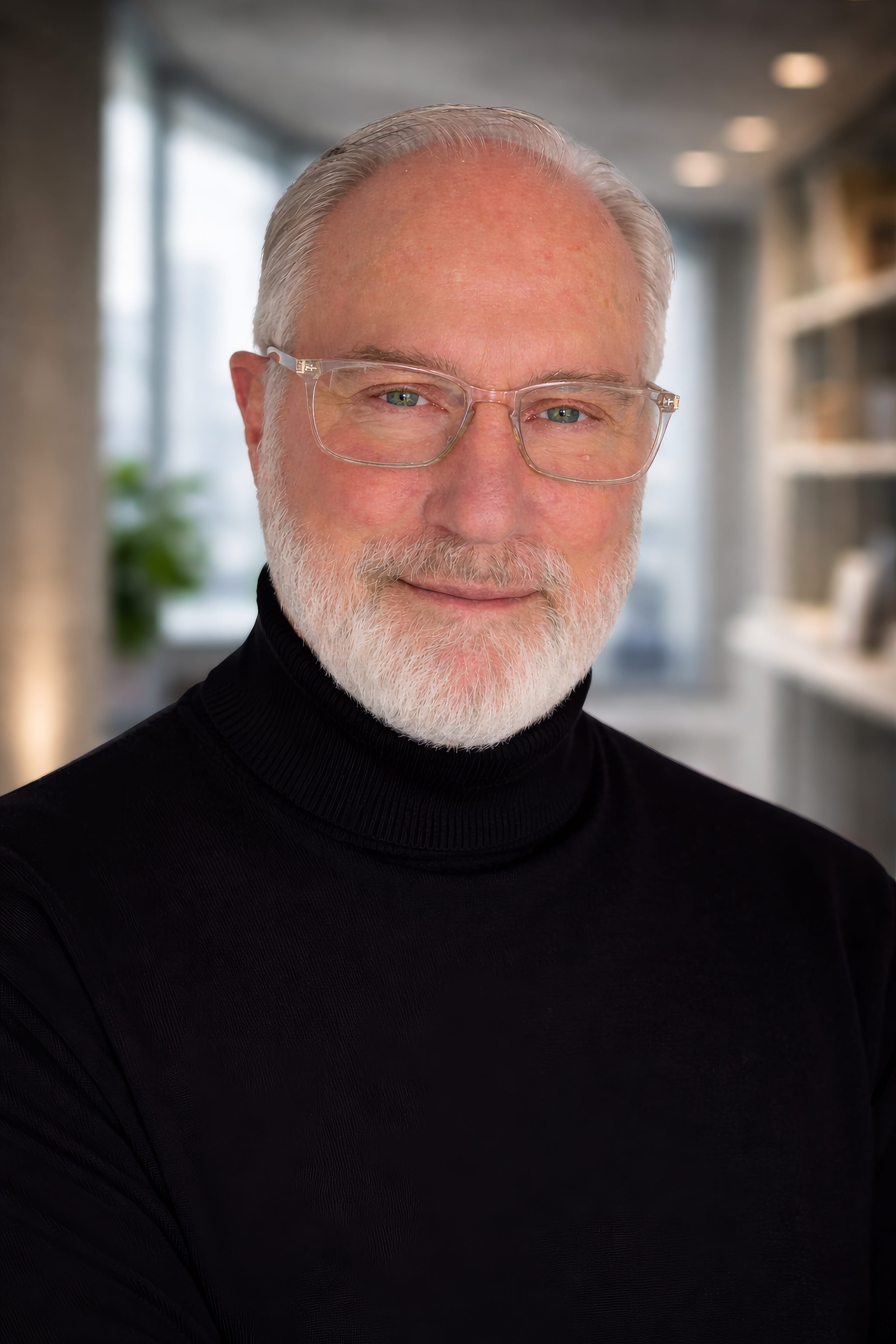
Darrel Rhea is a design strategist and innovation leader who served as CEO of Cheskin, where he expanded its global research and innovation practice. He is coauthor of Making Meaning, a foundational book on meaning-driven innovation, and founder of Rhea Insight, advising Fortune 1000 leaders on strategy, design, and customer-led innovation.
So, as you may or may not know, I start all these conversations with the same question, which I borrowed from a friend of mine who helps people tell their stories. I love it because it’s a big question—but because it’s really big, I tend to over-explain it, like I’m doing now. Before I ask it, I want you to know that you’re in total control. You can answer or not answer in any way you want, and it’s impossible to make a mistake. And the question is: Where do you come from?
So, first, let me just acknowledge the kind of the brilliance of that question, right? Which is to say that you’re modeling great qualitative research technique by starting there, right? Because it automatically flips the power in the conversation to the subject and makes them an author rather than just the subject of the interview.
So, I just, I love that. And it’s a great way to segue into identity and meaning.
So, where do I come from? I grew up in Southern California in the 1950s, ’60s, and ’70s. And that was a really dynamic point in time—kind of a historical anomaly in a lot of ways.
And when I was growing up in that period from the ’50s to 1970, the population of California doubled. And that’s really significant. And I was in Southern California, and that even grew even at a greater rate there. So, people were arriving from everywhere. Almost nobody was from California.
My family was actually a couple of generations there, but that was kind of rare. So, you had people leaving their old cultures behind, and they’re busy inventing new ones. And so, identity was this kind of DIY thing that was happening.
You had this explosive post-war prosperity that was happening in Southern California. You had Hollywood, and you had movies and the music industry exploding. You had defense-driven technology and the University of California research influence on that.
So you had this strange mix of abundance and innovation and social mobility and permission that other places in the world, I don’t think, had that at the same time. So, the message was come to California, you can be whoever you want to be. So, it attracted a whole lot of people who wanted to be something different.
And that was the soup the cultural waters that I was growing up in. And it created an explosion of subcultures that were created while I was young. And I participated in that.
One of those was the surf culture. So I lived close to the beach, and the surfing culture kind of emerged and was invented in my neighborhood. Not surfing itself, but surfing culture.
I knew—friends of mine went to school with the Beach Boys. And it was like, this was an essential kind of rite of passage. I spent my youth chasing waves, going up and down the coast.
And so the savoring the sublime of beauty and protecting the environment and that was very much a subculture that I felt like I was not just part of, but helping invent, which is, I think, kind of a different thing.
Also, in Southern California—well, in California at that time—the countercultural movement was in some ways centered there. It was certainly a center of the countercultural movement of the sixties. And it wasn’t something I read about. It was not something I experienced on TV. It was on our streets.
And where were you? What town were you in?
I was in Fullerton and Newport Beach, and in Orange County—basically just south of Los Angeles. But hippie culture the Summer of Love, the Age of Aquarius, the anti-war movement—I mean, that was what I was just immersed in.
And that that sense of oneness and harmony and community and enlightenment—those were all kind of meanings and values that were embedded in that countercultural movement that were something I experienced kind of deeply.
And at the same time, I went to an experimental liberal arts college. So we were reinventing education, or what college education was, and seeking meaning in new ways.
So, that was another subculture that was emerging there.
When you were young, what did you—did you have an idea of what you wanted to be when you grew up?
Well, I wandering around, I had a sense of wanting to be a designer. So, another subculture that I can speak of kind of on a personal level was Southern California was the epicenter of the global car culture.
And so the most important marker of identity in Southern California—where cars are everything, and you drove everywhere—was: what car did you drive?
Not just what car did you drive, but what brand did you choose, and how did you personalize it, and how did you customize it?
And so that was a marker of identity. And my family’s business was at the epicenter of that. So, we were part of the hot rod culture. We were part of the performance car culture.
And, so I grew up from the age of seven working in my dad’s business in that.
What was the business?
It was basically car customization—interior design. Cars, boats. We were doing cars for Hollywood, and we were doing automotive restorations for the museums. And, my uncle started the Hot Rod Association, National Hot Rod Association.
Wow.
So it’s like—right. Yeah. Doing land speed—trying for land speed records in the salt flats. And this was car culture. Right? And so I was in that, and not just as a participant, but as a designer. Right?
So, I was designing cars and interiors. So, I had that—I think I had that sensitivity to industrial design as an expression of identity. And that was really important to me. And I knew I wanted to take that somewhere. Pursuing design was one of those things.
And where are you now, and what are you up to? What’s your sort of catch-up in terms of where you are now and the work that you’re doing now?
So, yeah, after 30 years with Cheskin—the company that I helped build; didn’t start, but helped build and scale—sold that to WPP. And for the last decade, I’ve been an independent consultant, kind of committed to not having employees and not doing another performance review in my life, after having a large organization.
And yeah, I’ve mostly been doing strategy consulting, working with senior executives on those issues, and also doing a lot of AI implementation work to say, how do we bring technology and make it actually useful to how organizations operate?
Yeah. And how did you go from all those subcultures to Cheskin? What was that journey? How did you get into—your CEO of Cheskin, and you built that business—how did you get into that position?
Yeah, so I kind of went from designer to— I tried working in the field of design and found that not very satisfying. I didn’t have really good mentors. I wanted to participate in design at a higher level than craft, but I didn’t have access to that.
And I didn’t know enough that I should just go down the street and hang out with Charles and Ray Eames, like a friend of mine did, and understand systems design. And that was, like, over my head. I didn’t have access to that.
So, I kind of dropped out of design. I’d gotten a degree in psychology because I was really interested in how people learn and evolve and grow.
And that didn’t hold a lot of promise for me either, because I didn’t want to get a Ph.D., and I didn’t want to work with sick people.
So, bottom line was, I wasn’t just a surfer or hippie or gearhead. my parents had grown up in—that part of that economic expansion was—they went from poverty to wealth by being entrepreneurs and starting their own businesses.
And, the dinner table reality was it’s all about value creation. And you’re going to grow up to be a business leader and an innovator and an entrepreneur.
So, what did I do? I started a company with a college roommate of mine.
And part of that was introducing 20 new products—happened to be in the agriculture or cut-flower industry—introducing 20 new products into the domestic market that hadn’t seen a new product for 20 years.
And I needed to brand them. I needed to call them something. And the only person I knew in marketing was a father of a friend of mine who happened to be Louis Cheskin.
And through introductions and through another friend, I connected. And when I decided I wasn’t a farmer, and the floriculture industry was interesting but it wasn’t where I wanted to— I got hired by Louis Cheskin in Chicago. And I thought I’d be there for a year and ended up there being CEO, owning it, and running it for 31 years.
Amazing. I encountered Cheskin, I think, through Added Value, maybe later in its lifetime, and I’m aware of its reputation. But how do you place Louis Cheskin in the broader legacy of research and strategy?
Yeah, well, he was a seminal figure and pioneer in the field of consumer research. And it’s—I think in today’s world, very few people in the industry tend to know much about Lewis Cheskin.
But he made design something that was—from and took it from subjective taste to science, basically.
So, he was a Ph.D. psychologist trained in University of Chicago in the ’30s, at a time that was this really interesting, revolutionary time where physics and statistics and psychology and the social sciences were actually becoming first truly empirical.
And he moved in these circles. He hung out with Einstein and Fermi and kind of the scientific elite back in those early days.
And he told—Cheskin, he told Einstein, “I want to define what the science of art is,” which was a really kind of avant-garde, really ambitious kind of aspiration—and controversial at the time, because art—the applied arts—were subjective and could not be quantified.
So, he had that aspiration. During the Depression, he ran the Works Project Administration arts programs in the state of Illinois. So, he had hundreds of artists on his payroll—really good artists, great artists.
And what did he do with it? He said, well, I’ll start doing research on color perception, because I really am interested in this. And he did some of the foundational and first color research—research on color—deploying quantitative research techniques. Taking a room and painting it—painting everything in the room red, and having an identical room painted with everything in that blue, and another room with everything green.
And didn’t ask people if they liked the room. He just—he looked at productivity. He looked at physiological measurements, psychological measurements, and determined in an indirect way what the impact of color was on the human being.
And that’s—that’s where he started his work. And that launched a whole career. He founded the Color Research Institute of America.
He ended up doing consulting work with Disney on Fantasia, and with the military on camouflage. And, he created color systems—basically, the precursor to Pantone was the Cheskin color system.
He invented four-color printing methodologies. So, Cheskin kind of emerged as this scientific color guy.
And, that’s—that’s where he started. And then he expanded that to understanding about shapes and symbols and materials and imagery, and how they affect perception and behavior in products and brands.
Which was a totally this is the ’40s and ’50s. So, this is at a time where that’s just a crazy idea.
Yeah. So, he was this real kind of anomaly. And the context for that was what was happening in the ’40s and ’50s.
Well, we first had a national road system or highway system. We first had national retail for the first time. We had national and broad media for the first time with radio and then television.
And so, you had businesses stepping in to address that scale and risk management, and the desire to make decisions not just subjectively, but with some kind of grounding. There was a market for that. And he stepped into that—making that case.
And, he was, I think, one of the first people, first researchers, that really kind of bumped up against, the struggle and conflict with the more creative agency world. He was working with David Ogilvy and all these big names.
Yeah. I want to come back to this question of this bumping up—this collision you’re talking about now. But I’m dying to know—do you have any, I mean, insight into—it’s sort of obvious that one could be curious about color. But do you have any insight into what it was about color? Why did he start there?
So, at age 18, this guy from Chicago was doing one-man art shows in New York as a watercolorist. So, he was an artist who was also a Ph.D. psychologist. So, he had a strong affinity to art and design.
And that’s why he was running the WPA arts programs—because he understood art. And so, I think that was the locus that, yeah, that pulled him into that.
Interestingly, until I met him, it never occurred to me that I could combine my interest in design and art with interest in psychology. So that was kind of a natural—
Talk to me about him bumping up against the creative agencies and the relationships. The conflict that happens there when you have a research agency with insights on creative implications, or the implications of creative decisions, right?
Yeah. So, this is the time when Madison Avenue was at its highlight. It was the Mad Men era. Literally, if you watched Mad Men, that was Cheskin’s world.
And, they basically wanted control, very much like a McKinsey or whatever—they’re going to be very jealous about determining their recommendations and subjective decision-making around that.
And Cheskin was able to quantify in very precise empirical detail the effectiveness of various design assets. And you can’t underestimate the impact that this guy had in those—that era.
Because, he worked on the development of Marlboro cigarettes. The rebranding from a woman’s cigarette to a male cigarette came out of research. The package—the Marlboro package—came directly out of his playbook for looking at that.
So, the advertisements that Madison Avenue, for example, would want—They’d want to have people smoking Marlboro cigarettes in their advertisements in an Eames chair, a suit, reading The Wall Street Journal, because that’s what they aspired to.
And Cheskin was saying, no, it’s about a cowboy. And cowboys in the ’40s were bums. You know?
So this whole—his filter view into the world definitely challenged both the creative independence and also brought some very, very objective evaluation of the utility of marketing assets in a way that nobody had ever done before.
And that made him very much a public intellectual. He wrote 16 books, was quoted on the front page of newspapers regularly. And he influenced hundreds and hundreds of the biggest brands of the day.
It was the equivalent—he was working on Apple and Nike and Tesla of those days.
Yeah. And what was your—you were there for a very long time. What was your tenure there like? What were the challenges that you faced? And what—I guess maybe the big question is, I want to get us to present day—how has research changed, or how has the environment changed?
Yeah, well, it’s changed fairly dramatically. There’s kind of two questions—how did I get where did I—how did I evolve there?
And I’d say I obviously started as a designer, then became a design researcher. I’d been working at Cheskin in my early days—this is my early 20s—I was working on—I worked on literally thousands of packages, thousands of brands.
I worked on 100 major corporate identity programs that were, like, multinational-level, and pulled me into all different kinds of categories—from automotive to financial services, healthcare, furnishings, architecture.
And so it was just this great place to learn as a researcher—to research the effectiveness of marketing tools and marketing assets to communicate brand. So that was—that was a place that I kind of started.
And then, after years of doing that, I moved into design management, which is what are the processes and the systems to manage design across large organizations? And how do you deploy all the disciplines of design and communications in a coherent way to support the brand?
So, if you’re HP and you have 90 billion dollars’ worth of product around the world—literally tens of thousands of people working on everything from handheld items to rack-mount servers and software—what’s the coherent architecture for managing all that?
And that was that practice through the Design Management Institute that I was involved in, and others. That was a big focus.
And then I think we evolved more to marketing insights and business analytics as we kind of moved up the food chain. And finally we became an innovation consultancy, and I kind of moved into strategy.
So that’s kind of the arc of my career—going from design, design research, design management, innovation, and then strategy is where it kind of ended up.
What do you love—oh, go ahead.
I was going to say, you were saying, well, how has research changed?
Well, it’s changed dramatically. I mean, when I started, research was mostly around kind of arbitration research or validation research of solutions that people had in design or in communications.
Right. Which was kind of applied research, kind of after-the-fact of creation.
And then, we basically moved upstream from that—helping and participating in the creation process itself—and then started becoming specifiers of what that creative should do.
So we started writing the specifications for communications, for packaging, for industrial design. And we moved further up.
And then research moved even further upstream to really kind of get at those design strategies. So, what’s the framework or process that we’re going to execute to produce a financial or economic output?
And then it moved even further upstream to say, okay, well, what’s the strategic intent of the organization? What makes this category or this set of products appropriate, worthwhile, and on strategy?
So, I think that the bigger arc of how I participated in the research—and what I saw in my set of practices—was going from very kind of tactical research, moving all the way up to really strategic research. Where I was looking at, okay, what’s the context for the market? What’s happening in the organization itself? And how do we define a path and navigate development and scaling of business opportunities in a world where there’s change? You have to be somewhat agile to do that.
Yeah. So you’ve been working on your own for the last ten years, mostly with leadership, right? What would you say are the biggest challenges leaders are facing right now—especially when it comes to the role of research? What are your thoughts on that, and how are you helping people navigate it?
Maybe the real question is this: when people reach out to you today, what are they actually asking you to do? How are you helping organizations now, and what are the biggest problems they’re facing?
So, I think one of the biggest problems that every organization—and probably soon every human being in our country—is going to be dealing with is the shift in context, the shift in the environment that we’re operating in.
Specifically as it relates to your audience of brand people and designers and researchers and social scientists, which have been great—All those practices that we’ve developed over the last half-century were really predicated on an environment that was fairly stable.
Yes, we had change, but change happened in an almost predictable way. You could see technology changes coming. So our methodologies, our approach, our mental models have all been developed on that basis—to support decision-making, clarity and coherence, and risk management in a stable market.
Now, what we’re all experiencing is: hey, the market is not stable anymore. Culture is not stable. Meaning is not stable. Technology is going absolutely crazy with the advent of AI.
So, we’ve gone from the stability of an environment to persistent change. And we’re about to go through radical change.
So, we’re going to go through a change that’s at 10x what we have for the last decade. And no one is really prepared for that. And everyone agrees that they’re not prepared for that.
But how do you—so you still need to make decisions. So, I think what I’m frustrated with is a lot of people in the research world are tending to, rather than try to reinvent themselves to be relevant in the context of all this change and the new realities, they—
Look, clients don’t have the tolerance for rigor and clarity of insight now. I used to do big, ethnographic research projects that would take 17 weeks, and then we’d do multiple phases. We’d do a six-month or a year insight program.
And now you have people in business just running scared, thinking, well, we’ve got to run fast and break things, right? We just need a minimum viable product. We have to be agile. We’ll fix it in a software update. Don’t worry. Let’s not overthink this. It’s more important to move fast and get in the market than it is to be smart.
And research and insights—and our craft—has largely been around bringing that sophistication and nuance of insight. That’s just not, I don’t think, going to be demanded.
So, I think that’s a big problem.
So, when people reach out, I think it’s that context of, okay, we need to figure out how to act. And, how do we make decisions in a coherent way?
So, I’ve kind of gone from - I can say what gets me in the door, from a business standpoint, is my background in design, in innovation, teaching innovation, and understanding brand, and, the toolset that you and I have developed over decades. That gets me in the door. It gives me some credibility because I’ve worked on so many thousands of projects and hundreds of companies around the world. That gets me in the door.
But really, the value comes from helping leaders lead. And what I mean by that is they need to build clarity of purpose, they need to build alignment within their teams, and they need to mobilize action and make decisions.
And then research is great for producing lots of options, but not a lot of researchers have the comfort or experience or confidence to realize that strategy is about eliminating options now. It’s about eliminating them and committing and accepting accountability.
And that’s what management cares about. That’s their world—making decisions and having to be accountable.
So, if we can help them have a process to think about that and to have them facilitated through that process, that’s very, very valuable. And that’s basically what I’ve been more known for, especially in the last maybe 15 years, is helping groups and teams and management address that.
Yeah, I feel like you’ve been—and I’ve encountered you as—someone who’s not exactly critical of strategy itself, but of the way strategy is often practiced or confused with planning. How would you describe the state of strategy as you encounter it today? And how do you help organizations actually do it well?
Yeah, well, strategy—so I teach strategy. I won’t do a lecture here, but what strategy is has evolved really dramatically every decade for the last century.
And so our notion of what strategy is is very different. It’s conflated with strategic planning, which is kind of an oxymoron. Strategy is largely delegated to people who are strategists.
You hire McKinsey, and for two million dollars, they’ll give you a binder and, take away your responsibility for creating a strategy. But strategy is not a document. It’s not an event. It’s not a workshop. It’s not a PowerPoint.
Strategy is an evolving story that lives in the conversations and the commitments of people—of a group of people. And making that clear and vital and actionable is what strategy is.
And it was defined two thousand years ago by Aristotle. There’s four chapters in the story that strategy is. They’re always the same four chapters. They’re always told, and it should be developed in the same order.
And this is just not understood. It’s not understood by business, including people who sell strategy and scale businesses. And it’s certainly not understood in the design world.
So that’s why I’ve been critical about it. When people jump to strategic planning, they’re making a whole lot of assumptions.
And they’re not really going to: what’s the problem that we’re trying to solve? What are the boundaries of that problem? What are we authorized to solve and not authorized to solve? How can we be very clear about what we’re trying to do?
And then: what is a great solution, right? What does a great solution look like? Aside from the executional side of that, what’s the purpose? What are the principles that we should deploy to create that? What are the metrics that would assure us and the rest of the world that we’re making progress on that commitment to that purpose?
What’s the path that we need to go through—that we’re going to navigate? What are the phases to that path? And then: what are the commitments that people need to make or are willing to make? Who’s going to do what, by when, and with what resources?
That needs coherence. And the practices of strategy that are broadly used don’t address that and don’t really bring coherence. They bring a point of view, but they don’t bring coherence.
And I think also what’s critical about strategy is that it lives in the conversation and commitment of a group of people, which means it needs to be co-generated. It needs to be co-designed with a group of people, so they own it.
So it’s not just this document that comes in or an authoritative leader that says, “This is what we’re doing.” It’s something that they embrace, so the whole culture gets behind it, and you can execute it at scale.
You’re using that word coherent very intentionally, I imagine. What makes something coherent? And does it have to do—I’m curious to hear—you sort of glided over the Aristotle and the four parts. Are these things related? That which makes something coherent and the source in Aristotle?
Yeah. So, there’s lots of ways that coherence plays into it. I think coherence has to come from the logical needs that you have. It also needs to come from the emotional needs that you have and the ethical needs that you have. So you have…
This is rhetoric?
Yes. Aristotle invented rhetoric. Rhetoric is an argument for change. Strategy is an argument for change.
So it makes sense that what a good argument—what a coherent argument—is, is based in rhetoric. And people like Dick Buchanan, who was one of my mentors, and Tony Goldsby-Smith and others, have been really—decades ago—very much on that path of introducing rhetoric into the design practice.
That’s beautiful. What do you love about your work? Like, where’s the joy in it for you?
The joy of it is in helping groups be empowered to express and act out their commitments in the world. I don’t—you spend a lot of time around corporate America. I’ve spent 40 years working at all levels, and especially the higher levels of multinationals. They’re soulless places.
They tend to be operated based on incentives that are financial and don’t have a whole lot to do with ethics or human purpose. And to be able to enable people and empower people to express and integrate their sense of values and their sense of meaning to a declaration of purpose—whether it’s on a project in the middle of an organization or whether it’s the strategic intent of a whole organization—bringing that human authorship is really, really satisfying.
You’re knocking it out of the park with a team when you do a strategy and everyone wants to have it blown up on a poster. They want to sign it, and they want to have their picture taken next to it, because it says so much about who they are and their collective group.
So, I just love that. I also love that I’m able to help them keep the focus on value creation and actually serving human beings.
Design is about serving human beings. It raises the question: what human? What humans? What serves them? That’s what research does a great job of uncovering, right?
But at the end of the day, it’s: how do you help organizations take their assets, their capabilities, and focus it on serving—not just reducing the pain of ineffectiveness and inefficiencies, right?
Because I think, people do experience design—kind of the first level is you’ve got to remove the blindness. Oh, by the way, you have customers. They matter, and they care.
Because there are a lot of organizations that don’t even know that, right? Customers have rights. They have expectations.
Wait—hold on. There’s something about this joke I want to explore. What do you mean when you say there are organizations that don’t know they have customers?
Well, they think they have—they have checks coming in, right? And they don’t necessarily acknowledge that they’re in the business of actually serving human beings. You know? So, what can I—what example can I use without getting in trouble?
Qantas Airlines. Qantas Airlines was an organization that had 15 years of labor and management strife. And labor basically made its decisions, and their service design was based on what their contract said.
So, if their contract said, this is what you do, and you’re a customer and you need to have your bag moved four feet—if it’s not in the labor agreement, they’re not going to move it. So they’re not even seeing the customer.
They’re seeing, in that example, their internal systems and viewpoints and agreements. So there’s this blindness that I think a lot of organizations have.
You ask, “Who are your customers?” and they’ll talk about their distributor, the distribution—the people who buy from them, right? And that’s not their customer. It’s like, who’s going to use this thing?
Yeah, and deploy it.
So, you have to—I love it, to take people like that, or that kind of organization, who want to produce more meaning, and have them evolve from this kind of focus on stopping the pain and removing breakdowns, to creating satisfaction and engineering efficiencies, which is a whole other level.
And then taking from that to creating delight, right? Which is not just kind of meeting the requirements; it’s exceeding the requirements and creating pathways.
And then if we can take that and go through actually creating meaning, which is a focus around building relationships with customers, then that’s really my goal—to move them up that chain so that they’re reinforcing the values of the company that’s selling and addressing the values of the consumer or users and integrating all their touchpoints to be able to have those values addressed in a meaningful experience.
So how do you see the practice of strategy in that environment? What does it mean to do strategy over the next ten years? What ideas are you exploring, and what kinds of experiments have you been playing with? I’m really curious about how the shift in the broader environment is going to change the practice of strategy itself?
I’m really curious about how the shift in the broader environment is going to change the practice of strategy itself, and whether we can spend some time thinking that through.
Yeah. So, specifically for the research world and design world, to whatever extent that you’re currently providing value with inputs to strategy, you will be—I promise you—you are about to be replaced.
Because anything that is not judgment—anything that can be digitized—is about to go away and be automated. So, anything that can’t be automated will be automated in inputs—including pattern recognition, mental models, insights. AI is fabulous at it, and it’s getting dramatically better, and it’ll be 10x better by the end of this year.
Yeah.
So, I just want to call out the urgency of redefining it, because what we have done historically as researchers and consultants is about to disappear.
Yeah.
Knowledge work is toast, because the value of knowledge is quickly going down to zero. Right? So, that’s the challenge, right? And the reckoning here.
So, the future is, for me, is really about—the future of research isn’t about finding insights. The future of research is helping organizations see, decide, and act under conditions of instability.
We have persistent and constant change now, and we have to design what we do to address that.
And so, I think what we can do is ask ourselves, how do we help organizations develop learning as a core organizational capability, more than how do we generate insights?
What do we do with those insights? We have to create new mental models and assume that we’re going to have to recreate those mental models, because in six months they probably won’t be again.
So, I think that’s what our practice needs to evolve into. And for me, that’s why I am a proponent of moving it into the domain of strategy. Because strategy deals with that, right?
It’s about declaration of purpose. It’s about judgment. It’s about trade-offs. It’s about accountability.
If you’re not doing something with those things, you’re going to be out of work. Right?
And we’re not trained—we’re not trained as researchers and designers to do that. So the challenge will be: how do we get into that game?
Yeah. Tell me about that game. What were the things you mentioned?
A declaration of purpose, right? Using human judgment, discernment, right? Creating an understanding and making choices around trade-offs, right? Because people have to still decide. The AI is not going to decide for you. You’ll still have to make those decisions.
And accountability—sticking your neck out and owning those decisions. That’s what humans are going to do, I think, in this coming world where AI is just taking over the functions that we have previously built our careers on.
Yeah. What has your experience been? We have talked a couple of times before, and I know you are knee-deep, if that’s the appropriate expression—you’re sort of playing with it and deeply engaged with it. What are you learning? What’s the experience been like for you?
Well, it’s been quite a ride, especially in the last two years. With the—kind of the ChatGPT explosion has kind of been a seminal time that things tended to shift for a lot of us.
And I was working on generative design a decade before that with clients—developing intelligent design systems and even the notion and kind of the first instance of generative design.
So, this is not a new area. But things have dramatically changed.
And the question is, okay—I think my experience is that we’re trying to take AI tools and apply them to the existing frameworks and construction of organizations and the processes of organizations.
So, what we’re doing right now in this particular phase is that we’re trying to use—we’re trying to bring efficiencies with this AI tool, but we’re not challenging and realizing that structurally, a lot of the stuff we’re doing doesn’t even make sense anymore.
And so we’re optimizing these old legacy systems, which is kind of the first level. The next level is really going to be focused on, well, how do we eliminate human beings in that process?
And I think ultimately—and I’m seeing huge opportunities for that, unfortunately—and in implementation, that yes, you actually can reduce a headcount dramatically because you don’t really need people to do those things that we used to do.
And the question—where we’re evolving, where I’m most excited about looking—is when we don’t try to eliminate the humans, but we try to augment our humanity and use AI to give us powers that we don’t currently have now.
That accentuate our judgment, accentuate our discernment and help us be better at being human beings. And a lot of that’s through learning. So, I’ve been focused a great deal on that.
Yeah. Yeah. What examples are there out there, either your own or elsewhere, that represent what you’re talking about—this sort of AI as augmentation?
Yeah. So, one of my pet peeves in my own personal experience was in deploying AI. So, we all get on—we all get on our chatbot, and we start prompting, and we start asking it questions to solve specific problems.
And we do that. It’s very easy to do. And we do it in this kind of quick, recursive, fast-paced way. And AI is fabulous about giving us volumes of text that sound fluent and intelligent and—oh, okay. It gives us an answer in seconds.
And so, there’s this natural behavior that we have to take that, cut and paste it, plop it into our document, and say, hey, we’re done. And if you take that and multiply it, what happens is we’re offloading our cognitive capabilities to AI.
And in doing that, I’ve found that it’s expedient, but it’s making us dumb. It’s making us stupid, because we’re not having to think, because we’re delegating the thinking to AI. And so, that’s a really bad way to use AI.
So, the question is, well, what is a good way to use AI?
It’s developing AI into systems that actually help you learn and slow down your thinking—to make you really accountable for what your questions are, what the boundary conditions of those questions are—and really, really pull out of you some clarity about: what’s the concern that you have? What does the computer not know that you know about your question?
Yeah.
Right? We don’t give it that. We give it a one-sentence prompt, and today you can give it a three-word prompt, and it does fine.
I’m amazed too. Everything you said resonated with me—I kept finding myself nodding along. Especially that idea of “atrophying,” if that’s the right word for it.
It honestly feels like I’ve forgotten how to start thinking. One thing I’ve noticed is that I don’t even care whether I spell things correctly anymore. You know what I mean? All sense of discipline feels like it’s gone out the window.
You can write something full of typos, with no real grammatical structure, and as long as it’s somewhere near a concept, it just takes off anyway. It’s kind of astounding.
Yes. And on top of that—I mean, I don’t even bother to write anymore, because I can just turn it on, and I can just speak to it. And I was like—before, I was spending hours on these two-page-long text prompts to architect exactly what I want.
And what I learned was, hey, I can just talk to it. And I can ramble for five or ten minutes, and it will create that kind of prompt that does exactly what I want.
So, yeah, we get sloppy, and we get atrophied.
So, what’s the answer to that? You have to have AI systems that produce some kind of cognitive friction—that slow us down, that have us be more thoughtful, and that challenge our mental models.
So, in learning, we have mental models. We don’t learn anything until we see what that mental model is and see that there are alternatives.
And so, we have to be challenged by AI to see alternative mental models so that we can learn.
And that’s—that is less the expedient, ripping off a prompt and getting a quick answer, and it’s more an in-depth conversation. It’s more Socratic learning and that model. And so, I’ve developed a theory and a system and a practice for how we can learn with AI. And I’ve been deploying that.
This it the GPT you sent me - Guided Learning?
That’s what I’m talking about. So, that—I don’t know if you’ve used it yet.
I did. Yeah, I did. It’s why—I mean, I don’t have a ton of time to talk about it, but I played with it this morning, and it’s awesome. It’s really great.
And in a particularly meta kind of way, I asked it about interviewing you, which is sort of funny. And it said—I was trying to find one of the quotes in here. One of the first things it said—”Darrel has been consistent for decades on a few core ideas. One, meaning is the unit of value, not data. And then, so you can frame the discussion as: AI finds patterns, humans discover meaning.
Okay.
“And a very Darrel way to phrase it on air would be: AI is extraordinary at scaling signals, but meaning doesn’t scale the same way signals do. That sentence alone will unlock him.”
Anyway, this is more of a novelty kind of application of this. But what I appreciate about what it did is that it did everything you said. And I felt that as a distinct benefit from my sort of unsupervised ramblings, meanderings, roamings through the chat interface.
And it was really great to be supervised—to be led through a process of making one decision after another and identifying the appropriate question. So, it’s really great what you’ve done. With your permission, I’ll keep using it.
Yeah, no, absolutely. I’m sharing. It’s fairly new, but I’ve got—every day I get an email with people raving about how it’s almost virtually changed their life.
So, people are experiencing learning at this deep level. When I use it deeply, it makes me feel like I’m back in college—in a good way. I’m being really challenged and growing.
And that’s the experience that I’m really interested in, because it’s not about AI eliminating that. It’s how to make AI—how to make us smarter, more capable, more discerning, more thoughtful, more ethical, more principled human beings.
Yes. And do you find—last question here—do you find that when you interact with people around AI, I feel like there’s this binary—we get trapped in this frame of boomers versus doomers—but that all the actual activity and possibility and threat really is in this middle space, where it’s not even middle, but just trying to chart a path of—I mean, to your point about how radical this change is—it just feels like I’m overwhelmed by how different things are, with an awareness of what this can, might do.
Yes. Think about how quickly this has come upon us, right? We still have—most of our country hasn’t even experienced, at a basic level, AI. And as someone who follows it on a daily basis, I’m continually blown away—continually blown away—at the rate of change.
So, what I’m concerned about is, most of the conversations around AI happen at the level of technology. Is it good technology? Is it bad technology? What’s the next part of the technology? What kind of capabilities are we getting?
And no one is kind of leading the conversation of: how do we integrate this? What do we do with this? What’s the cultural impact of this?
Everyone’s saying, “This is going to have a huge cultural impact. We’re going to lose 30 or 40% of the jobs. What happens when we have more robots than human beings on the planet?”
That’s going to happen, right? And if your job is moving atoms or moving bits, you better have a different thing to do.
But we’re not designing the human interaction and the human environment. We’re focused on, oh my God—sitting around and we’re in wonder about the technology.
And so I think what I’m seeing is missing is that human side. And by the way, that’s what social scientists, that’s what researchers, that’s what designers should be able to bring to that conversation.
And I hope to God that somebody out there is listening, going, oh yeah, I’m going to participate in that, and I’m going to help start creating solutions for the breakdowns that are going to happen really dramatically—especially over the next two, five, seven years—until we actually figure out what to do with this stuff.
The breakdowns are going to be huge.
Yes. Well, Darrel, thank you so much for your time. It’s been fun. I really appreciate you sharing your time with me, and I’ll share a link to the Guided Learning GPT in the post. But thank you so much.
Yeah. Thank you, Peter. It’s a really fun conversation.