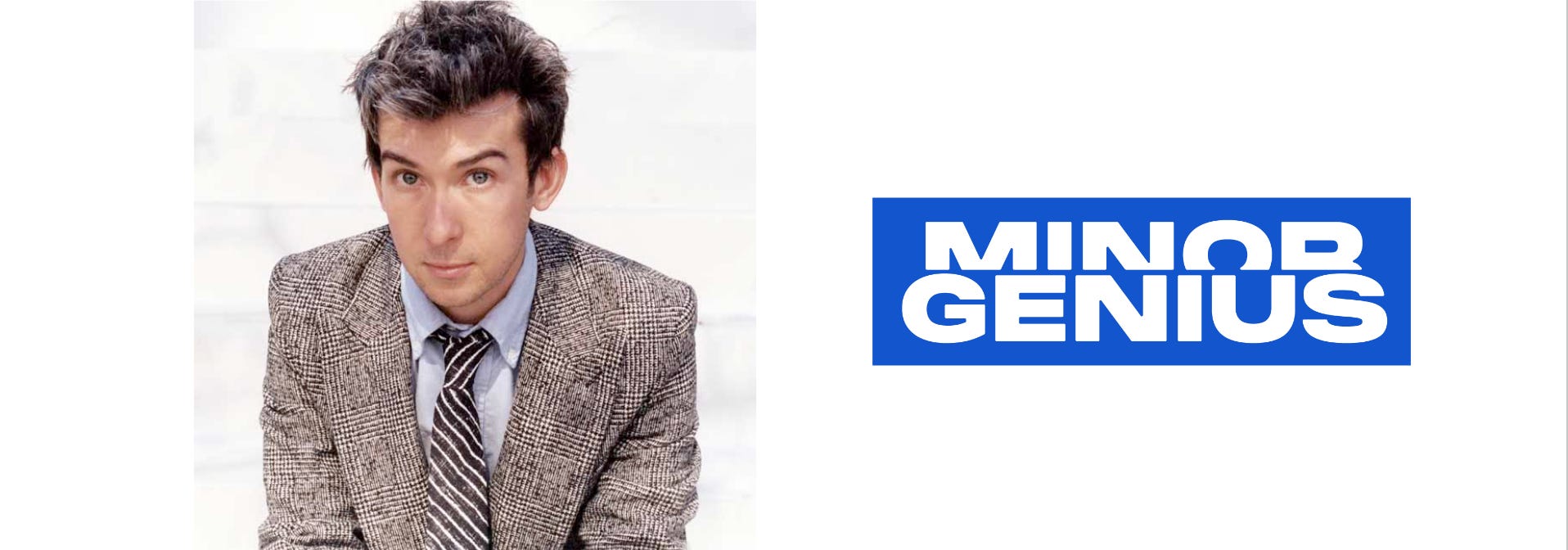
Eliot Aronow is a former GQ columnist, fashion editor, and music industry innovator, he is the world’s first Spiritual Creative Director™ and founder of minor genius, blending creative vision, spiritual leadership, and business strategy.
Thank you so much for accepting my invitation. Happy to be here. So I start all of my conversations with the same question, which is a question I borrow from a friend of mine who helps people tell their story. And it's a beautiful question, which is why I borrow it. But it's a big question. So I kind of over explain it the way that I'm doing now. So before I ask it, I want you to know that you're in absolute control and you can answer or not answer any way that you want to. And it is impossible to make a mistake.
Sounds good.
The question is, where do you come from?
I come from spirit. I have incarnated here as Eliot. And in a more mundane sense, I come from the cultural mecca known as Staten Island, specifically in the early 1980s, the son of two English teachers.
What was it like growing up in Staten Island?
I loved it. I mean, I always say kind of half jokingly, I think the great tragedy of my youth was moving to New Jersey in 1991. I felt very in tune with Staten Island as a kid. You know, I've always been really interested in style and fashion. And I guess as compared to New Jersey, it just seemed like people had more of a sense of being put together or more sophisticated. Perhaps that's due to the proximity to what we all call the city.
I don't know if that applies to people that are not from New York, but anyone who's from New York just always calls it the city. We never call it New York or Manhattan. But yeah, I would say all around. I really enjoyed it. You know, I think like a lot of folks that were living there at the time, you know, my parents have been Brooklynites and raising a child. Staten Island was like the closest thing to the suburbs. And so a lot of people left the city and Brooklyn and Queens and moved there in the early 80s because, you know, you could be an English teacher and buy a condo.
Do you have recollections of what young Elliot wanted to be when he grew up?
Yeah, I would say I think I always saw myself as an entertainer of sorts. You know, I think ever since I was little, I was always drawn to the aesthetic realm and sort of the arts. You know, my father taught theater appreciation at John Dewey High School, which is a bit of a famous high school in the New York public school system.
It's a lot different now, but back in the day, it was kind of like a hippie magnet school. Spike Lee went there and Larry Charles, who is the co-creator of Curb Your Enthusiasm, or I think it was Seinfeld. Anyways, the guy that was the other Larry that wasn't Larry David went there.
Foxy Brown, the rapper. And so for me, like that was just kind of always in the air as a young kid was being interested in aesthetics and colors, music, all those sorts of things.
Yeah. Was there an entertainer that you looked up to? Like what was an entertainer to young Elliot?
That's a great question. I think at the time, I didn't really understand entertainers as maybe performing. Like I thought that they were just like that permanently.
But you know, again, I'm a child of the 80s. So for me, I think a lot of it comes down to like, you know, Michael Jackson, Prince. I remember the first cassette that I bought was like, Huey Lewis in the News 4.
So, you know, I didn't quite understand that there was a difference between like the entertainment industry in real life. I just thought that like, yeah, those were who those people were like all day. You know, although if I'm keeping that a buck here, I would say that, you know, the 90s when I was a teenager, of course, had a much more powerful impact on the way that I saw entertainment and specifically like music and fashion. You know, I think like most middle class Jewish kids, like I wanted to be a Beastie boy more than anything. And I think as a 44 year old man, I'm still kind of on that vision quest.
Yeah. What does it mean to be a Beastie boy?
At that time, I remember that moment. I really saw it as successful weirdos. It's the best way to describe it. It was like, I was never really drawn to things that are too, you know, mainstream. And so I think like, again, growing up in the 90s, you had such an interesting cultural moment where things that were weird and things that were popular live together in the same cultural conversations. I mean, like I'm kind of dating myself here, but like Primus. In what world are Primus like a successful band that has like top 10 albums? You know, these guys have like a lead bass player, like it's crazy, you know? And so I think that cosmology that you could be weird and outsider, but also in mainstream culture just had a really profound impact on my psyche and really my professional ambitions.
Like, where do you, where are you now? And what do you do? Sure.
Well, I'm the world's first spiritual creative director. And what I do is I help people get paid to be themselves.
And how does that work?
It's a great question. Well, in order to do that, a couple of things need to happen, right? First, you have to uncover who the yourself part is. So in my framework, that's a spiritual transformation. Then once that has been kind of unfrozen and you get a sense of like, oh yeah, like I've actually been masking for my entire adult life. Then that informs the second aspect, which is creative.
So I partner with people to make stuff. So I've helped people make short films, magazines, brands, websites, fashion companies, really anything that would fall under the traditional reins of a creative director. I partner with them to create a project and get it out into the world.
And then the third component is entrepreneurial, which is once you've become the new person and you've made the new thing, you have to package it up such in a way that people want it.
Yeah. And how long have you been doing this? When did you first discover that you could be a spiritual creative director?
Well, the creative bona fides have really been there since my early twenties. You know, I came up, my first job was working at the Fader magazine and I had a music startup called record label, which was one of the kind of medium to bigger size music blogs back in the indie sleaze era. I had hosted a television show of my own called our show, which was kind of like my homage to Glen O'Brien's TV party, which had like LCD sound system and the yeah, yeah, yeah. And DAS racist and pretty much all the, you know, kind of indie heartthrobs of the time.
So in terms of the creative stuff, like that was always kind of second nature to me. I think the spiritual part was a lot harder earned, which was that basically like in my thirties, like none of my dreams came true. And I felt very lost and washed for many, many years. I had different entrepreneurial ventures. I had a tie company and I had a creative consulting agency. Neither of, I mean, the Thai company did a lot better. Like we had a collaboration with the strokes and we're sold at some of the more Shishi stores in NYC. For those who remember Odin, we were sold there and like The Standard Hotel.
The creative agency maybe had less of a success ratio, probably because I didn't really know like how to sell anything. Like I think I understood the contours of like how to make things cool, which is very different from like learning how to sell things. So anyways, I'll try to get through this with as much alacrity. Did I use the right word there? I'm not sure if that's, is that it?
Yeah, that sounds right to me.
Yeah, okay. It's always funny when you use a fancy word, but you yourself, I mean, yeah, it's a weird, weird thing to use a fancy word and not even be sure if it's the right one. Anyways, I'll try to get through this a little succinctly. Um, you know, uh, at the time I didn't really know what it was, but looking back, I can say that I had a very profound ego death in m…