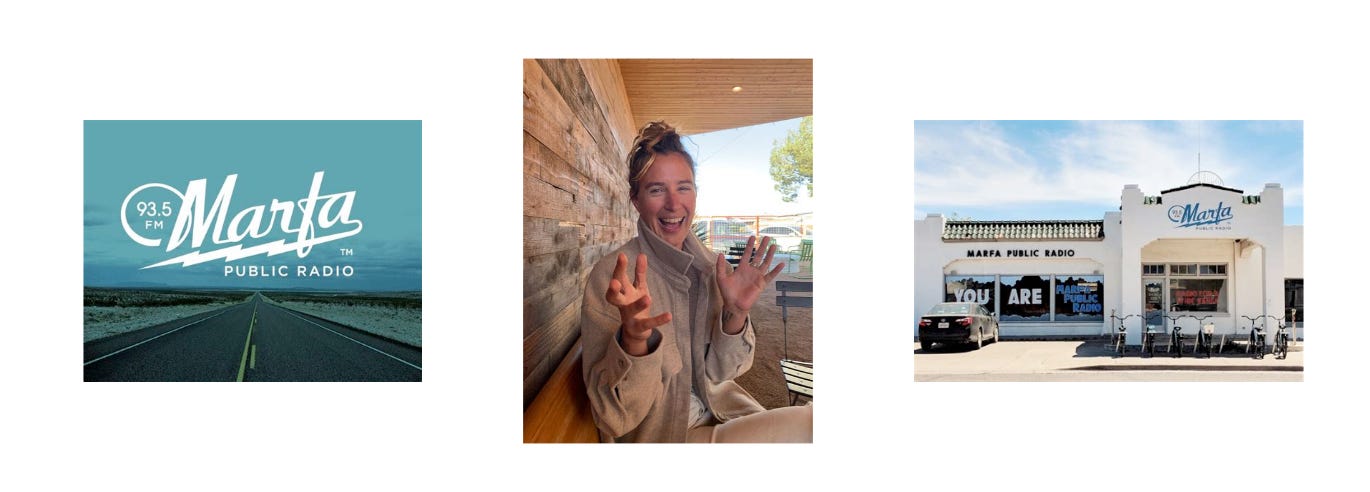
AI Summary. In this interview, Peter Spear talks with Elise Pepple, director of Marfa Public Radio, about her unique background and passion for place-based storytelling and community engagement. They discuss the role of public radio in creating gathering spaces and fostering connection, especially in light of the isolation and disconnection prevalent in society. Pepple shares examples of how Marfa Public Radio has innovated to meet community needs, from providing critical information to hosting virtual events. The conversation also touches on the culture of public media and the importance of reinvention to stay relevant. Throughout, Pepple's dedication to public service and the power of storytelling shines through, offering a compelling vision for the future of public radio in fostering understanding and belonging in a fractured world.
Elise Pepple is the Executive Director of Marfa Public Radio in Marfa, Texas. She is a wanderer with amazing stories to tell.
I met Elise in Brooklyn in a small world moment. We discovered friends in common in Marfa and Hudson, and we bonded immediately on interviewing and listening. I was excited to get into a conversation with her about stories, public media and small town living.
Elise began her career in public radio in 2008 when she brought StoryCorps to Alaska. In 2011, Elise produced and hosted a radio show celebrating sense of place in Sitka, Alaska for KCAW. At Marfa Public Radio, Elise uses old school and new school techniques to make the station a lifeline, a beacon for the stories of West Texas, and a center for media innovation.
I have a particular kind of anxiety about asking this question because you know so much about it. You know Suzanne, who I borrowed it from…. I start all my conversations with this question and always caveat it because I want people to feel like they're in control. So you have all the control. You can answer or not answer the question any way that you want to. Where do you come from?
Where do I come from? Yeah, we've talked about this question because I was like, "Oh, I don't know how I relate to that question." Rather than deconstructing it or having an anxiety attack, which is what it elicits in me, I would say that I come from a gigantic Catholic family. That's very chaotic. And that led me to know all kinds of people. I come from a family that's Catholic and magical realist at the same time, which maybe they're the same thing.
Tell me about giant. Can you paint a picture of what it means to grow up in a giant family?
Oh yeah. My mom's one of 12. And my grandparents had a mom and pop bakery. So they had 12 kids living in an apartment upstairs. Growing up, every kid had a bunch of kids. So 30 plus grandchildren, 30 plus great grandchildren, a meal would be like a hundred people.
I grew up, I had one older brother who wanted nothing to do with me. What is it like to be in a giant family?
Just like your life probably seemed normal to you. It just seemed normal to me that nobody fit around one table. We maybe fit in one house.
In what way were your family magical realists?
I guess being Catholic, I wouldn't think that Catholics are magical realists. They're different brands to me. But magical realist, so there's a lot of death when you have a lot of people in your family. So I grew up in funeral parlors. And the dead were always alive. My aunts who died young, my aunts who are alive, who are conventional in many senses of the word, talk to their dead sisters on the regular.
Did you have an idea of what you wanted to be when you grew up?
It depends upon the age. When I was really little, I wanted to be an inventor.
And what was an inventor?
It was science based. That did not stick with me, but I wanted to be an inventor. I wanted to invent a flying machine. They already existed in airplanes. And then later, when I was in seventh grade, I wanted to save the planet and address human rights.
Where was this? Where were you growing up?
Baltimore.
Tell me, where are you now? Tell me a little bit about what you're up to these days.
I'm currently in Brooklyn, New York and also remotely Marfa, Texas. I run a public radio station.
What do you love about running a public radio station? Where is the joy in running a public radio station?
The joy is that it is a job that is about making meaning collectively. The other joy is that it's a way to tell stories.
When did you first encounter this kind of work? What was your first moment of realization that collective meaning making is something that you could do?
I'm slow so I was writing and making public art but I wasn't good at the material objects. I don't really care about them. I dropped out of art school. I was like, "This is dumb. Why do people do this?" I lived in a 300 person town in Alaska. I had moved there from Brooklyn, New York right after StoryCorps, which is an oral history project, was created and I would just talk to everyone. I was like, "Everybody has these amazing stories." So I called StoryCorps from this little town. And they said, "Oh, you should come up here." And they said, "Why don't you do it for us?" Great idea. That was the first time I did anything related to storytelling or public radio, I was 27 or 28. And then I was like, "Oh, stories. Oh, place based stories."
You said that you had no interest in the material objects. I have so much identification with that. Can you tell me more about what that means to you?
I think the thing that interests me is social space. When I was making art, the thing that interested me was not objects, like sculpture, painting, photography, it was the space where a person decides to come towards something. I was a bad artist. I didn't care and I would propose these things. I'd be like, "I want to harvest all the fruit in California that can't be picked by migrants because our government just stopped letting people cross the border." There were farmers who had the largest pear harvest on record and they were listening to the fruit fall off the trees and crying. I wanted to relieve them. I was like, "I want to relieve these farmers of hearing their fruit fall to the ground and not be harvested." And then I wanted to relocate. I wanted to pick up all these pears and relocate them to San Francisco so that we would encounter the thing that we couldn't see happening. I think my professor at the time was like, "What?"
Doesn't sound like bad art to me. What do I know?
Who knows? But yeah, so now what's so exciting is culture and that we should culture and that's not necessarily material, but it's more the social space, relational space.
What did you learn at StoryCorps? What was that process like of you discovering this practice that fits? What did you learn from StoryCorps or that experience?
From that experience I learned that most people don't think they have stories. I also learned that StoryCorps didn't teach me how to interact with people. Being my mom's daughter taught me how to interact with people. Never met a stranger. Just tell me everything! But maybe for the first time aligned the way that I am in the world with the work that I was doing in the world. And then what I would say is because I work for StoryCorps in Alaska and I moved to the Arctic to keep working for them, a lot of what I learned the hard way, but in a really necessary way, was about colonization, indigenous genocide. There's no separation between cultural and physical genocide. Yeah, so I had a crash course in being a white settler and being in communities that were thousands of years old.
And what was the role of story there? What gets done? What do you do when you're inviting stories?
It depends. When I'm in a cultural context that is where I'm from, it's all I do. I've done a lot of storytelling projects, all kinds like live storytelling events, oral histories, public art projects. But when I was in the Arctic what I learned is that stories, both in the Arctic and in Southeast Alaska, it's intellectual property. And so to show up to a place y…