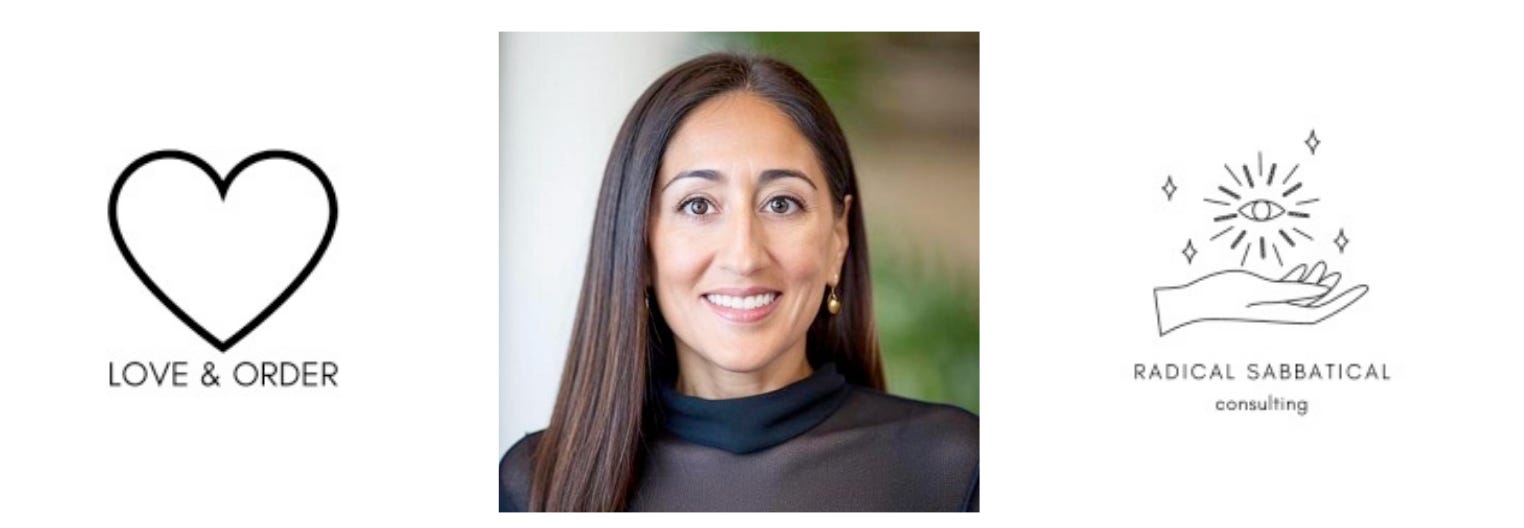
I first met Eliza Yvette Esquivel at lunch in Hudson, New York. She was visiting a mutual friend. We stayed in touch over the years and grew close over the pandemic when myself, Eliza and Martin Karaffa would meet for regular calls.
She has a long, storied career in brand strategy. She was Chief Strategy Officer at Barbarian, Senior Director, Global Brand Strategy, Management, Naming and Partnerships at Microsoft, and before that VP Global Brand Strategy at Mondelez.
She is redefining the future of leadership towards a Protopian tomorrow, with Love & Order, and helping professionals grow through sabbatical planning, career break consulting with, Radical Sabbatical Consulting using meditation and mindfulness coaching for deep self-discovery and significant change.
Check out her series on Cyberpunk, and The Blue Economy.
All right. So I am not sure if you know this or not, but I start all of these interviews and conversations with the same question, which is a question that I've borrowed from a friend of mine, this woman, Suzanne Snider, who lives in Hudson and teaches oral history. And I love the question so much because it's a big, beautiful question, but because it's so big, I couldn't over explain it. So before I ask, I want you to know that you can answer any way that you want. We're not, sir. You are in total control. Where do you come from?
Ooh, where do I come from? Yeah, that's actually a really good one. Europeans always judge Americans for focusing on "What do you do?" and they actually often say, "Where do you come from?" I like to ask "What are you up to these days?" because it leaves it open. You know what I mean? It doesn't have to be about work or place or whatever.
Where do I come from? I come from Texas. I come from a place. I come from Laredo, Texas. That's where I was born. It's right on the border to Mexico. When I was born, it must have been like, 99 percent Hispanic but in the United States. I think now the numbers drop to maybe 97 percent Hispanic. It was a very specific place and all of my parents' family live there - their brothers and sisters, cousins, et cetera. Very integrated into the community. Kind of pillars of the community.
My parents left when I was three, but all of my extended family remains there. A couple of my aunts have PhDs in education. So they're educators. And then one of my cousins is an architect and one of them owns a cafe. So it's this whole sort of thing about being from a very specific place.
I think a lot of people don't know that about me. I don't really carry my, I don't believe in identity politics. I'm like, "Oh I just don't think it, I'm a human being. I'm not a Mexican. I'm not a woman." You know what I mean? So I don't subscribe to those things. So I don't really talk about that origin story of where I'm from. But since you asked, you can say it that way.
What was childhood like in Laredo, Texas?
I only lived there until I was three, so I have zero idea. My parents moved to Fort Worth, which is also a very interesting place. I don't know if you know the story about Fort Worth, but in the days before any of these places were developed in Texas, there were cattle trails that ran along the semi western border north to south of the United States, go up to Utah, come through the Rockies and all the way down to Texas, and I think even into Mexico. The cowboys would run cattle up and down and stop at these little towns along the way. Some of them would be forts, some of them would be shanty towns to rest and then continue the journey.
There was a fort that they all stopped at, which was called Fort Worth in Texas. But it was a dry fort. It was very Christian and they didn't have alcohol. So the cowboys would stop there and rest, but to go get their joy on, they would go across the river to this shantytown where there was booze and women and whatever. That shantytown is Dallas. And Fort Worth is where I grew up. Isn't that charming?
Oh my God. You've really just exploded my understanding of so much. Certainly.
Yeah. I worked at the Texas State Historical Association in a gap year in university. I was really into Texas history and making sure that everything is recorded. During the time that I was working there, they were digitizing the encyclopedia, taking it from volumes of books and digitizing it. So all of this fascinating history of Texas is available.
How does it feel? What does it mean to be from Texas?
I joke that I'm from "Tex-ass". That's a good joke. Because I did leave. I think Texas is an interesting place because it used to be Mexico, and it was colonized. There's a whole history there that I think most Americans don't know about - why Texas, New Mexico, Arizona, and California became the United States when they used to be Mexico and what that land grab and power grab was about. A lot of it had to do with slavery, and Mexico was not into slavery.
There were a lot of natural resources that were attractive. People could look it up and be like, "Oh, what happened there," and get into it. Growing up in a place where my parents didn't come to the United States - the United States came to us - and yet I was made to feel other or less than or a foreigner in my own home.
I remember playing soccer in Texas as a very athletic young lady. After our soccer game, there was a water fountain in the park. I went to go drink water and there was a girl behind me. She stopped and then started walking away. I was like, "Oh, you don't want any water?" She said, "Oh, I can't drink after you." Because...
Those are just little stories. I've had many experiences in Texas that were, shall I say, unwelcoming. It's a complicated place. It really is a complicated place, with where it sits on the border and what drives the oil that drives its economy and the culture that is attracted to that.
Living in Austin for 10 years was really cool though, because it was like a liberal oasis and almost the antithesis of much of what I experienced growing up. But yeah, that's what it's like to be from Texas. It's complicated. And you're glad that you're not there anymore.
Do you have, what did you want to be when like young Eliza in Texas, did you have ideas about what you wanted to be when you grew up?
Yeah, actually I wanted to be a poet and a literary critic. That was horrifying to my super right wing conservative father, which is why I had to take a gap year, because he cut me off of university, because I was actually succeeding at those things at university, and he was like, "That will not stand."
Where'd that begin? Where did poetry, how did poetry become a North Star like that?
I don't know. I always just thought everybody wrote poetry when they were 12. I was just like, "Isn't this what we're all doing?" Our ideas. It just, I don't know. It's just something that bubbled out of me.
I later learned, and I didn't grow up knowing this, but as a young adult I learned that I was named after my great grandmother, whose name was Elvira Yanez de Escutia, and she was a poet and a playwright. I had no idea, but I was just this person who was really into that stuff, really into literature, really into creativity, the imagination, but through the word in particular.
My mother had been an artist. She was a photographer and she did stained glass. So I was around that world of art and the imagination while she was in university when I was like six, seven, eight, nine. I would go to the university to watch the art classes or go to the art openings and the gallery. But for me, it was really about the word.
And tell me now, where are you now, what you're up to, what are you up to and where are you now?
Yeah. I made a big pivot to walk away from working for other people for as long as I possibly can. And I've also stepped away from being in the business of helping corporations build wealth and being in the business of advertising or brand or any of that.
I don't know that I'm completely removed from it, but I'm just taking a pause to really invest in my …