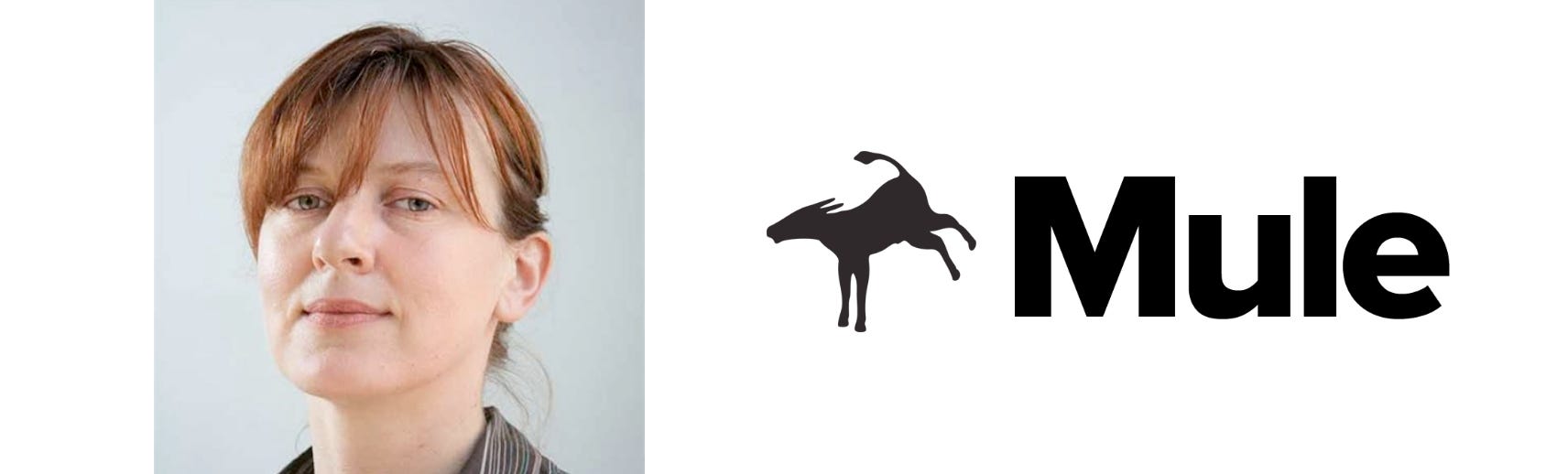
Erika Hall is a designer, author, and consultant. She is the Co-Founder and Director of Strategy at Mule Design Studio in San Francisco and author of the influential books Just Enough Research and Conversational Design. Her work centers on evidence-based design, organizational learning, and ethics in digital practice.
Research Questions are Not Interview Questions:
So I start all these conversations with the same question, which I’ve borrowed from a friend of mine. She helps people tell their story. I stole it because it’s such a big, beautiful question—but because it’s so big, I kind of over-explain it the way that I’m doing now.
So before I ask it, I want you to know that you are in complete control, and you can answer any way that you want to. That’s my general way I approach life. And the question is: Where do you come from?
That’s a fantastic question.
Yeah, I’ll answer that on several levels, because I think they’re all important to where I am now. And the origin point is I come from Los Angeles. And it’s a two-parter.
I come from across the street from the airport until we got eminent domain, and then the Valley. So if you’ve heard of Valley Girls—I was there. I was a child when that song was blowing up.
But those parts of being in Los Angeles, and then really being in the Valley in the ’80s—that’s a cultural context. And then the next most important origin is I got the heck out of L.A. and went back East for school, where I studied philosophy. So I come from L.A., I took a tour through New England, and I’m back in the Bay Area. So my perspective is very Californian and very question-asking. I don’t have a traditional design or research background. I come from philosophy, with a dash of studying abroad in Moscow. And all of those things—I’m finding, and the reason I’m answering this question like that—is every part of that is so wildly relevant to what I do and how I am now. Those are kind of the key ingredients to that.
So having grown up in the suburbs outside of Rochester, L.A., California—the Valley—I mean, these are mythical, mythical places. That you were there, growing up—what was it like? What can you say about growing up in that?
I mean, the really salient thing to say is: it’s well documented. Because I really felt like I was growing up in a place and time that all the movies were being made about. So it’s like, what was it like? I went to a prom in the same ballroom that Pretty in Pink had been filmed in. So it was like, I really felt like—if you want to feel like, “Oh, we’re the center of the cultural universe”—in Los Angeles at that time, that’s sort of the feeling.
And yeah, so if you watch Terminator 2, that aqueduct is right by my house. That’s sort of the fun part of it—how much was happening there then that was culturally important. Like we had KROQ, which is an amazing radio station.
So I felt like all of the best new music—I was listening to it. And then, yeah, it was really funny because I went to school back East, and to people back there, it was mythical. I came from this mythical place, and they would ask me questions about it, like, “Does everybody really talk like that?”
And I think part of it—one of the reasons I left—was I needed finishing school to get rid of my strong Valley accent. Our lawyer actually spent a lot of time in Southern California, and we had a podcast, and one of the podcast reviews was, “Their California accents are so strong.” So if I’m talking to someone who’s from the same place, or if I go back there, the accent comes back.
And the other question I got was about whether I was worried about getting shot on the freeway, because that was a thing that was happening.
And I’m like, well, yeah, I worry about being among all those cars and everything. And so, yeah, it was like that in a lot of ways. I feel that Frank Zappa—that song—is an ethnographic document, really, a linguistic situation.
But I went to the Galleria. I went to the beach. There was a section of my yearbook devoted to the large hair. People had shoulder pads. I hated Reagan. I don’t—I don’t know.
So yes, I’d say the one thing is the movie Valley Girl with Nick Cage, which I love—I love him so much—the thing that’s most wrong with that movie is that he’s supposed to be punk, and he was in no way punk. Because it was about this girl from the Valley, this affluent suburb. I went to public school, and a bunch of my friends drove BMWs. I was not from the BMW part of the Valley, but it was wild.
And people were really self-aware, you know? Because I think children and teens always know more than adults give them credit for. And we were really clear on what was going on in the world and in politics and everything—even before the internet.
So yeah. I drove once I got a car when I was 16. I drove a lot and really was like, yeah, if you watch those movies—and there was Booksmart, I think, is a recent movie—that was still the vibe in Los Angeles.
So yeah. It’s incredibly well documented, I think, just because the movie industry was there.
What—do you have a memory of what you wanted to be as a child? Like, what did you want to be when you grew up?
I wanted—well, there were a few different things. I wanted to be an architect for a while. And I had an Etch A Sketch, and I would actually draw floor plans on my Etch A Sketch.
And then a couple of things took me off track. I even applied—one of the schools I applied to was a school of architecture. So I got in, and I could have done that.
But I was all over the place. I was like, maybe I’ll do psychobiology, maybe I’ll do architecture—we’ll see what I’ll do. And then I ended up going to a liberal arts school, which was perfect.
But then I took a look at the built environment of Los Angeles, and I’m like, oh, we don’t need more architects. And then one of my teachers made us read The Fountainhead, I think in a prophylactic manner—like, you have to read this to be inoculated against these terrible ideas. And I read that, and it angered me so much that I was just like, I don’t want to be part of this.
Also, you read about the profession, and it’s super competitive and super misogynistic and all of that. But I also didn’t realize until much later that I grew up surrounded by Eames stuff, right? Because being in Los Angeles—we had Mathematica, which I think is still in Boston, which is this amazing, kinetic, sculptural, experiential exhibit of the principles of mathematics. And that was my early childhood. So if you haven’t seen it, look it up—it’s at a science museum in Boston, I think still. There were a few different instances of this. And at the Museum of Science and Industry, they had the Eames explaining math.
And I think the sort of Eames was in the air—all of that mid-century modern stuff was in the air. And that was a big part of coming from Los Angeles, too.
And so I think the fact that I ended up doing a lot of information architecture—I was like, oh, this is sort of similar. And buildings are great. And I have friends who are architects who have gone to architecture school. It’s just—I am not a patient person. That’s also why the movie business—even though I grew up in Los Angeles and love the movies, everything about that—I never wanted to be in front of the camera.
But seeing that process, I have so much admiration for filmmakers. But wow, the patience of putting something like that together is beyond me. So I’m happy about the internet.
I’m curious about—you went East to a liberal arts school. And, you know, I’m from the East, I went to a liberal arts school, so probably the question of what it’s like to be from California came to mind. But what did you make of the people in the Northeast? Who did you find at these liberal arts colleges, as somebody from the Valley?
It was a lot of—I couldn’t afford to visit. So I just kind of dropped in, like, oh, I guess I’m doing this now. I just flew out, you know, September of my freshman year, and I was like, what is going on here?
Because I didn’t understand a lot of the things…