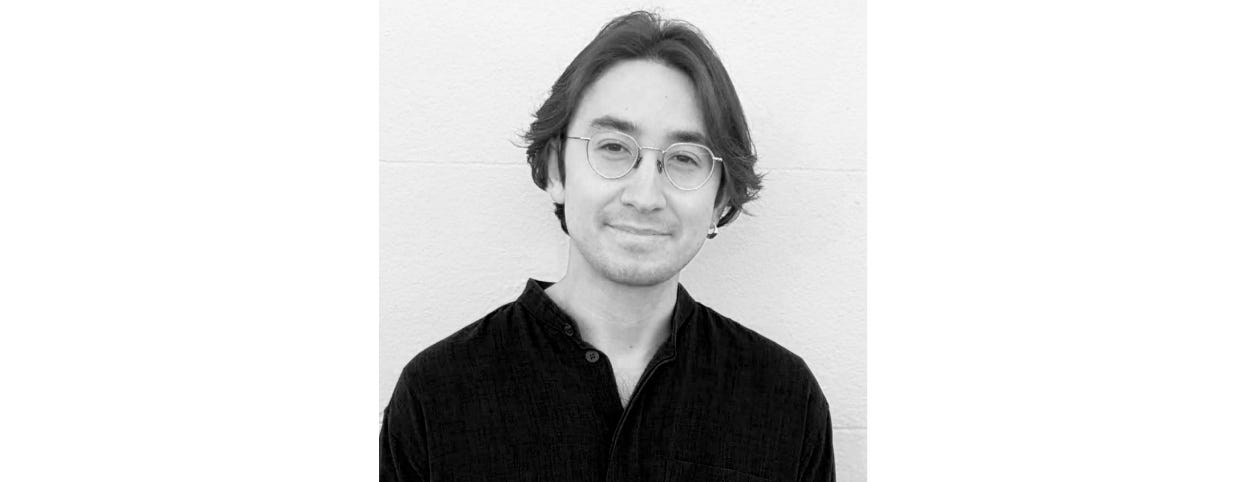
Eugene Healey is a brand strategy consultant and educator in Melbourne, Australia. Previously, he worked as an Associate Strategy Director at The Contenders and Head of Growth at Lively. He kind of exploded into my line of sight with super smart TikToks, so I was excited to talk to him.
Check out “The End of the Hollywood Celebrity,” “Identity Marketing is (sometimes) Overrated,” “The Power of Framing,” and “Why Millennials Are So…Uncool?” Sign up for his newsletter, Considered Chaos.
All right, Eugene, thank you so much for accepting my invitation.
Yeah, it's a pleasure to be here.
So I start all the conversations that I do with the same question which I borrowed from a friend of mine. She is a neighbor. She helps people tell their story. She has this beautiful question which I love but it's a big question so I kind of over explain it before I ask it. So before I ask it, I want you to know that you're in total control and you can answer or not answer any way that you want to. And the question is, where do you come from?
Where do I come from? I come from New Zealand, although I live in Australia. I don't really consider myself Kiwi or Australian, although I don't also really consider myself half Malaysian Chinese either.
I consider myself, where do I come from? I would consider myself a person who lives in Melbourne. I would say I'm a Melbourneian. I guess now we're talking about place but also identity. I guess I would consider myself as someone who has come from in between places.
That's kind of how I felt my whole life about things.
I think it's reflected in my work as well. I've always felt like I've lived in between things, in between identities. Never quite being fully enveloped in any one place, one identity, one perspective, which I'm really grateful for, I think is a privilege. Yeah, that's almost how I would answer that question, I think. Yeah, I'm from the in-between.
Yeah, you say you're grateful to have come from that place and it's still something that sort of shows up in your work. What do you appreciate about it?
I think it was something I struggled a lot more with when I was younger. That feeling of always, never quite, the feeling of every room I enter felt slightly outside of which I, yeah, I struggled with that a lot when I was younger because it felt like I was never able to quite blend in in any environment. But I think now having that slight outsider's view is something that I really enjoy.
I think it allows me to see things about culture in particular that other people might gloss over. I think it's kind of like I'm always in a state of a little bit of culture shock wherever I go. And so it makes it easier for me to sort of, makes it easier to sort of see or comment on that, but those particular parts of culture.
But I'm also actually quite, I'm also quite extroverted. So I find that that's sort of where my perspective comes through is like, while I find myself on the outside of things, like I'm still really interested in engaging with them. So that has developed into, I think, this interesting mix of observer participant.
So, you know, in my work, while I'm providing a lot of commentary on culture, I'm also participating in it at the same time. And I think that that feeling of being slightly outside, I think that you're also moving alongside with is something that that that really does show, particularly I would say in the content that I create, which is about which is cultural commentary. I think being able to sort of someone, someone said to me that it's not that what I'm creating is anything new. It's just that there's particles in the air that feel more disparate. And I'm making connections between all of those things.
I love the idea of a perpetual culture shock that you sort of you presented that that's somewhat familiar. Do you have a recollection of when you were young, what you wanted to be when you grew up?
Yes, I do. And it's not going to be the answer that I think anyone suspects. I wanted to be an investment banker.
Oh, wow.
Yeah, I wanted to be. And when I'm talking young, I'm talking like seven years old.
Like I had, I just had to be different. We had a neighbor who I was obsessed with money with when I was younger and we had a neighbor that told me about an investment banker and what investment bankers did. And I was there with my mom. I was like, Mom, I want to be an investment banker. And that was what I wanted to be like until I was like 15 or 16.
And then and then I had the like, you know, regular teenage crisis of confidence where you're just like, what on earth? I'm 15 years old. How am I supposed to pick a career path now? You know, because you're not picking a career path, but you are picking subjects. And the subjects determine what you're going to be able to study at university. So at that point, it was looking like I was going to be an engineer because I was picking one of the all approved Asian pathways. And then I ended up picking a business subject, which I nearly failed physics, but I got my end of year for business. I got 100 percent. So I was like, maybe I should try something else. And that sort of is in one way or another. What what put me on the path to where I am today?
What what do you recall? What was an investment banker to your six year old seven year old self? What was an investment banker?
I think he would have just said something along the lines of they do. If you like money, they deal with a lot of money. They move around very large sums of money. And I think probably he would have had something to say about them. They also control the way that the world works. Those are two very compelling, compelling. Yeah, exactly. Everything your precocious megalomaniacal child needs to aspire to.
Tell me a little bit about where you are right now and the work that you're doing these days.
Yeah, so I've actually just started my own consulting outfit a couple of months ago, but now I'm doing that full time, which is providing brand strategy, consult consultation services. And I'm still working out exactly what to call it, but I'm thinking I'm calling it brand training. Basically, I think I've worked in brand strategy for about eight years. I've also worked in teaching for around 2024 for around nine years as well as a lecturer.
So I started as a tutor at the University of Melbourne. I also lectured at the University of Melbourne. I'm often lecturing come semester one next year as well because the subject that I teach branding only runs in semester one. And I've kind of been in what I'm doing now. I'm starting to bring those two things together because what I love is not just giving people things, but I love helping them to learn. So in terms of the brand strategy that I run, I don't actually write brand strategies anymore, so I wouldn't consider myself a traditional brand strategist.
I work with founders and exec teams to understand the role of brand strategy, what it is actually supposed to help you do. And I help them to create, you know, I almost treat myself more as a facilitator. That helps them to understand and create the brand strategy itself.
I mean, that's driven from an insight that basically a strategy is not an output. You know, you may call it a roadmap, you may call it a framework for action, but there's no actual deliverable in the same way. So the success of a strategy is defined by the people who have resources in your organisation, their belief in it and their willingness to commit resources to it.
So I've kind of separated all the copywriting element of brand strategy out there now. And I say, OK, in these sessions that we run together, we're just going to get you to commit to a position that you are willing to put resources behind. And I found that's been really effective for the clients that I've worked with so far. And so I always have a sponsor in the exec team, preferably the CEO for those projects. And then the other part of the business that I run is this brand training, which are basical…