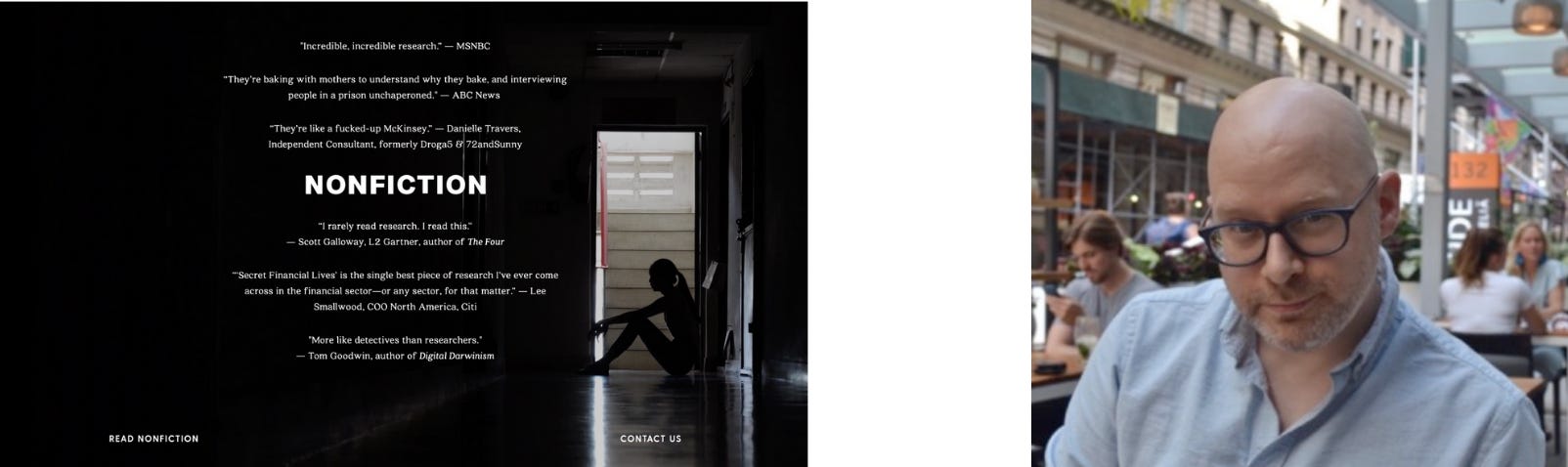
Gunny Scarfo is the co-founder of Nonfiction Research. Previously, he was Head of Strategy at VICE Media's digital agency, and Head of Strategy at Tenthwave, as well as the Inaugural Board President at Brooklyn Poets.
He responded to my newsletter one day a few years ago, and we’ve stayed in touch since. I was excited to meet for the first time with this conversation.
Thank you so much for agreeing to speak with me. Nice to meet you face to face finally.
I know. I'm going to intercede your normal first question and ask you what you and I just talked about before we started recording. We're subverting the genre. I was just saying that I've been on a handful of podcasts and not once has anyone talked to me in advance and said, "Hey, here's what I, as an artist, am trying to bring forth in my podcasts. Don't talk so much about yourself, talk about your work," or "Don't talk about your company, talk about yourself. I'm trying to do this podcast to inspire young people coming up," or anything like that. So let me begin your interview by asking you the question: What do you hope to bring out of these conversations with people? Because I'm a fan of yours. I love your work.
Yeah, I appreciate it. We've just only met but it makes perfect sense that this is how you would arrive. I appreciate the question, and calling me an artist to describe it is also very flattering. I feel like the answer is that I backed into it, you know what I mean? Like it was a way of not doing something else, and then I realized that I had people receiving the email and saying nice things to me about it. Then I realized, oh wait, I could actually talk to them because I'm a people person. I am curious about people and, as an independent, I'm alone a lot. So it's also this opportunity to connect and hear how other people talk about their work. I think that's what I did - not come in with a structured approach. I invited people into conversation and then I've developed this flow.
I think what I want is to get to know people, understand their relationship with work, and then I want them to tell me that qualitative research is important and why. That's my explicit selfish motivation. I'm curious about how research, the work that I do, fits in the world that everybody else inhabits.
I love that. You describe yourself as a "brand listener." I've never seen that term before and I love it. I think it's a really bold choice to describe yourself as a listener because everyone else is looking to talk. Everyone else is listening to profess how brilliant they are at this or that, or advance their POV on this or explicate their thought leadership. To describe yourself as a listener, I think, is really bold and fun.
I love hearing that. It was very conscious. After years of being a moderator in the corporate market research machine and feeling like an instrument that wasn't really respected, I wanted to celebrate what's happening when you're actually listening to people and trying to understand them and explore their experience.
The French have an expression - I can't speak French, so I can't say it, but I think it translates to something like "professional deformation." It's the aspect of your work that deforms who you are as a person, for better or worse. You will meet someone and just immediately look at their shoes. It's the impact that your work has on you. One of the things that I find is after, I don't know, hundreds or thousands of conversations with people where your job is to listen, you develop a different ear for what people say. I'm going to verbosely set up this question to see if you experience this:
A normal person will hear a sentence like, "Oh, I went skydiving last week with my brother in Colorado." A normal person will hear that sentence and try to relate to it, like "Oh, my friend is skydiving." But as a listener, as an interviewer, you don't do that. You hear every piece of that sentence as a thread that you could pull to go deeper: "Is this the first time you've gone skydiving? How close are you with your brother? Is he still living in Colorado? Did you grow up in Colorado? Do you normally do daredevil things or is this just a one-off sort of thing?" As a listener, you hear every phrase that a person says within a sentence as a potential thread.
Building up to my very leading question, it drives me nuts in casual conversation when I'm in a group of people just socially, and no one is pulling any thread. Someone says something and I'm like, "Wow, there are 14 interesting things I'd love to know," but then people just move on. I'm curious if you have this, because if there's another person on Earth that has this, it might be you. Go ahead and disappoint me, but do you experience this as well?
Oh, my God. Absolutely. I really couldn't say it any better. I often thank my first job - I thought it was an ad agency, but it wasn't, it was a brand consultancy. They said, "Go talk to people," and then they made it my job to ask questions and pretend like I was listening. At that point, I don't know if I was seeing threads, but I knew that I had to ask questions. Yeah, I feel that's made me sensitive to all the threads. You become thread fluent in a way, or literate maybe, in a way that some people don't have.
It reminds me of a guy - I think his name is Georg Kuhlwind, my therapist recommended this guy. He wrote a book called "From Normal to Healthy." Somewhere in the beginning, he says, "We don't know what a person is and we don't know what words are." I think it speaks to what you're talking about. We have an idea of what a word is, like "Oh, that just means that thing," but no, the word is just the beginning. It's endless. You can follow it forever. So anyway, yeah.
I will seed the microphone and let you ask questions, but I can't stop. I just want to point out that one of the things I think makes your conversations different than most podcasts that I listen to - I feel like calling your conversations a podcast is almost an insult. But I think your conversations are different because you pull threads, you ask follow-up questions. I think oftentimes, especially in business-related podcasts, there's a set of questions that you hear the interviewer ask. Then somebody says something, but the interviewer doesn't pull the thread, and you're like, "Goddammit, pull the thread, man!" The conversations end up being almost this litany of disappointments, like I just collect things that could have been explored. But I find that your conversations with people tend to be more organic, free-flowing, and all that.
Nice. I really appreciate the fact that you're listening. I appreciate the hesitancy around the word "podcast." I also try to talk about it as a "conversation series," but it's very clunky. All right. So I want to begin the way that I always begin with this question that I borrowed from a friend of mine, and you're in absolute control. You can answer it any way or not answer it any way that you want. The question is: Where do you come from?
First of all, I want to tell you that I've heard you ask this question to a couple of people and you've described it as a very powerful question, which I think it is. But I think the most powerful thing is that you start with it. It grounds the conversation in such a way that everything that follows is shaped by it. So whatever a person's grounding story is gives shape to everything that comes after. I think that's the real genius of it.
I want to answer this question by talking about something that I've wanted to talk about publicly but haven't had a venue for. I would say that I am born from the tension that comes from living a dual life as a kid - living simultaneously in two different worlds.
On the one hand was my school life growing up, which was very much grounded in the everyday struggles of everyday people trying to defy the odds to get by. I went to school in a city called Coatesville, Pennsylvania. It's a city outside of Philadelphia that has endured more …