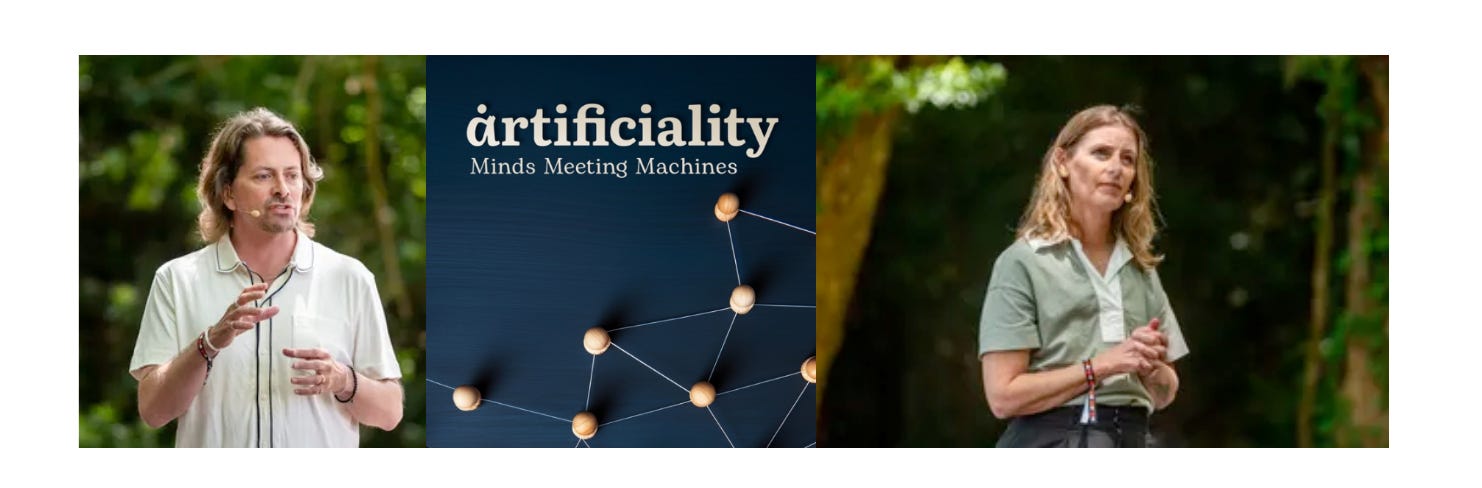
Helen & Dave Edwards are a husband-and-wife team of ‘analysts, artificial philosophers, and meta-researchers.’ Artificiality is a research & education company that helps people make sense of artificial intelligence and complex change. They have a long history in AI, and I consider them scouts to this new world. Sign up for their newsletter here.
Helen was CIO of Transpower, New Zealand’s national grid, and head of emerging products at Pacific Gas and Electric. Dave was head of software application marketing at Apple, head of consumer strategy at SunPower and a lead technology research analyst at Morgan Stanley.
I was excited to speak with them, and get their take on where we are right now in adapting to the arrival of artificial intelligence.
AI Summary. In this thought-provoking discussion, Dave and Helen Edwards from Artificiality explore the complex landscape of AI. They delve into the challenges posed by this rapidly evolving technology, including the need for responsible development, the impact on jobs and education, and the potential for exacerbating inequality. They emphasize the importance of embracing complexity thinking and allowing people to express their anxieties about AI. Despite the concerns, they remain optimistic about the possibilities of AI when approached with care and consideration for human values. Ultimately, they believe in the enduring power of human connection and creativity in an increasingly AI-driven world.
All right. I have never interviewed two people as part of this thing. So I thought I'll just take turns. But I start all of them with the same question. So I guess I'll start with you, Helen, but then David, it'll be your turn. I always start this conversation with the same question. I borrowed it from a friend of mine. She's an oral historian. She helps people tell their story. You can answer or not answer any way that you want. And the question is, where do you come from?
Helen: You are absolutely... That's a question. Where do I come from? I come from a place that fundamentally believes that we are animals. We're not... You know, there's no... That's where I come from. In my bones I feel that there is no higher meaning to our lives other than the people that we spend it with and the knowledge that we gain. I'm a committed atheist. There's another way of saying that.
It's beautiful. Dave, how would you answer the question? Where are you from?
Helen: He's a royal b*****d.
Dave: It is actually true. I am a member of the Society of the Illegitimate Sons and Daughters of the Kings and Queens of England.
I don't even know what that means. What does that mean?
Dave: Means that somehow I descended from somebody who was a b*****d. I think of King Edward II or something who apparently had a bunch of kids out of wedlock.
Oh, wow.
Dave: And I'm member number 200 something or 400 something because my grandfather was a great genealogist and he thought it was really funny. He had an unbelievable sense of humor. And he became a great genealogist after he was forced into retirement at age 60, after spending his career as an analyst at the CIA. And he was like, "Oh, I'm going to go figure out the rest of my family." Yeah. Oh, b*****d. Where am I from? What a great answer to that. What a great question.
I come from a place of this desire of deep human experience. And that's why I'm trying to find the unification of it all. I grew up in a very creative family that was always trying to passionately feel things, whether it was music or dance or theater. I spent my summers in Maine trying to understand what it meant to live in the woods and fell in love with this great Sanskrit poem that was always about looking to this day. It's called "Look to This Day." It's about getting the most out of every single moment in every life. And so I have this sort of insatiable desire to experience every day a little bit more deeply. And that can be enriching and it can also probably be irritating to people around me. But it is what it is.
Do you have a recollection of being a child and what you wanted to be when you grew up?
Dave: I wanted to be a performer.
Is that right?
Dave: Oh yeah. Cause I started dancing at age six and singing at age nine. And my dream was always to perform. I love creative expression. And so that drove me intensely, my whole childhood and adolescence and into early adulthood.
Helen: I have a recollection until I was 17... My recollection just full stop really was I wonder if I'll ever figure out what it is I want to be when I grow up.
You remember that you have a recollection of wondering.
Helen: I have a recollection of wondering. And then the process of having to make a decision about what to study in college cemented a path that took away that wondering, but that wondering came back in full force in my early 40s.
In what way? Tell me that story. What happened in your early 40s? Where are you now? What are you guys up to? How do you explain what you guys are doing now?
Helen: I'll explain it from the wondering and where I came from perspective. I find that the more I learn about artificial intelligence, the more interested I am in biological and living intelligence and what that means. And that's what I want to be when I grow up, someone who actually understands this and is able to speak on many levels to many different people from many different angles and synthesize what it means to be building intelligence in a non-biological substrate, building artificial intelligence. And that came from that place of respect for the natural world and wonder for the natural world.
Dave: He grew up performing. I grew up walking around, digging holes, looking at soil and picking up rocks and studying plants and birds.
I think the best description of what we do that resonates the most for me right now is that we attempt to make the philosophical more practical and the practical more philosophical. And I think I've found over the now many years that we've been studying artificial intelligence that has followed along on a career of mine of at least on and off building technologies is that I find myself gravitating much more to the philosophical questions. I'm much more interested in who we are and what it means to be who we are in relationship to all of these technologies around us. And what I like most about what we do is combining those deep questions with all of the deep scientific knowledge and thought that I can pick up from Helen. And then figuring out how to communicate that and tell that through stories to people that inspire them to question the world and question the technology that is rapidly embracing us.
So how do you describe what you guys do? What is Artificiality to somebody who's never encountered it before?
Dave: We're a research and services company. So everything we do is ground in research, whether that be scientific research or humanities research. We like to dig deep and understand the relationship between humans and machines. And we deliver what we've discovered through publications and through services. Publications, a weekly publication. It's written, we do podcasts, we have videos. And our services are larger organizations usually, sometimes corporates, sometimes universities, colleges. We help them figure out how to make sense of this whole AI craze, how to think about a strategy for what they might do and help them figure out what it means to build a team and build the capabilities that allow them to go pursue whatever change is important for them.
What do you guys love about the work? I sense it... We've talked one time before and I've followed your stuff and I feel how much you care about it and how much you love about it. But what's the joy in it for each of you?
Dave: I think for me I have always loved the next thing. And that has taken me to some really interesting parts of my career. It's also probably had me jump around a bit too much here and there. But I love uncovering what's next. And this is, I think will prove to be…