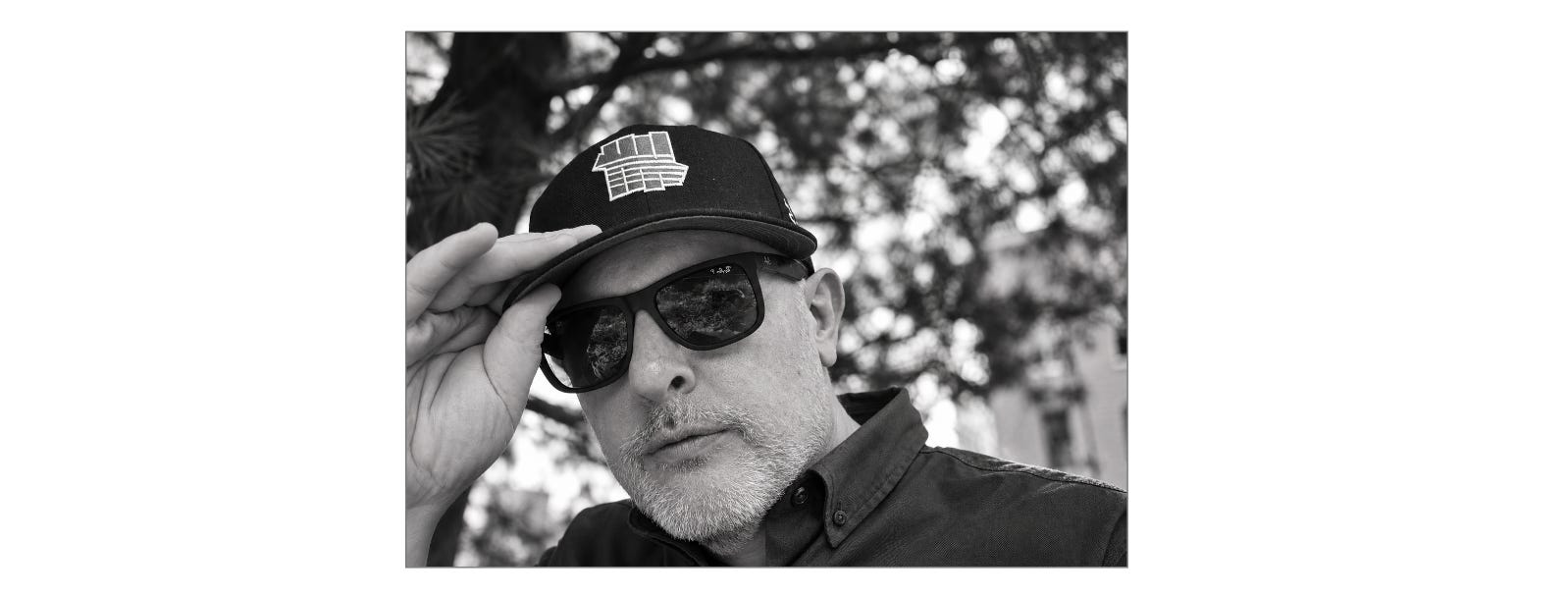
Ian Edgar is a strategic creative consultant who advises Netflix, Spotify, Snowball and People Inc. Previously he was Vice President of Creative Strategy and Video Programming at Condé Nast for seven years, where he devised the WIRED Autocomplete Interview and Bon Appétit’s Gourmet Makes. Before that he made official audiovisual remixes for Motown, Fatboy Slim, Public Enemy and U2. He writes the Substack Screen Theories. Start here, “The Elements of Appeal.”
I start all of these conversations with the same question, which I borrow from a friend of mine and a neighbor who helps people tell their story, and it’s such a beautiful question. I stole it, but it’s really big, so I kind of over explain it the way that I’m doing now. So I want you to know before I ask it that you are in absolute control. You can answer or not answer any way that you want to. The question is, where do you come from?
“I come from lots of places,” in the words of Christopher Lambert in Highlander.
Oh, that’s great.
But I want to answer it in a bunch of ways. I want to say I’m from North London, which is the most obvious view, the geographical origins: born in the London borough of Camden. But I feel allied to North London.
I feel proud of North London. “My blood will forever run through the stone,” as the song goes. But there’s a kind of relationship I have with it, and memories of Air Max bouncing along concrete and down escalators.
I feel like London’s in me in a very specific way. I find kinship with weird kids that I’ve brought up. I live in New York now, and kids that I’ve brought up in Manhattan are all weird.
And I sort of relate to them. I always think there’s a harshness to the city. I wrote once, “London eats its young.”
And I googled that at some point, and I think someone used it as a tagline. But when I wrote it in some notebook when I was 17, I was like, oh, there’s a real harshness to the city. But I also come from underground dance music culture and drugs and decks and dance floors and sample culture, which informed so much about my artistic self and occupied a decade of my life on tour as part of the sensational pop group Eclectic Method.
And so that’s a whole part of my life that I sometimes marvel at, that I’ve played to all these crowds and music was such a big part of my life. It’s only really starting to come back now. But then I also come from media, where reading Baudrillard, probably in the late 90s, shaped the way that I feel about the reality we live in.
Diving into opening a random box here, but Carl Friston and the predictive mind or the Bayesian brain, or the idea that we are predicting our reality: for the most part, we are interacting with that prediction or expectation, and that’s being updated. I think our lives are so much formed by media that the media is kind of more the truth.
And I don’t want to bastardize Baudrillard, but I recommend everybody read a little bit of it, or even just internalize the proposition of hyperreality, that all the big ideas of your life have been projected at you as sort of hypernormal stimuli. And that now informs your relationship. So obsession with media, of magazines, of video. I used to make VHS art, trying to warp and change the stuff that was then broadcast. It was like playing with TV and playing with radio.
But now it is what it is. So I’m coming from that. And then of course, I ended up working for a magazine company, making videos for Condé Nast for a long time.
And so I sort of came from that as well. We were the biggest digital-first publisher in the world on YouTube by monthly views. So it was an absolute whirlwind of making YouTube stuff happen.
And then most recently, I’m coming from meetings where we’re talking about what a weird moment in media it is, and what crazy points of convergence are happening, and everything pointing to YouTube, as luckily I predicted a decade ago.
Yeah. I want to go back. You quoted a song, something in North London, “Blood from the Stone.” What song were you referencing?
It’s a song by Louis Dunford called The Angel, which is the song of Arsenal Football Club, which says, “North London forever, whatever the weather, these streets are our own. My blood will forever run through the stone.” I’m missing a lyric somewhere.
I’m probably gonna be kicked out of the local Gunner fan club.
That’s beautiful. That’s amazing. I was also curious because I have a feeling about New York City. I’ve never lived in New York City, but I have a feeling about New York City and the story of New York City. But I don’t really have one for London or for North London. What is it? What does it mean to be from North London?
Oh my God. Talk about a big, beautiful question. Do you know University Challenge?
If you don’t know University Challenge, you must get to know University Challenge. It’s a wonderful, rich institution.
It’s a three-players-per-team quiz show where you get asked hilariously dense questions in a really stuffy way. And it’s so beautiful and rewarding. And I encourage you to look it up on YouTube.
But whenever the people say they’re from North London, I sort of go, of course you are. We’re a little bit snobby, and we’re a little bit sort of clever and liberal, but interesting, and a bit... because North London encompasses a lot. North London is Tottenham.
North London is Camden. I was watching Grand Designs, another British show that you should watch if you haven’t. And these eccentric people were building a house in Kentish Town.
And I was just sort of like, of course you are. So there’s a kind of eccentricity, and it’s like respect for intellectualism, but not too pretentious. And I don’t know, it’s got enough edge, but not too much, but it’s also quite green.
And there’s a lot to North London. I don’t know. I’ve been here 20 years.
I need to sort of go back there and recommune with it.
And do you have a recollection of when you were growing up? What did you want to be when you grew up?
I think there was a certain point in Thatcher’s Britain. I met Thatcher as a boy because she was the MP for Finchley, where I lived. And she visited our school, and I was sort of pushed forward to talk to Thatcher. There’s a picture in the paper.
Anyway, in Thatcher’s Britain, there was this kind of attitude of make the most of... I don’t know. She was a bad person, but she said, if you find yourself riding the bus, consider yourself a failure. Words to that effect, but just kind of do it yourself, make something happen. And so I kind of had that when I was very young: make business happen, just sort of be a little businessman, do something impactful, financial. I guess it was just an image of glamour and power and something like that.
And then I got wise to how cruel the world is, and so on, and went to the light side of the force. And really wanted to, if I’m really honest, sort of change the bad things in the world. And then I understood a bit more about how the road to hell is paved with good intentions.
And how, when you’re chasing the tail of the beast, you don’t necessarily know if you’re the beast or not. I think a lot of bad things are caused by people trying to do good things. Or I think Malcolm Muggeridge... all my British references are really coming out now we’re back in time.
But Malcolm Muggeridge saying, in some, like the Buckley Vidal debates, those kind of old-fashioned, some old white men smoke and debate the issues of the day. It’s a kind of a show like that. And Malcolm Muggeridge saying, “every talent in the history of the world has in his heart the interests of his people.”
And so I kind of thought, oh, well... there’s that Flaming Lips song where he says, “what would you do with all your power?” There’s just that question of, yeah, okay, let’s say you do brilliant things.
What do you do? And then what you do, you could screw things up for people. So kind of then I wanted to be an artist.
But I couldn’t figure out how to make art in a non-transactional way. So I would make work and then leave it on the tube.…