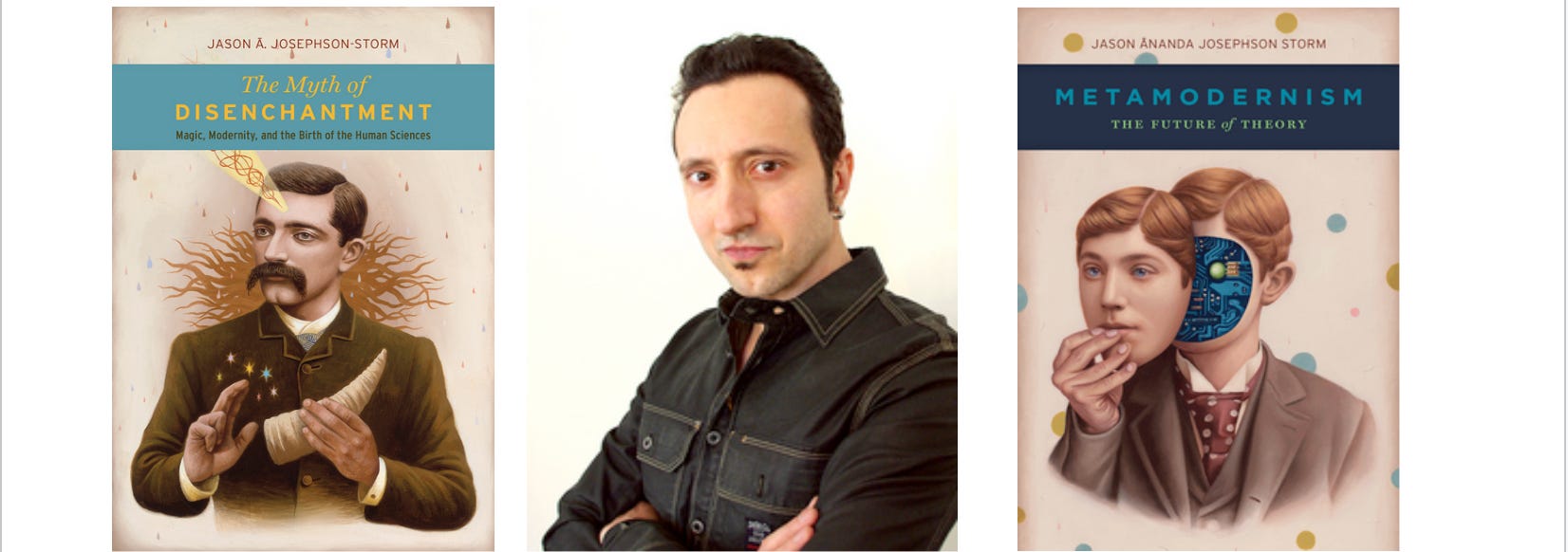
Jason Ānanda Josephson Storm is Professor of Religion and Chair of Science & Technology Studies at Williams College. I first encountered his second book “The Myth of Disechantment: Magic, Modernity and the Birth of the Human Sciences.” The question of this book was, “How did a magical, spiritualist, mesmerized Europe ever convince itself that it was disenchanted?”
His most recent book, and what inspired the invitation, is “Metamodernism: The Future of Theory,” which I understand as a desire to create a more affirmative and constructive way forwards after the devastating deconstruction of the post-modernists. It’s heady, but fun - and I think has implications for how we think about the self, and the future.
This is the first of two interviews. The second is “Revolution & Happiness”
I start all these interviews with the same question, which I borrowed from a friend of mine. She's an oral historian, so she helps people tell their story, and I stole this question from her because it's such a big, beautiful question. But because it's such a big, beautiful question, I'll explain it. So before I ask it, I want you to know that you're in absolute control and you can answer or not answer this question any way that you want to. The question is: Where do you come from?
Mm-hmm. Yeah, that question could be located in discourse around identity, or it could be one of geography, or something existential. I'll dip into that with geography and see where we can get from there. Maybe there's some demography. I'll be there. My mother's an immigrant, but I was born in Ohio.
I grew up in Ohio and New Mexico. At 16, I won a fellowship to go to England for the first time to study a little bit at Cambridge University. I had enough credits to finish high school early, basically, and took what would have been my senior year of high school to figure out whether I wanted to be a private investigator or a Buddhist monk. I didn't end up on either path.
I ended up on an academic trajectory, although I didn't know that. I thought I was gonna be a rock star, but I went to college anyway, and I was very well prepared for the academics because both of my parents are professors and three out of my four grandparents taught college or university. I went to school on the East Coast initially for undergrad and master's program, then I started a PhD program in California and then had a year in the UK and then lived in Japan and went to lectures of various posh people in Paris while I was writing up. So I spent two years in France and a year in Japan and then somehow ended up at a job in a small town in Massachusetts at the tail end of my 20s. In certain respects, I've been here with the odd sabbatical accepted ever since. That's one way to talk about where I'm from.
That's maybe a particularly abstract series of movements, basically. But yeah, I was intrigued by a moment in there when you talked about being either a private investigator or a philosopher. Can you tell me a story about that time? What was happening in that moment?
Yeah, so when I was finishing up high school or after my junior year of high school, I was very restless. I've always been restless. So I was already taking college classes even in high school, but I wasn't sure if that was even that exciting. I was quite enamored of the genre of private investigation fiction, and I was also into Sherlock Holmes. My father had read Sherlock Holmes to me. One of the figures my father worked on was Charles Sanders Peirce, and there's a way in which Peirce and Holmes have very analogous thinking processes, basically something we could call inference to the best explanation.
I thought, with a kind of egotism, that I could perhaps be a Sherlock Holmes-ish figure and contribute. So I went and interned with a private investigator. I picked a private investigation firm because it didn't do domestic stuff; it wasn't a private investigation firm that was mostly about divorces. What it was about was things that were either breaking the law or some other fundamental, more serious issue was at stake.
But what I quickly realized was the job of being a private investigator actually was producing paper trails for lawyers. It was much more tedious. It was interesting to interview people from different walks of life, but it didn't turn out to be what I was looking for. So then that led me into some more profound sense of what I wanted to do and what I wanted to be.
To fast-forward a little bit, by the time I started college, I thought what I wanted to do was combine playwriting with philosophy. I wanted to write like the great philosophical works of classical antiquity; for instance, Plato's works are written in the form of dialogues. I thought this was a way to do new philosophical work and bring it to a broader audience.
Then fairly quickly, people told me that didactic preaching philosophy was crappy theater, and what theater departments were interested in was confessional monologues as a model for doing theater. So I moved from theater to film. In philosophy, I grew up with an inherited engagement with Asian philosophy and I wanted to do that, but it turned out that after taking a bunch of courses in a philosophy department, Asian philosophy was basically not taken seriously for Eurocentric reasons. That flipped me into a religion department initially, where Asian philosophy and then continental philosophy (French and German stuff) were taken more seriously. Then all along, I was playing in bands and trying to do other stuff.
But yeah, do you have a memory of what you wanted to be when you grew up? So maybe you've answered this a little bit, but young, in New Mexico, what did you want to be when you grew up?
I think for a long time, I wanted to be a rock star. I really thought that was what I wanted to do. But I also have always loved writing, so the other thing that I think I also knew from quite early was that I wanted to write. One of my models for the pivot to academia was my grandmother. When I was in New Mexico, I was living with her and she was actually a fairly famous anthropologist, Felicitas Goodman, who in a way people said went "native" insofar as she came to believe in the reality of spirit beings, which I did not. But I found her just amazing.
Spending time with her where she would tell stories drawn from her fieldwork among Mayan Indians, or stories of Greek myths, or folk tales from ancient China, was really provocative. She was just an amazing woman, very inspirational, and really convinced me that there was something cool and even fun about academia, or at least a kind of intellectual life. Even though both my parents are academics, I was grappling with them in a different way, let's say. My grandmother was really a hero for me and an inspiration.
Yeah, what was heroic about her? I'd love to hear more about her and her work.
She came out of an experience of various kinds of trauma connected with the Second World War and immigration and a whole bunch of other things. She had a kind of brave ethnographic ability. She would go into different parts of the world for most of her ethnographic work. She spoke ten languages and had spent a lot of time working in the Yucatan in Mexico. Her technique was to go into different communities and go to the kitchen and hang out with the women. While learning to cook different kinds of things, she'd learn what they were saying in a sort of real way about their communities and their ideas about the future, etc.
She also had a kind of rigorous scientific side, had a strong background in linguistics, and was very interested in the phenomenon of glossolalia or speaking in tongues. That's what her early publications were about. Then later, after she retired, she was very brave about what she actually believed, which didn't fit into a lot of people's paradigms because she lived in a world where she thought spirits were real and such things.
So all of that was very appealing in a certain way, very heroic.
Yeah, what was …