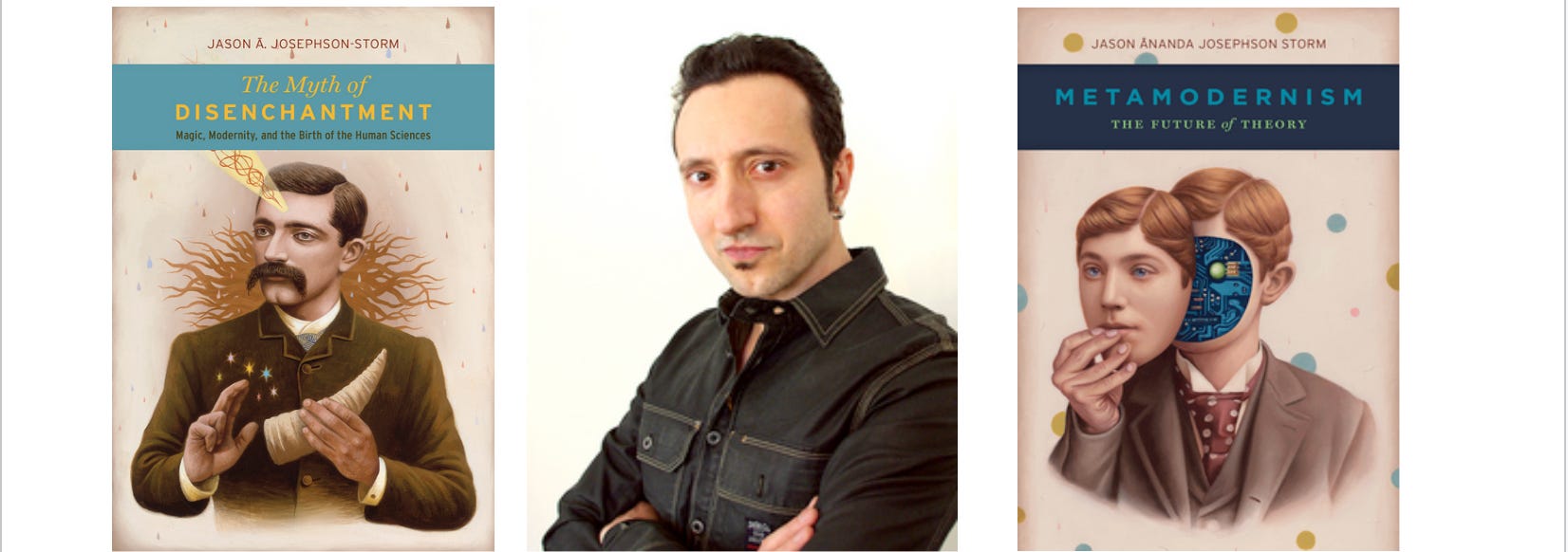
Jason Ānanda Josephson Storm is Professor of Religion and Chair of Science & Technology Studies at Williams College, and the author of “Metamodernism: The Future of Theory.” This is the first time I’ve done a second interview - and it is because I want desperately to understand what he means when he say Metamodern.
This is the second of two interviews. The first is “Myth & Metamodernism”
All right, Jason, thank you so much for accepting my invitation to come back and talk about metamodernism.
Yeah, it’s an honor to not only be on your program once, but twice.
It’s true. Just to catch people up, I first encountered you through your book The Myth of Disenchantment—which I really enjoyed. Then I discovered you had written a book on metamodernism, a concept that pops up here and there in my world of brand and cultural strategy. I was really keen to talk to you about it last time, and I’m excited to dive deeper today. The idea keeps resurfacing, and I find myself wanting to better understand it. So, let’s start at the beginning. When did you first encounter the term "metamodernism"? And what did it seem to mean to you at that time?
Sure. In a way, despite the title of my book, I actually came to the term “metamodernism” fairly late. The manuscript initially went out for peer review under the title Absolute Disruption: The Future of Theory After Postmodernism.
That was the original full title. And the peer reviewers kept saying, “Okay, we get that you're critiquing postmodernism—but what is the name of your positive project?” They wanted something I could identify with, or at least a shorthand for it.
I realized that made sense. I also wanted to avoid any egotism, like having it referred to as “Storm’s theory” or something. So I started looking at other movements and thinkers who were also trying to move beyond postmodernism.
And for me, when I was brainstorming during the revision process—thinking through what to focus on—I was reminded of some work I’d read decades earlier by the Nigerian art historian Moyo Okediji. He wrote an essay in a book about diasporic art, specifically focusing on both African and Jewish diasporas. I had picked it up while preparing to teach a course on diaspora, which, in the end, never got greenlit.
In that piece, Okediji used the term metamodern to describe certain artists he saw as working through—not just past—modernism and postmodernism. He used some really evocative imagery, talking about processes like fracturing and reappropriating elements of both the modern and the postmodern. And I remember thinking, that’s kind of what I’m trying to do.
With that in mind, I started looking around to see how else the term had been used. There were scattered instances—a volume here, a mention there—but overall, I wasn’t aiming to describe a fully established movement called metamodernism. I was more interested in trying to intervene in the current moment.
What I noticed among others using the term—and I’ve mentioned this before—is a shared sense that postmodernism needs to be worked through in order to be transcended. Where I diverge from most of the prior work on metamodernism is in the approach: a lot of people were focused on categorizing cultural works as modern, postmodern, or metamodern.
That’s not a game I’m against, but it’s not really the game I’m playing. I think there’s room for debate about how useful that kind of cataloging is, but it wasn’t my primary aim. I wasn’t trying to describe a shift—I was trying to trigger one.
And since the book came out, I’ve been really pleased to connect with others in the broader metamodernism space—people like Brendan Dempsey and others who are exploring the philosophical, political, and cultural shifts happening right now. What we all seem to share is this belief that postmodernism—however we each define it, and I do offer a specific definition in my book—is no longer the dominant framework. And that what’s needed isn’t a return to what came before, but the creation of a new mode entirely.
There’s definitely been a lot of conservative backlash against postmodernism. But what’s striking to me is that these metamodern movements aren’t part of that reactionary trend. Instead, they’re trying to forge a different—and often more optimistic—path forward. I can go into more or less specificity, but that’s the broad picture.
Yeah, yeah. That’s wonderful. I’m curious about drawing a distinction that I think is where you and I connect—the difference between describing a paradigm shift and triggering one. What’s your sense of the people who are trying to describe metamodernism as a paradigm shift? What does that look like to you? And then, what do you mean when you say you’re trying to trigger one? That feels bold and ambitious.
Yeah—yes, to both of those things.
So, on the first point: there are folks out there trying to describe this shift. One key figure is Timothy Vermeulen. I’ve met him briefly—he seems like an interesting guy. He and a group of colleagues contributed to an edited volume where they tried to understand why contemporary art movements feel so different now compared to the height of postmodernism in art and literature.
They landed on two main insights. One, which I think is genuinely useful, is that there’s been a kind of retreat or backlash against the cynical, ironic distance typically associated with postmodernism. I think that’s a valid observation.
Where I find their approach less helpful is in their definition of metamodern art as a kind of oscillation between modern and postmodern sensibilities. That framing is really hard to falsify. Once you define something as an oscillation, you can essentially include anything—because nearly anything can be read as oscillating between sincerity and irony, or whatever poles you’re working with. It becomes too inclusive to be analytically useful.
That said, I do think they were onto something in noting a tonal shift. I just interpret it differently. I don’t subscribe to the idea of a singular zeitgeist in the way some of them do. I think the picture is more complex than that.
I don’t believe we’ve moved neatly from modernity to postmodernity and now into metamodernity. That linear framing doesn’t really hold up for me. But I do think there were dominant, idealized artistic and academic models that gained traction in the 1970s and 1980s—models often labeled as postmodern—and those are no longer driving the conversation today.
For example, much of the discourse around postmodern literature focused on figures like Alain Robbe-Grillet, who essentially no one reads anymore. It would’ve been a mistake to assume, as some did back then, that that was the future direction of literature.
Similarly, when thinkers like Jean-François Lyotard were arguing that there were “no more grand narratives,” that may have described a narrow slice of cultural production at the time—especially in certain philosophical and literary circles—but it absolutely doesn’t apply today. In our current moment, we are awash in grand narratives. They’re everywhere, in all sorts of competing and overlapping forms.
So, while I may be critical of some efforts to define metamodernism as a kind of fixed era, I do think those thinkers accurately captured a tonal shift—a change in what Raymond Williams might call the “structure of feeling.” And I don’t want to downplay that. I think they were right to notice that something had changed.
Yeah. How would you describe that tonal shift? What do you mean by “structure of feeling”? What does that look like to you?
In the realm of art, I think we saw a kind of clutch—a moment of holding on, maybe even a panic—when postmodernism had reached a kind of saturation point. And to me, the most perceptive analyst of that moment is the late literary historian Fredric Jameson.
In his influential book on postmodernism, Jameson described it as a kind of cultural consciousness that emerged out of late-stage capitalism—one that had effectively flattened depth. He focused on figur…