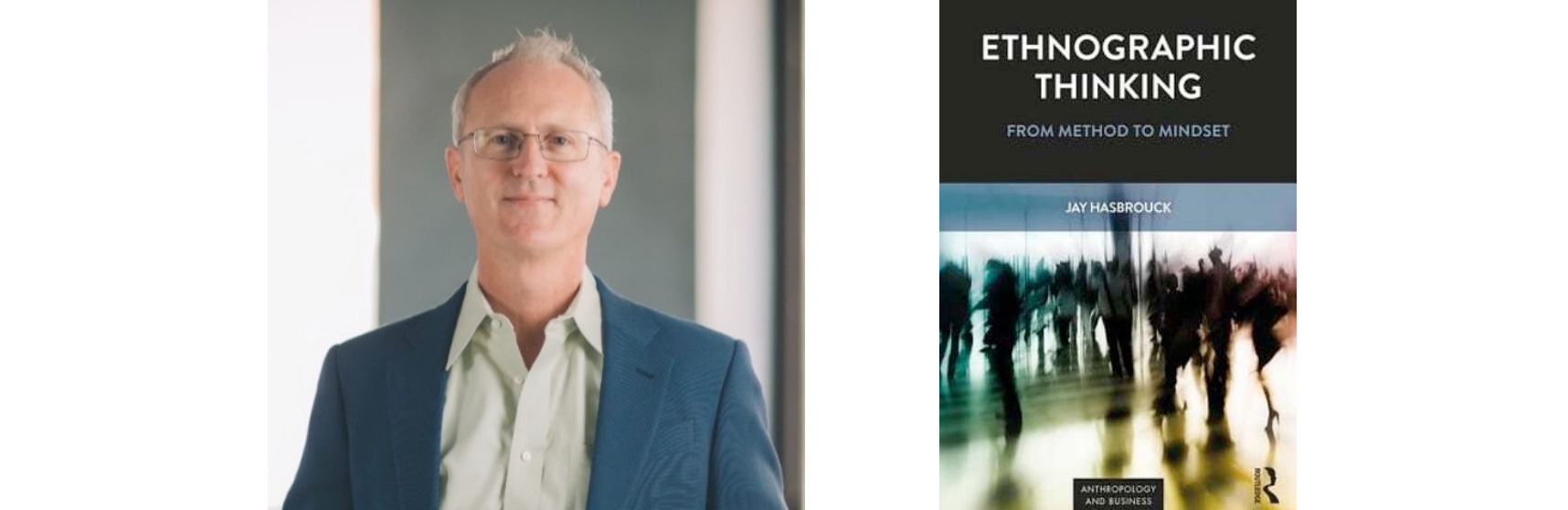
Jay Hasbrouck is a senior staff researcher on the ads team at Google, previously holding Pathfinder roles at both Google and Meta. He's the author of "Ethnographic Thinking: From Method to Mindset.” He specializes in applying ethnographic methods to drive innovation and strategic direction for companies, non-profits, and government agencies. His work bridges academic anthropology with practical business applications. He writes wonderful essays you can find at his newsletter Ethnographic Mind, including this on ethnography and collaboration, “High Intensity.”
Yeah, definitely. I think you may know this, but I start all these conversations with this question that I borrowed from a friend of mine who helps people tell their story. And I love it so much because it's so big, but because it's so big, I kind of over explain it. So before I ask, you're in absolute control and you can answer and not answer any way that you want to. Where do you come from?
Yeah, I love the question. And I think it's definitely, you know, a true researcher's question, you know, I think in a lot of ways. And I think for me, I think probably one of my most, you know, the biggest influences I want to say from being, you know, not just geographically, but as a person.
But anyway, I'll start with geography. For me, I grew up in Florida and very much a child of the 70s, I think, in a lot of ways. And I look back and only in hindsight have realized that I was definitely part of a few experimental education initiatives when I was a kid.
One of them called High Intensity, which was just like throwing a bunch of kids together to do creative things and come up with different experiments and execute on them and then think about what you did. And a lot of other programs like that. And I actually kind of admire what they were trying to do there in hindsight.
And I think from that, combined with my parents in a lot of ways were very free thinking and really encouraged me to think through things and pursue my own interests shaped a lot of how I approach what I do today. So I'm super grateful for both those things. And I think it's both a sort of a blessing and a curse in some ways, because it's sort of like, you know, I tend to run toward open-ended thinking.
And so sometimes it takes a little bit of effort to bring myself back, to reel myself back in from time to time. But anyway, I think that definitely shape a lot of who I am today based somewhere.
Yeah, you mentioned being a child of the 70s. What does that mean for you to be a child of the 70s?
I think it's a pretty unique time. It's like, you know, post 1968, and I think there was a lot of, you know, there was a lot of rethinking of what norms meant in the United States. And we were definitely part of a generation that was free range, for sure, like, so we were just out and about doing our own thing with not only, I mean, with, I would say, loose boundaries.
Like, the program that I mentioned, actually, the High Intensity Program is a great example, because there's a bunch of kids put together, given very loose assignments, and then we literally would scatter across the campus of the school and just go investigate or find out or make a little movie or record a video, record a video show or something like this. And it was pretty, I think, pretty exemplary of what was going on at the time. It's like, you know, like a free range, I think, in a lot of ways, a lot of rethinking and pretty open mindset, I would say.
Do you have a recollection of what you wanted to be, a young Jay, what you wanted to be when you grew up?
I don't really know. I mean, like, I think, I know that once I got to high school, I started testing, you know, you do all those evaluations. And I always scored highly on, like, analytics, right?
So I knew I'd probably do something around analysis, something that involved analysis, but I don't know that I would ever have identified anthropologists, right? I probably knew very little. I know I knew very little in high school about anthropology, which is a shame, actually. I think that should change.
Tell me a little bit about where you are now and the work that you do.
Sure. Yeah. Now I'm at Google. I've been here for over two years now and focus it primarily. I sit currently within the ads or primarily focused on the web. And thinking about what is the future of the web. And Google cares about this because they care about publishers, people who actually create content for the web, because that's where ads end up, right? But we're really seeing a lot of change. It's a very, very dynamic space right now.
And I'm sure you know this, Peter, just from your own experience. But there's a lot of changing. AI is just one piece of what's happening in this landscape where publishers are tending to use tools to think differently about their audiences.
It isn't all just about replacing writing, right? There are a lot of different backing tools that are making a difference in the lives of publishers. And in addition to that, the landscape is changing just in terms of what does media mean, right?
We're seeing a lot of shift in terms of how people are defining what does mainstream media mean versus what does alternative media mean. All of that's shifting. And so we're trying to get our heads around what does that mean for Google and how it is that we can encourage a high quality experience for users so that it doesn't become littered with poor experiences. And people are getting the kind of content that they want, that they're seeking.
What do you love about the work? Where's the joy in it for you?
I really love the, I mean, I've been reading a lot lately about trying to get at least more experience and more knowledge around complex systems and different models that people have used. I mean, a lot of that is, you know, early, early days, it's like things like cybernetics, Gregory Bateson, and those folks that were thinking about, you know, early on, what do systems mean? And they were using ecology largely as a model.
But trying to get my head around that is really exciting to me and thinking about, you know, interdependencies of these different systems that are in play. You know, the open web is a really complex set of different players and different systems and people. So that is very exciting to me, making sense of that and figuring out, you know, where to play in that space.
And also, I've been doing a lot more foresight's work, thinking about what are the trajectories that we see in this space and where do we think there are, you know, what's the range of probable, possible, implausible? And where should we be among those three? Where do we want to be?
When did you discover you could make a living? You're an anthropologist, yes? Like, when did you discover you could make a living? When did you discover anthropology as a path or something you might make a living in?
I was drawn to anthropology just as a passion, really. Like, I had a great undergraduate professor, her name was Judith Modell, at Carnegie Mellon as an undergrad. And she was awesome.
And I took a number of classes with her, starting out with visual anthropology and then moving on to cultural anthropology. And I was really inspired a lot by how she shaped, you know, how anthropology shaped how you think about the world. But then I was sort of like, well, I mean, there was no major at the time in anthropology at CMU.
So I ended up making, yeah, not for undergrads. So then I moved on a little bit, did some work for a while in D.C. in environmental policy, and then decided that, like, I was still drawing anthropology at CMU. So I went back to grad school just because, like, I knew that's the thing that really moved me and, like, engaged me.
So I had no idea what I was going to do with it. And then that turned into 10 years of undergrad, which is actually average for a PhD in anthropology, about 10 years. Is that right?
Yeah. And then I wasn't sure. I didn't go right into the applied setting right away…