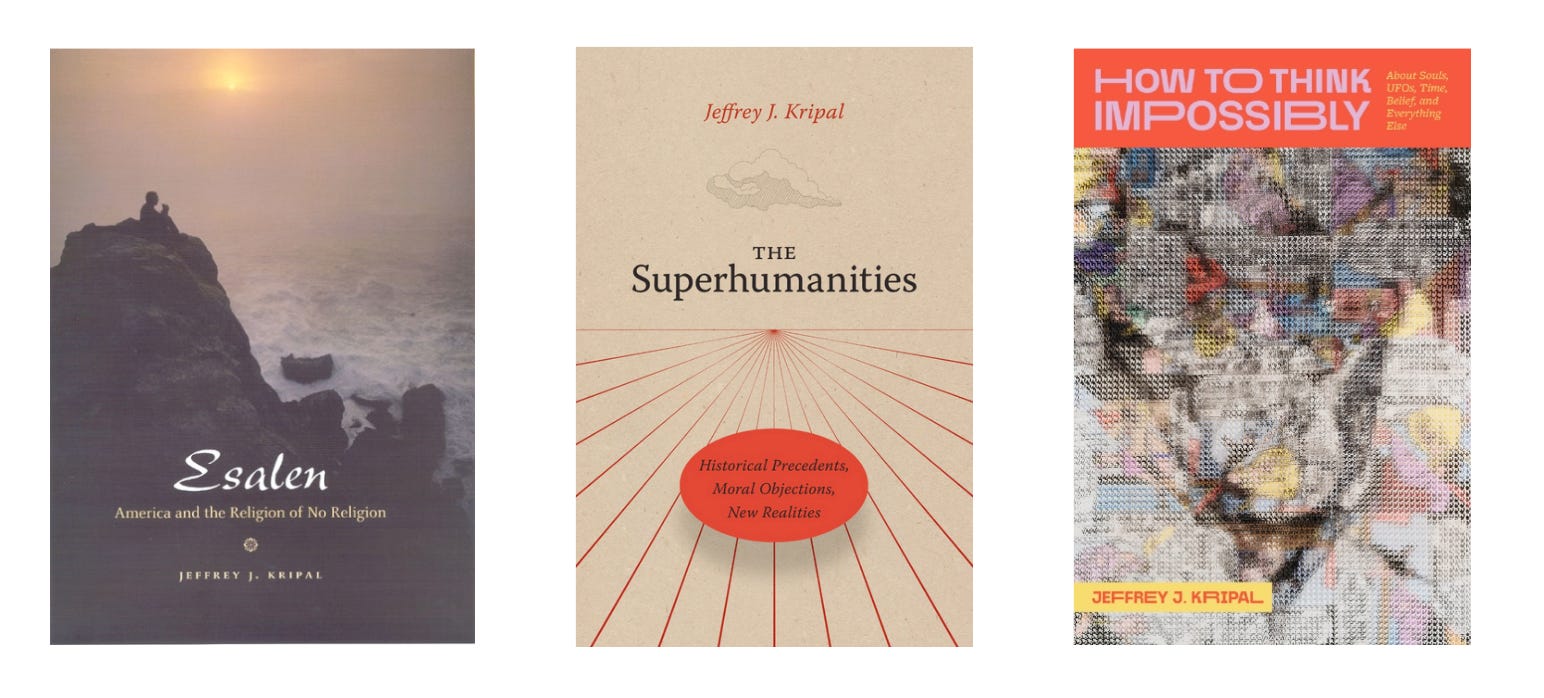
I am a true fan of Jeffrey Kripal’s work.
I think his invitation to re-think the humanities by seriously engaging with the study of mystical and paranormal experiences is a beautiful thing.
We talk about category creation in the marketing of products. Here, we are talking about the humanities, and the discipline we use to explore and understand the world, and our experiences of it.
I was absolutely thrilled to get a chance to speak with him. I hope you enjoy.
Peter
AI Summary. Scholar Jeffrey Kripal discusses his efforts to "re-enchant" the humanities by taking seriously the extraordinary experiences that have shaped many great thinkers. He explores the distinctly American "spiritual but not religious" movement, its roots in the country's pluralistic approach to spirituality, and the challenges it poses in creating stable communities. Kripal also reflects on the mental health struggles of younger generations, who often feel depressed by the world they have inherited. He suggests that "The Superhumanities," by offering positive visions of human potential and the future, can provide hope in the face of these challenges. The conversation ultimately highlights the importance of integrating extraordinary human experiences into our understanding of ourselves and the world.
Jeffrey J. Kripal holds the J. Newton Rayzor Chair in Philosophy and Religious Thought at Rice University, where he served as the Associate Dean of the School of Humanities (2019-2023), chaired the Department of Religion for eight years, and also helped create the GEM Program, a doctoral concentration in the study of Gnosticism, Esotericism, and Mysticism that is the largest program of its kind in the world. He presently helps direct the Center for Theory and Research at the Esalen Institute in Big Sur, California, where he served as Chair of Board from 2015 to 2020. Rice is the home of the Archives of the Impossible.
He specializes in the study of extreme religious states and the re-visioning of a New Comparativism, particularly as both involve putting “the impossible” back on the academic table again. He is presently working on a three-volume study of paranormal currents in the history of religions and the sciences for The University of Chicago Press, collectively entitled The Super Story.
Thank you for being here. I start all my conversations with the same question that I borrowed from a friend of mine. She teaches oral history, and it's this beautiful question, so I always use it, but then I over-explain it, because I want you to know that you're in total control, and you can answer or not answer any way that you want to. And the question is, where do you come from?
That's a loaded question. I can tell you where I come from organically or biologically. I'm not sure I can tell you where I come from metaphysically. I come from Nebraska. I grew up in the American Midwest, a little farming community, actually grew up in a hardware store.
Oh, wow.
Metaphysically, I'm not so sure. I don't know. I don't remember, I'll put it that way.
Do you have a recollection of what you wanted to be when you were a kid, when you grew up?
Yeah, I do. I wanted to be a comic book artist. That was my first dream and that didn't happen. Then I wanted to be an NFL quarterback. Then I wanted to be probably a Catholic missionary, and then I wanted to be a medical doctor, and then I became a professor of religion of all things. We fail at certain things, and we succeed at other things.
What was your first comic book? What was your sort of entry into comics?
I was born in '62. And I grew up, of course, in the late '60s, early '70s, and Marvel Comics was still inappropriate at that point, which meant it was good. Marvel Comics was a radical disjunction from what we call the DC universe - Superman and Batman. They were blocky figures in the '60s. They knew right from wrong, and they stood for the American way, and it was all this sort of impenetrable man kind of thing going on. With Marvel, the so-called heroes were always making fun of themselves and their villains, and the Hulk was always battling the U.S. Army. Dr. Strange was on God only knows what. We, as kids, didn't know anything about LSD or psychedelics, but the comics were wild and they were psychedelic in a creative or an inspirational sense. Those were really what inspired me early on as a kid, as a little kid. I couldn't explain why I found these bodies so attractive and so exciting but I did. I was what, 11 or 12 or whatever I was.
So that was my initial fascination. It was actually comic books, and I know they make a lot of money now, and they're all over the screen and the television, but they weren't in the '60s and '70s. They were just basically a kind of junk literature for kids that was sold where your dad bought pornography. It was a drug store. So they were like drugs for 11-year-olds.
Tell me a little bit about where you are now and what you're working on.
I think I'm at the same place. I think I'm stuck into superhumans and comics. I don't do psychedelics, but maybe sometimes I wish I did. I'm still really interested in people's extraordinary experiences. I think the human being is an extraordinary being and is far more than we imagined. So I think I'm still with the superhero comics of my youth. I just call them saints or mystics or something else now. I think it's the same kind of fascination.
I resonated with your work. I really have read everything and just connected on so many levels throughout. I'm excited to talk to you about this stuff and I'm really amazed at what you're doing at Rice. You're formalizing this stuff in a pretty radical way. It seems to me anyway, like you're asking for things that never felt like they were taken seriously to be really considered. I just wonder what that's been like and when did that actually begin? When did you decide that this was what you wanted to be doing?
First of all, I want to hear what you resonated with, because that to me is the real key here. I think with an academic or an intellectual, you either move or you create an environment around you that reflects something of what you're doing. I think I've done the latter. Rice University is a very friendly, very good place to be and to work, and it allows a kind of creativity that a lot of other schools don't allow. I know that because I've taught at other schools. I used to live on the East Coast and I lived in Pennsylvania and I interviewed at a lot of East Coast schools, including Ivy League schools, and they all wanted to tell me what to do. When I came to Rice, they were like, "You can do whatever you want. We'll follow you." I didn't believe them, Peter, because I had been told the opposite for many years, but I believe it now. I think it's essentially true, at least of this institution.
So what I've done is I've created an ecosystem around myself and have tried to authorize and mainstream a lot of the interests I've always had and I've always written about, but didn't seem to have a home or a stable home. What I'm finding is that the academy and my colleagues are very friendly to these interests and that most people have these interests. They just don't admit it. So when I talk about these things or when I write about them or host conferences around them, people are like, "Yeah, we should be doing this." And I'm like, "Yeah, you should."
Of course, I think the reason the humanities are being defunded and ignored is because we don't do this. We don't address the issues that really matter to a lot of people. I think we should. I also think all the critical theory and all the issues around race and gender and class are really important. But I think we also need to do this sort of vertical dimension.
You wrote, "Why do we let the physicists go off and they tell these fabulous stories about string theory and yet we don't allow ourselves to talk about this stuff?" Can you tell me a little bit about what it is, for people who don't know your work, l…