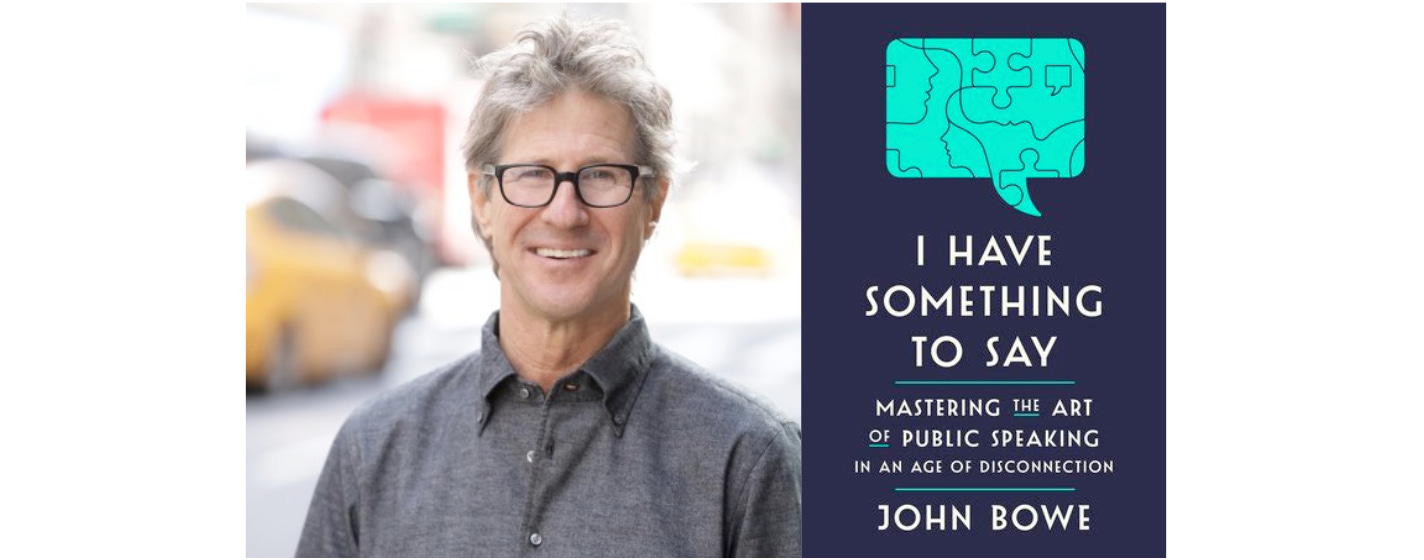
John Bowe is a speech and presentation consultant, and author of I Have Something to Say. He specializing in corporate and individual presentations. John contributes regularly to CNBC about public speaking. He has written for The New Yorker, The New York Times Magazine, GQ, McSweeney’s, This American Life, and is the author of numerous books. His work has been featured in the Harvard Business Review, The New York Times, and he has appeared on CNN, The Daily Show, with Jon Stewart, the BBC, and many others. He lives in New York City.
So in this conversation series, I start all my questions, all my interviews with the same question, which I'm excited to ask you. Because I love this question. I borrowed it from a friend of mine. She works up here. She does oral history. I know you have a history with oral history. And it's a big, beautiful question. And so I over-explain it. So before I ask it, I want you to know that you're in total control. You can answer or not answer any way that you want to. All right. And the question is, where do you come from?
So part of me wants to do this in the most literal way possible. Grounded way imaginable, and part of me wants to just go way big. I think I come from the most disastrous, panicked, spiritually aggressive place possible. Which is, we're all doomed, and I have to come in and save everybody and think of some great solution that will save the world. So that's where I come from on one level. On the other level, I come from Wayzata, Minnesota, which is 12 miles west of Minneapolis.
And what was it like growing up in Wayzata? Is that how you say that? Wayzata.
I heard something that said it was the third richest suburb in America at that time. And that was America's richest time. So I grew up in the heart of white privilege and bloated 70s America at its apotheosis. And it was a disaster. We weren't among the super, super wealthy, but the town that we lived in was not facing a lot of crises. And it was like that documentary, if you've ever seen it, called An American Family about the seventies family that's just falling apart. Everybody's alienated, the parents are getting divorced. One of them might be cheating on the other one. They just have three cars and one of the kids is coming out. Another kid is maybe on drugs. I can't remember. Just everybody's going in their own direction and nobody is pulling together. There's no sense of family unity culture. It's all just that moment when American culture is just falling apart because there's too much excess and nothing sustaining people, no kind of binding myths or anything. And so that's where we came from. Just, there was no - we had all the freedom in the world. We all had our own bedroom and somehow it was a disaster.
And that feeling you described that you come from this place of "World's on fire. I need to save it." Is that captured?
I know, I just - I'm growing up in like the richest society, the best most materially satisfied demographic in history, in the entire world. And yet, most of the time I thought that life is a problem. Oh my god, I can't believe this. What are we going to do? This is - How can we go on? How can we go on? And so like my family was completely not religious. And yet from a young age, I was almost like some Flannery O'Connor character. I was obsessed by whatever. I could even put a name on it, but it was God and religion and spirituality and something like that. There had to be something. And I guess that was nature, but I kept looking for other names or dimensions to it and there weren't any. We weren't going to Sunday school or anything like that where I could have gotten glimpses into the fact that, oh, people are putting a name on this. People have struggled with these same problems before. You're not weird. You don't have to feel ashamed or weird or isolated. Here's a whole trajectory that you could jump onto that would explain a lot of that or give you options for explaining it in the way that you want.
Yeah. Yeah. What kind of child were you? What, how did this express itself? What did it look like? John Bowe in Wayzata?
I think it was a bit of a wiseacre. I think it was a total rebel and not an interesting one. I thought I was interesting, but I don't think I was at all. Like our fifth grade teacher said his name was Mr. Haybison and me and my best friend, Mike, who was also a miscreant. We would say, okay, Earl. And then he'd say, write down my name, Mr. Haybison, 200 times. And we'd say, okay, Earl. So that was the level of rebellion that I thought was interesting. Or stealing vegetables from a church vegetable garden. Or dropping rocks off of a railroad bridge onto cars and thinking we were like Julian Assange or something.
Do you have recollections of what you wanted to be when you grew up?
Yes. I told my mom when I was about five or six years old that I wanted to start a new religion and then retire and be a farmer.
Wow. Wow.
Isn't that crazy? Isn't that totally? So then when I was about eight, I discovered writing. I was looking at a book that I wouldn't read. It was some book by a Norwegian writer named Piers something called The Dwarf. And it won. It was about a court jester, I think. Anyway, I was looking at the cover, which had this really mean, scary cover, and I said, I'm going to be a writer because writing will solve all the world's problems. And I have, again, no idea where this stuff was coming from other than just probably total desperation.
Yeah. What did it mean to you to be a writer?
That there was this magical thing you could do that didn't use materials, that you could wave it around like a magic wand and it would solve the world's problems. Or at least theoretically, potentially.
Tell me a little bit about where you are like right now and what you're doing now.
Short answer is I was a writer and a journalist forever. I did oral histories. I wrote for the New York Times magazine a lot and the New Yorker sometimes, just long nonfiction, high quality journalism. And eventually that led me by accident to discover public speaking and the idea that you can train people to speak in public and that it just unlocks all of these psychological pathways and ways to connect with people. So before that, I was not at all interested in public speaking. I thought it was corny and uncool. And then I realized, Oh God, this is like free or super, super cheap, fast psychiatry sessions and it helps people in the same exact way that I wanted to since I was a kid. Here's a way to use words to help people, but it's not what I thought. It's not me writing. It's me helping other people get access to the skill of expressing themselves. So it's cool. It's weird in that way that you always are wrong. And then you discover really what you were trying to do in a much better way. It's not what I thought at all. It's much cooler and easier than that.
Yeah. What is the joy in it for you?
Oh God. So imagine when you get a haircut or a new change of clothes and you look at yourself for a second, just that second where you think, Oh my God, I actually look okay. For me, when I can help someone express their ideas better or learn better than just doing it once is I can give them the skill of doing it every time. They become so empowered that they literally become happy. I can say that most of the people I work with become way happier. And this isn't after working for a hundred hours, it's after working for two or five or eight hours. So it's pretty, it's a pretty lucky job. It's a pretty great job.
Yeah. And how did you discover it? You're the, as a journalist all that time and I want to go back and ask you about some of that stuff too, but what was your first encounter with public speaking when you discovered that it was something that you could do?
In my own history, I was always a pretty mediocre public speaker. I didn't like it. It terrified me. I don't know if I was as terrified as a lot of people, but I was definitely terrified, and I never prepared f…