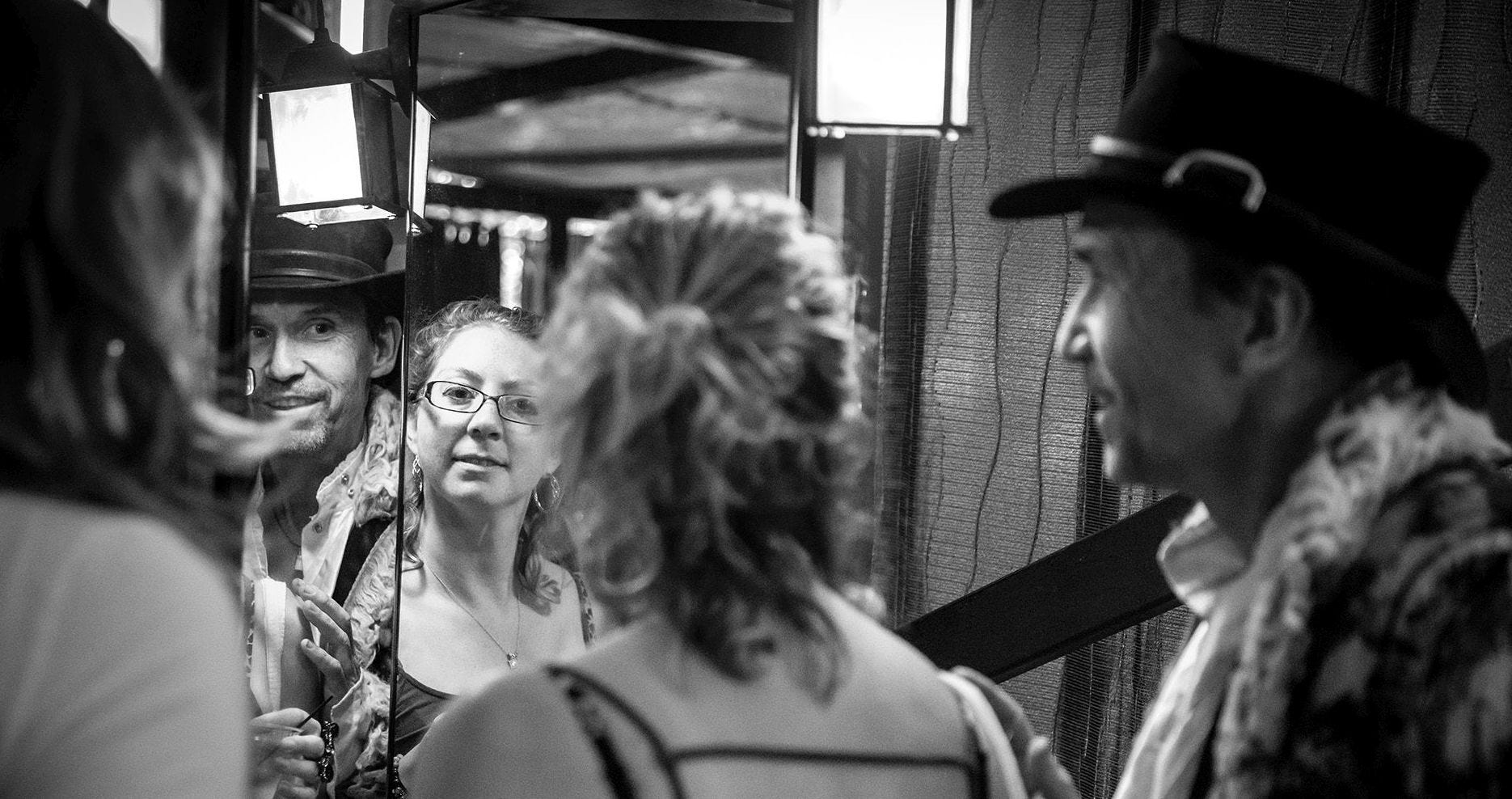
John Walter is the inventor of the TrueMirror. Check it out!!
I am the only person in the world I experience in reverse.
My self-image is wrong in one giant way. And so is yours. The way we appear to ourself in a mirror, is not how we appear to anyone else.
And so, I was excited to discover that, John Walter, the inventor of the non-reversing TrueMirror, lived just across the river from me. Within days of connecting with him in Instagram, he invited me to his workshop to try it for myself.
I find the topic so baffling and so full of wonder, I wanted to share a conversation with him.
Hope you enjoy.
Peter
Where do you come from?
Where do I come from? First of all, it's a good thing. I know what you mean by that I come from the Bronx, no, where do I come from? So I think, maybe part of the answer comes from how I solved some of my problems. I had some eating disorder issues when I was in my twenties and I went to some therapists and talked about everything other than the eating issues and really.
Eventually I just solved it and I suddenly realized I don't have this problem anymore. And really what the solution was to ask myself, what am I really hungry for? Obviously I was going to food because food was filling this hunger inside of me and it really wasn't filling me up. And so I was eating more and more food and all that stuff.
So by asking the question, what am I really hungry for? And the answer came back as experiences. I'm hungry for experiences that, you know, and then when I flesh it out, that are meaningful, that are fun, that are exciting, that are adventurous, that's my, that's where my joy comes from is experiences. Coming from that place where that's what I'm valuing is the essence of the experience.
What did that ask of you?
So I was probably in my mid, early, early to mid twenties, maybe 24, 25. And I think it just turned the focus again from, because I definitely was looking for experiences. So when I realized that's what I was hungry for, when I realized if I go ahead and get experiences, I will fill that hunger.
And I think that's been true. I eat to live rather than live to eat and so that what really nourishes me is connection and people and experiences and fun and adventures, that sort of thing. So it just changed the focus a lot for me.
What did you want to be when you grew up?
My background is in math and physics. So I was at an early age and singled out to be, Oh, he's really smart. I skipped third grade and was like this, considered to be a very smart person.
And so there was a sense of, Oh, I'm going to be this person that has some sort of achievement at the end of my name, which was going and physics was going to be the avenue for it. First of all I became popular in college. I was very nerdy and shunned by my peer group and all of a sudden I figured out why and I changed it and all of a sudden became popular. And that's a long story, but it is actually related to the mirrors.
PS: You said you figured something out and you changed it. What did you figure out?
So it was basically my hair part. I changed my hair part.
PS: Is that right?
And if you Google hair part theory you'll see my stuff come up on it. In fact, it was a Radiolab episode I think in 2011, where we talked about it. And not just the hair part theory, but the mirrors as well, the true mirror as well.
What is the hair part theory?
John Walter: So it basically says that when you part your hair, You're emphasizing that side of the brain to the viewer, okay? And because of a thing called interactional continuity, because hair parts, especially for guys, tend to be on the same side for their whole lives, basically that, it's a bias. It's a little bit like body language, but you're signaling constantly more right brain or more left brain.
If you part on the left where the part is on the left, then people will see you as more left brained. If they part on the right, they'll see you as more right brained.
And as a guy, we tend to like men who look more left-brained. They're more rational, more logical, more masculine, more assertive, more visible. When you put it on the right, then you're projecting an image that's more intuitive and feeling and holistic, mysterious, feminine, all of these qualities.
Now, just a big caveat, these are generalizations that neuroscientists and psychologists can't stand that we use in public. This is quote unquote pop psychology. And yet there's a lot of validity to it.
And so what happened is when I was in front of the mirror one day, I had just had some photos taken, and the photos were very jarring. It was like, I'm in front of the mirror going, why do pictures always look so weird?
I look fine. And that's when I realized the guy in the mirror was a guy with a left part. And I'm wearing a right part, which when you take a photo, that's a true image. And it was like, eh. So I changed my hair part, I actually put my hair from the right to the left.
How do you describe True Mirror to somebody that hasn't encountered it yet?
And just to preface it the True Mirror is related to this hair part theory, actually. Because I figured it out about three years after I had found this hair part thing and eventually was doing my hair in the middle.
What a true mirror is a mirror that doesn't reverse your image. So when you look at yourself, you're not backwards. And it's a very simple idea physically. And so there's, I got a little physics in there, but what happens is that what I discovered is that when you make eye contact with yourself, your eyes actually communicate correctly and they don't backwards. And this is brand new.
ADDITIONAL LINKS:
“Mirror, Mirror” a 2011 Radiolab episode about John.
“What is your hair part saying about you?: The effects of hair parting on social approaisal and personal development” a 1999 paper by John and his sister Catherine Walter
“The Mirror of Dorian Gray: Mirrors never lie, they say. But how much truth do we really want?” The Atlantic by Cullen Murphy in 1999
'It's in the entire time that such a mirror was actually a thing, it was patented in 1887, no one saw it as anything other than the physical. And yet, when I first saw it, it was like, Oh my God, there you are. And this connection to myself as a kind of a happy, having fun kid on the beach in California, okay, was amazing.
And part of the story is I, I was and I guess now because it's legal, I can say this, but I was high as a kite and I was just flying and I walked into the bathroom and the regular mirror just shot me down hard. And that's when I saw this double mirror combination, which is all it takes to make a mirror. True mirrors is two mirrors at right angles. Although, mine, and then I turned the corner and there was this double mirror, and I did a double take. Because I saw something that I recognized. I saw my happiness. I saw the sparkle in my eye. When you're smiling, the light of your eyes in the smile is why you're smiling. And when you flip your eyes in a mirror, you lose that why, and all of a sudden you're just looking like you have a fake smile.
If you think about it, you've had that interaction with yourself since you were a child, and you've completely identify with that version. And then all of a sudden I saw myself in the double mirror. I did a double take and I spent like five minutes just absolutely loving on myself and there was so much of All this crud, this self doubt and challenge and struggle just absolutely disappeared. I felt like I'd taken a shower
And that kind of forms the passion for why I get so into this mirror, because it really fixed me, my internal self image, the main thing is, I'm okay, I'm normal. There's nothing there's nothing abnormal about me, which I see, I still, to this day, I still see in the reverse mirror.
What was the journey from that moment to choosing to develop a mirror?
So interestingly, because this is part of the story of this. I immediately started to show people. It's yo, check this out, and they didn't get it. It was like, what …