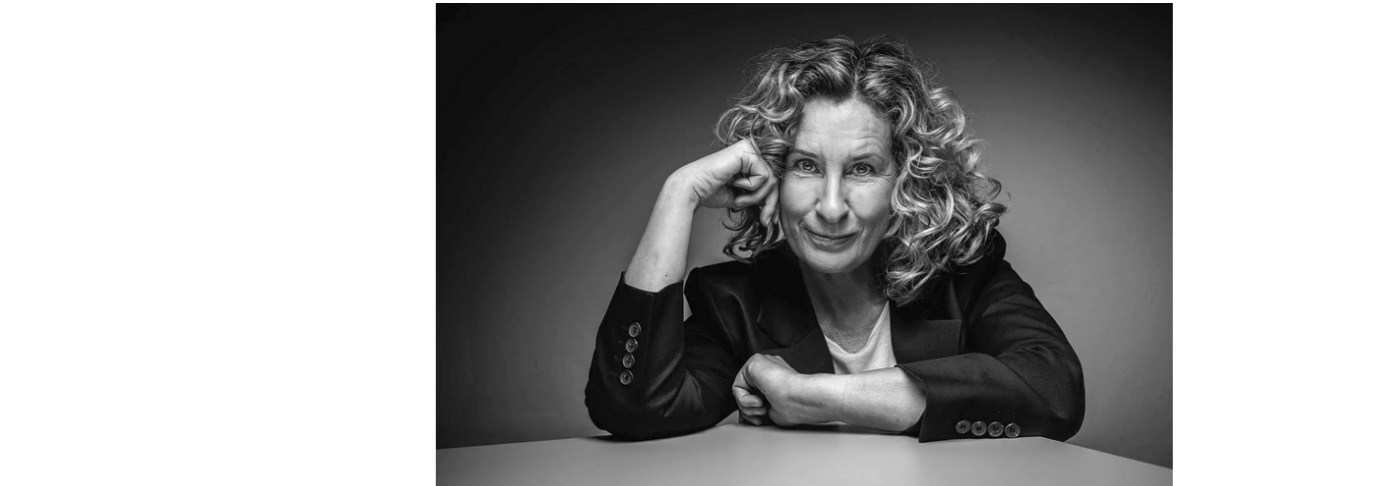
Katarina Graffman is a cultural anthropologist and founder of Inculture, a cultural analysis consultancy. She holds a PhD in cultural anthropology and is a researcher at Uppsala University. Her clients include IKEA, Volvo, Bloomberg, Björn Borg, Skanska, Swedish Radio, and the BBC. She co-authored *We Are What We Buy* (2018) and *In Search of the Time to Come* (2020).
Her TED Talk “The focus on the rational mind will lead to climate collapse.”
All right, so I start all the conversations I do with the same question, which I borrowed from a friend of mine. She helps people tell their stories. I don’t know, it’s just a beautiful question, so I stole it from her.
But it’s really big, so I over explain it the way that I’m doing right now. So before I ask it, I want you to know that you’re in total control and you can answer or not answer any way that you want to. And the question is, where do you come from? And again, you are in absolute control.
That’s an interesting question. I come from my mother’s womb. I was actually listening to a podcast this morning when I was out walking — a professor in nanotechnology here in Sweden, Maria Strömme. She’s from Norway, but she’s at Uppsala University. She has been in hard science her whole life, but now she’s started to dig deep into philosophy and the humanities, because she thinks she can build a mathematical formula to understand where people go after death. Where they go.
And I’ve never been someone who is afraid of death, even though I’m not religious. I think that in some way, we are around. So it was really interesting to hear this hard science woman arrive at the same conclusion through mathematics and physics. She will probably be a name in the future, I think.
So to answer your question — I come from my mother’s womb, but I think I come from all over the place, from many, many people from the past. That was a little bit maybe strange.
How does that feel? What’s that?
It feels good.
Nice. You used this phrase, I think, we are around. What did you mean when you said that?
I said that the spirit of us — or the something, whatever it is — something in us as humans is always around. The only way to explain it.
Do you have a recollection of growing up, as a girl, what did you want to be when you grew up?
I wanted to be someone working with elephants, but I ended up working with humans.
I don’t know what it says about me. What was the attraction to the elephants? I think I have always been fascinated by elephants because they are very wise. They have a really interesting way of living in groups, how they socialize with each other.
So I think maybe that’s also why I studied humans, because what’s interesting about anthropology is how people live in their groups, how we become herd members. We always talk about how humans are so individualistic and unique, especially in Western cultures. But the thing is that we are more dependent on the group than ever before in those individualistic cultures.
So that’s my area I’m studying today. Yeah. Did you have an experience with elephants as a child that inspired you, or where did that come from, do you think? I don’t know.
Not more than going to the zoo. And then later on, I went to Tanzania, but that was when I was 20-something, when I was starting my PhD. I went for half a year to Tanzania.
Of course, I saw elephants in the wild, but by then I had already started my anthropological career. Yeah. Tell us, where are you now and what do you do for work? Yeah, I’m an anthropologist and I took my PhD in Sweden, Uppsala University, in 2002.
And then I rather quickly decided to leave the university and academic life because I wanted to work outside. I think that as an anthropologist you can do a lot in society, in organizations, in different aspects of how to understand humans. I wrote my thesis about TV producers.
So that was a little bit different from many other anthropologists. My thesis was about how people in content creation produce content for people they don’t know. Especially in Sweden, we have public service and you are supposed to reach certain groups of people in our nation.
How can you do that if you don’t know them? So I wrote about that — how producers create fantasy viewers based on maybe one person they know in the countryside. And there was also an American anthropologist studying public service TV who talked about the same idea — that you create a viewer and then you start to make content with that fantasy in your head.
And I think that’s very interesting if you look at the marketing industries, because they often have very shallow knowledge of the people they are supposed to create products or advertisements for. So that’s where my interest started.
Yeah. I want to hear more about the field work on your thesis. That’s so fascinating. As somebody who’s worked within organizations and big corporations in the US, there’s all this talk about personas and empathy — all these shortcuts to help people develop products for people they don’t know. It’s a whole infrastructure, really. So what did you do and what did you really learn?
I started my field work with the idea that I was going to study how you make formats more locally adapted. For example, Who Wants to Become a Millionaire or Survivor or something — the format has a Bible, from the person who came up with the idea, and they say this is the way you should produce this format. But then you have to locally do something to make it popular in Sweden or popular in the UK or popular in Poland or wherever you are.
So I was interested in how you make this cultural adaptation of a format. But as an anthropologist, you can never know if what you’re interested in is going to happen during the time you’re there. So they didn’t do any formats. And when I was there — I was at a production company in Sweden, maybe they did 12 to 15 different productions — I started to become very interested in, OK, how do you know how to make this program? Because you don’t know your viewers, whether they’ll connect with it or not.
And then I talked to a guy who was in charge of the insights at this production company and he said, well, nobody in this industry comes and asks me anything about how to get to know people. It has happened twice. And I have put a sheet together with some statistics — that’s the only thing they want.
But I was so interested because I thought, wow, this is really something. So then I tried to understand how you as a creator actually make things when you don’t know for whom. That was my focus — to understand this process. And different producers use different strategies.
One guy, he said that when he’s out of creativity, he goes to a small town in Sweden and has some drinks at the bar. Then he goes home and writes new stuff. He’s met the ordinary Swedes.
So it was a lot of easy ways to get to know people without real knowledge. And maybe that’s why I talk a lot about insight washing in my work today. Because I think that what most companies do is insight washing. They have very, very shallow insights. You mentioned personas, generation descriptions, et cetera.
And that’s quite shallow because it’s mainly based on quantitative studies or broad categories. They don’t have this deep, qualitative knowledge of how people live their lives, what is meaningful for them, how people act in different groups — because you can never get that if you only ask people things. So insight washing is, I would say, the summary of everything I do.
Trying to make organizations understand what it is.
Yeah. What’s the definition of insight washing?
Well, I think it’s when you try to make very shallow insights look like real knowledge.
And I think that when you talk about it in that sense, people get two reactions. One is, wow, that’s true. But they also get a little bit offended — oh, so you don’t like quantitative studies? Well, it’s not about that, because you need both. You need different tools if you really want to understand. So what I say is that yo…