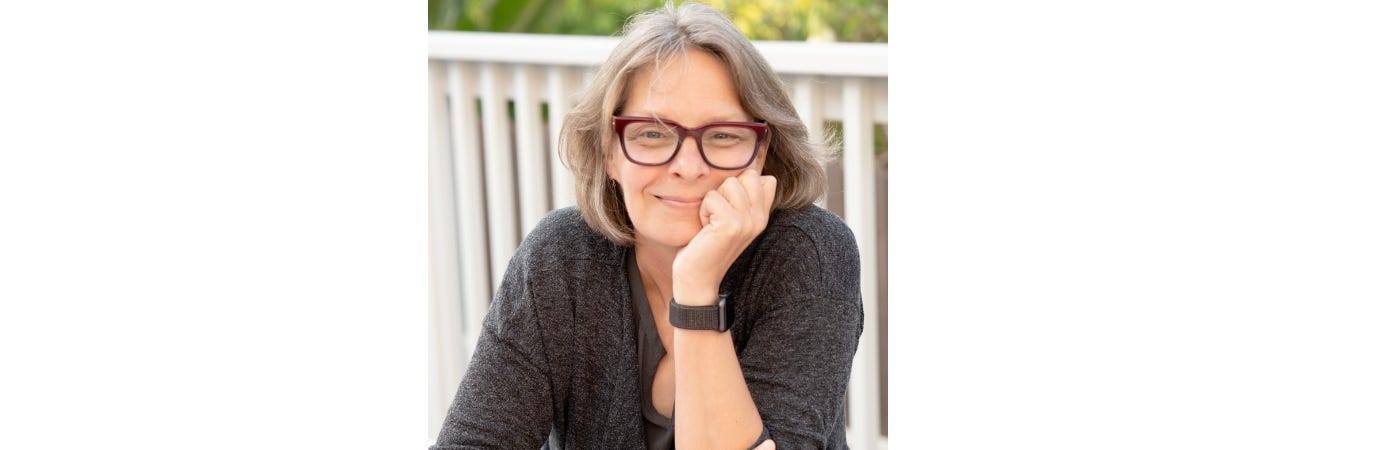
Kate Sieck, PhD is Director of the Human Centered AI at the Toyota Research Institute, where she leads the Harmonious Communities Department whose task is “developing technology that integrates AI in furtherance of Toyota's global mission of happiness for all and collective well-being.”
I met Kate through this newsletter. We spoke for the first time a couple months ago, and it was so much fun, I was excited to invite her into a conversation here. We spoke for almost an hour and half. The work she has done is amazing, and her enthusiasm is truly inspiring.
Mentioned in our talk is this paper on ritual-based research, “Move Me: On stories, rituals, and building brand communities.”
All right, beautiful. Kate, thank you so much for agreeing to sort of be a part of this. I think as you know, I start all these conversations with the same question, which I always want to give credit to Suzanne Snyder, who's a neighbor. She teaches this oral history summer school which is really amazing, and it's such a big beautiful question I have to use it. But because it's so big, I always feel like I want to caveat it and make sure you know that you can answer or not answer any way that you want. The question is: where do you come from?
So I'm going to answer that in two ways, and I'm so glad I've listened to all the other episodes to hear how everybody else is answering this. First, geographically, I grew up in the Midwest. Born in Wisconsin when my dad was in grad school, and then we spent most of my childhood in a Chicago suburb called Oak Park, which was this sort of—at both the time and the place—it was this sort of idyllic bubble of what's possible.
Oak Park had watched what was happening with all the blockbusting on the west side of Chicago and had really put a hard line on maintaining economic, ethnic, racial, and religious diversity within the community. So they changed a lot of how houses were sold and how neighborhoods were built. Well, it wasn't perfect. Let me be clear about that. As a kid, I had friends from every possible background you could think of, and the schools were one of the first to sort of integrate kids with physical or intellectual disabilities into the classroom. So we were all together, and you really saw, sort of in the truest sense of public, accommodating everyone.
That was really the foundation for where I grew up. You know, that's kind of through the eyes of a young kid. I'm sure there were a lot of other challenges that weren't on my radar at that time, but from my perspective, it really was an indicator of what was possible if we all kind of worked and lived together.
From a sort of more conceptual and emotional standpoint, and part of why we ended up in that neighborhood, is that I grew up in a household where three things were kind of paramount: gratitude, action, and community. So my parents very deliberately chose to live in Oak Park because they wanted us in a place where we were not the highest, we weren't the lowest, but we understood that it took everybody to make a community work. Every day we should approach the day from a place of gratitude for all that we had and how can we use that and share that to build and bolster our community. Not just like cheer it on from the sidelines, but what is our role, what is our action, what is our behavior in fostering all of that goodness that can come when you all kind of come together and work together. So I'll leave it at that.
It's beautiful. Can you tell me a story? I mean, I love how you highlight the word "public" right in the biggest sense of the word public. Is there a story that comes to mind that sort of captures what it was like to grow up in that place with all those values?
I think what I just remember was being in kindergarten and first grade and living on the block where we did. We were right off the train, so it wasn't—you know, right off the L trains into Chicago—and there were apartments on our block and there were really lovely homes on our block. There were probably, I don't know, 30 kids, which—it was the '70s, like we still had some big families. I just remember our neighbors were like these vegetarian hippies, and then there was another block, another house where one of the kids had—like, we would all just get together and run around and be crazy kids all afternoon and on the weekends.
It was just—there was no "you can't play with us." Like, everybody kind of fit, and we had, you know, kids from the apartments, kids from the homes. Like, everybody was just welcome to the crowd. I just remember I was one of the only girls on the block. I remember that, but even at that, it wasn't like, "You're not allowed to play with us, go play with your dolls." Like, it was as rough and tumble and bikes and soccer and tag and everything because that was what was expected. The parents kind of enforced that. It's like everybody was kicked out of the house after school and you were made to play together, and you had to figure out how to do it.
A lot of my work now looks at the very shrinking space of what are those truly public opportunities. Like, even back then, the pool—you know, the community pool—I think you got a free pass if you lived in the town, and if you didn't, it was like a quarter or something to get in. Now it's like 12 bucks, and there are so many ways in which public is actually no longer really available. So I look back on that moment and think about all of the lessons I learned and were afforded to me because I had to—had to and could, you know—interact with all these kids who were not me. So it's just like, that's where my head spins a lot.
I'm excited to hear about that work. What—before—while we're still in your childhood, did you have a memory of what you wanted to be when you grew up?
Yeah, I totally wanted to be a forest ranger. So I'm about as far from that as you could be. I still love hiking. I'm not as—much sure I love tent camping as I get up in the decades, but I'm still trying. I really loved the idea of being outdoors, of the expansiveness that you feel when you're among trees that are, you know, hundreds of feet taller, when you're on the edge of a lake or an ocean or something and you just know that the world is so much bigger than you.
Then as I got into high school, I decided I wanted to run the World Bank, which was, you know—
It's a hard turn from—
Well, yes and no. All right, so I was—high school was during—I think high school kicked off with the Live Aid concert for me. So the whole crisis in Ethiopia and the famine in Ethiopia, and I remember writing a paper about the policy. That's—my sophomore year in high school, this is how geeky and nerdy I was. I wrote a policy paper about why—why just dropping aid was probably not going to solve the problem. Like, this was a political famine, and in order to solve a political famine, you had to address the roots of what was going on. I think my high school, like, sophomore English teacher was like, "Holy cow." Who is this weirdo?
Yeah. So when did you discover that you could make a living doing anthropology?
Way too late in my career, as I'm still paying off student loans from grad school. But it was 2010, and I had been out of grad school for eight years at that point. Largely, I had two kids. We—I had two kids right at the end of grad school, and my husband at the time was also a professor. So I was doing—I was on more of like a lecturer track because we couldn't afford child care even if both of us were faculty, which is a whole other conversation we can have.
But we had moved to Minnesota. I had spent a year teaching five classes, usually with 60 students, and—sorry, let me close this so it's a little quieter—and made less than I made my first year out of college. I was like, this is an unsustainable career path. One of my students had come into office hours and had found this job in marketing, working for a marketing firm, but they wanted somebody with an advanced degree and she was just finishing undergrad. …