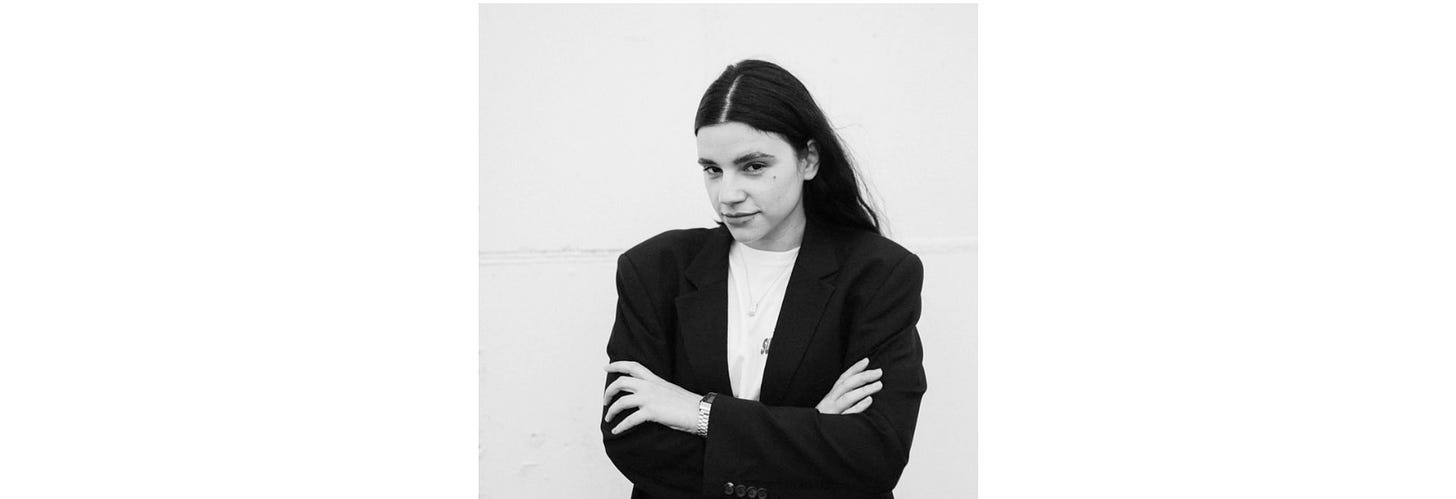
Lyubov Sachkova is the Communication Manager at dating app FEELD. I met Lyubov through the Exposure Therapy community, and was excited to speak with her.
I think as you know, I always start with this question, which I borrow from a friend of mine who helps people tell their story. I love it so much, but I always end up over-explaining it, because I want you to know that you're in absolute control. You can answer, not answer any way that you want to. And it's impossible to make a mistake. Where do you come from?
Yeah, you know, you really get people thinking with that one. And I've been hearing that people do start with the location. So I think that that is indeed very important about where we come from.
So I'm originally from Bulgaria, and I grew up my first 19 years. I was there nonstop, and didn't even travel that much abroad. But something that's very important about Bulgaria is like, not a lot of people speak Bulgarian.
So you have to learn foreign languages. For me, the first choice was French, then English, and then consequently also German. But that was kind of like my first 19 years, where I focus on basically adapting to other languages and other cultures, even without being part of it.
And from there, I've developed to, you know, then go and study in some of these places and really embed myself in the culture. So I think that kind of makes me a bit of a chameleon that can adapt to different places in a way. But I think my journey is also very much about now returning back to the roots and reexamining identity from a place where it's like, you come from somewhere, you've adapted to other cultures, but then you kind of are seeking a return back to the core of where you come from.
So I think it's, for me, it's a cyclical experience where I come from.
Yeah. And you say roots, have you returned back to where you grew up?
Well, I'm very fortunate to work from wherever I want. So I actually do travel back and forth pretty much all of the time, which is like, you know, roots are also something that it's like, do I really have any right now? I don't think I do because I travel all the time.
But yeah, I do go back to see my family in Bulgaria very often, and now I extend my stays of like a few months at a time.
And do you, when you were a child, what did you want to be when you grew up? Do you remember?
Yes. I hear you ask that question to other people. I think I was quite a creative child, which didn't quite translate so well as an adult, or at least it's not capitalized on yet.
So I really love to do performances for my family. And I had my cousins and my sister be performers alongside me. So I would organize them.
But I think the dream was to be a fashion designer, which is something that I then kind of transformed in my career. I think both the organizational skill and the wanting to be in fashion both kind of found their way into my career later in different forms.
And tell me, where are you now and what are you doing for work? What are you up to?
Is that where you are now physically?
Yeah, exactly. Now we're coming back to Earth.
Okay, okay. So currently I'm calling you from Vienna because I'm actually here with family and friends. We're doing a little trip.
And yeah, I'm also working on my, you know, as I said, I work remotely. So currently I work for a company called FEELD. It's a dating app for the curious, as we say. And yeah, I'm on the communication side and brand side of things at FEELD.
And when did you first discover, get into this kind of work? When did you first get into sort of brand and communications?
Yeah, you know, as I said, like the organizational skills and the fashion thing. So I first started in fashion PR actually, it was kind of that was my study. So, you know, I had the, I ended up in the position of being able to actually practice what I learned for, which was very nice.
And in an industry that I was really drawn to. So I started in fashion PR. I worked first in Berlin, then I worked in London.
And I think kind of what drew me to FEELD was a variety of reasons. But one of them was that as part of my masters, I did write this thesis around how to make sustainable fashion cool. It was kind of like the topic that I explored with my, I think graduate school, you said, in the U.S. Here it's masters. And so I was exploring basically the concept of cool and I applied it to the idea of sustainability because the Berlin showroom I was working for had like all of these amazing brands.
But then my boss at the time, who was the founder, had all of these sustainable, amazing, beautiful brands that he was showcasing in the showroom. And I just kind of noticed that none of the magazines would like really want to get samples from us. And I was like, why is that happening?
You know, it's beautiful there. There was one designer that had crystals grown on a dress, you know, that's kind of incredible. And she was this amazing, super talented lady.
And, you know, we weren't getting many requests. And I really wanted to explore what about the perception of these brands is stopping magazines from wanting them and making them a desirable product for other people to want to purchase. And so I explored that from the lens of like the communications and brand perception and just overall perception of the idea of sustainability and the desirability and what actually makes it cool because ultimately I think who was a big driver of people actually adopting something with virality and, you know, it kind of growing in culture.
And through that work, as I was living in London, I met the founders, Anna and Dimo, who, you know, were friends of friends. And Anna kind of, I think, took note of my work and was like, keeping in touch throughout my studies. And I was working simultaneously and still in fashion.
But once I finished the study, she was like, are you interested in joining the team? You know, we could really use someone like you. I think back in the day, we were like less than 15 people.
Now we're close to a hundred. So we've grown quite a lot internally and externally. But yeah, that's the point of me kind of transitioning into that work and then starting to work at FEELD.
Yeah. So we met through Exposure Therapy, right? We're both part of this community. And I was super excited to talk to you just because FEELD has been, you know, just the transformation, the revolution in how people sort of date and relationships and everything is shifting so much. And FEELD has sort of been at the center of that or the forefront of that. So I'm just curious, what has that experience been like?
What's it been like to be on what I imagined was kind of a rocket ship, a FEELD, and then to be at the intersection of so much cultural change, too, as a communications person, must be pretty intense. Yeah.
I think, you know, thank you for this question and also for acknowledging FEELD's place in culture. I think I still kind of have to pinch myself when people say that, because as you say, I've been in it in this transformation. And to me, it's kind of like the only natural thing to happen.
But I do understand that culture could have taken many different terms. And we could also totally not be in this reality and be in a different reality of things. I think people definitely needed a transformation to happen.
And I'm going to bring up another taboo topic for everyone now, which is the pandemic. You're like, our collective PTSD doesn't allow us to talk about it much. But I do think it was like such a transformational moment for a lot of us.
And a lot of people we've noticed definitely took that as a moment of introspection and a moment where returning to yourself and really re-evaluating everything that you're doing in your life, there was a moment to do so. And it accelerated things that were already in place that were happening at FEELD at the time. For instance, this growth towards relationship styles that exist outside of monogamy.
Because I've grown up, and I think a lot of us have grown up in a re…