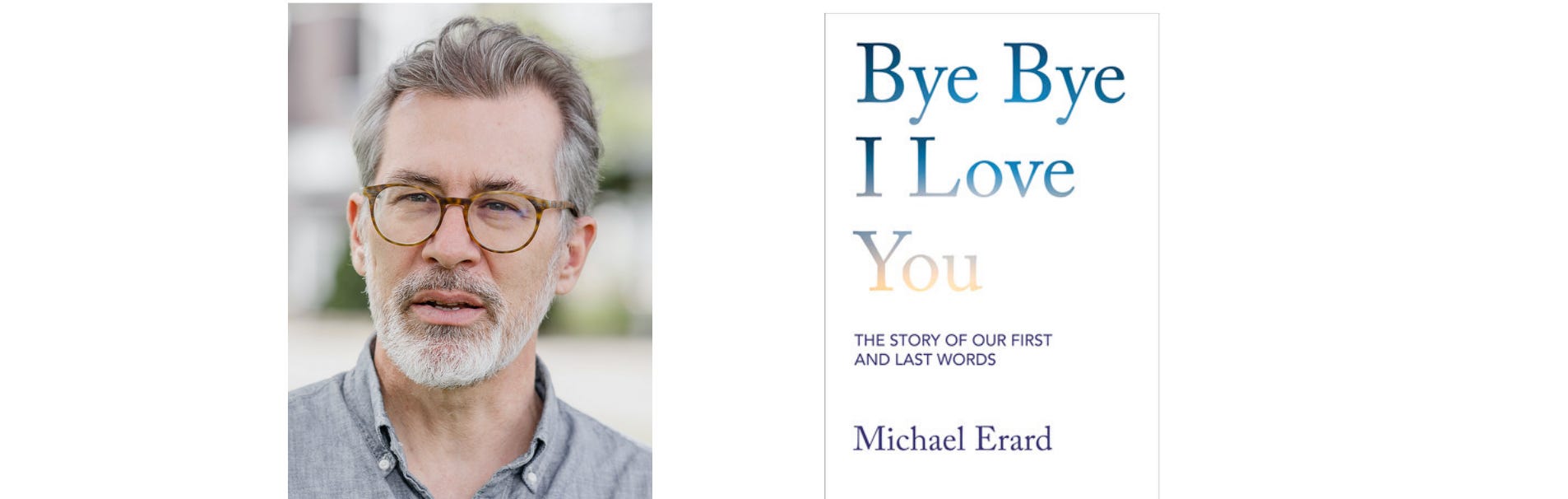
Michael Erard is a linguist and author based in the Netherlands. His book “Bye Bye I Love You: The Story of Our First and Last Words” is out now. He served as writer-in-residence at the Max Planck Institute for Psycholinguistics and worked as a metaphor designer at the FrameWorks Institute. His books "Babel No More" and "Um..." explore language learning and verbal mistakes.
So I have a question, I start all my conversations with the same question, which I borrowed from this friend of mine who, she's an oral historian and she helps people tell their story. And I borrow it because it's a beautiful question, but I over explain it like I'm doing now because it's sort of a big question. So before I ask it, I want you to know that you're in total control and you can answer or not answer any way that you want to. The question is, where do you come from?
Where do you come from? Yeah, I mean, I feel like I've been writing about that for a long time, that question, you know? I kind of come from a migrant people in the middle of, the American continent and, you know, I have kept moving myself.
So that where am I from is, you know, it's from, I'm from the places I remember and I'm from the places that I write about, you know, very much, I think in between things too. For some time living between Texas and Maine and going back and forth and now between America and the Netherlands and professionally I've always been situated kind of between academia and non academia. So academia and journalism, academia and strategic communications, academia and writing.
And I feel like, you know, for all of that in between this, there's a real kind of productive tension there. When you're in Maine and you come from somewhere else, people say that you're from away and it doesn't matter where you're from, right? I mean, it could be a hundred miles up the road, it could be Saudi Arabia, but you are from away.
And I'm married to someone who is a 10th generation Texan. So she's very much from, and we say that I'm the away part. I'm always looking for the next place to be, the next horizon, you know?
So, you know, that question, where am I from? It's kind of like, where am I not away?
Oh my gosh.
To bend that around, yeah.
Do you have a recollection of what you wanted to be as a kid when you grew up?
I think I cycled through all kinds of things. I wanted to be a cowboy. I actually knew real working cowboys. I grew up in Colorado as a little kid and knew these old, old guys who smelled like chewing tobacco and coal smoke and menthol, some sort of menthol joint rub. So that was part of it. And then when I was a little older, I kind of wanted to become a child saint. I grew up in a very Catholic kind of setting. And so, you know, of all of the people that were sort of shown to me as models, like dying as a child saint of some terrible unknown illness, blessing everyone for their sins. That seemed like a good career as any other ones.
What's an example of a child saint? That's not something that is part of my experience. What would you have encountered? What would you have been like, oh, that looks like a good gig?
You know, it was the idea of kind of like being a part but being exalted at the same time, you know, and going through these hardships, but always sort of being told, look, your hardships will add up to something that it will be for this sort of greater good or this greater power. But you will not have to endure it for too long because, you know, God is going to take you away before you reach adulthood. Now, looking back, I mean, I think that some of those stories and maybe even my own wish for that was really sort of a fear of losing childhood or a fear of what was going to come next in terms of, you know, puberty and adolescence. And so wanting to kind of arrest it and just skip the rest of it and go straight to heaven.
I identify with that.
Oh, yeah.
Tell me a little bit about where you are now and what you do.
So I'm located in Maastricht in the South of the Netherlands, Equatorial Netherlands, as they might call it, where it's so far South, it's not really even culturally Dutch anymore. You know, we're five miles from Belgium on one side and 15 miles from Germany on the other side. And people really have their own kind of thing going on here.
We moved here in 2019, me and my wife and my two boys. We had spent a year here, a year previously, not here, but in another part of the Netherlands where I spent 12 months as a writer in residence at a language research institute called the Max Planck Institute for Psycholinguistics. And we ended up liking Europe and liking the Netherlands so much that we decided to stay.
And then there was a job that came up here at Maastricht University in 2019. So I'm now a funding strategist and funding advisor for the faculty of law at the university, but that's really my kind of day job while I was working on a book about language across the lifespan or really these two storied moments that are sort of shrouded in mystery and ritual and expectation or nothing at all, which is the first words of babies and the last words of the dying.
This book has just come out. It looks amazing, right?
It's gonna be out in like two and a half weeks.
Before we get into the book, I'm just curious about the places you've mentioned. What do you sort of love about where you are? What do you enjoy about that part of Netherlands?
The language aspect of it, having to be in the face of not just Dutch but having to encounter my own kind of limits as a multilingual person, that's frustrating, but I also love it. And it's also a place where there's a local language that's not Dutch at all called Limburgish, which has different varieties spoken in different places. It's really not a standardized form of it.
And people are very proud of it. And people are very, they sort of wave it around as something that they do and that nobody else does at the same time that they kind of don't want you to have it either. They sort of reserve it for themselves. So I really like that sort of feeling around language and being around multilingual people. The food is really interesting. The landscape is gorgeous. And I like the access to all of these other countries.
When did you first discover that you could make a living doing this kind of linguistics thing?
I'm still waiting to discover that, I think.
No, really?
Yeah, I mean, I finished my PhD in 2000, but very quickly discovered that I didn't wanna be an academic, that I wanted to be a writer. And there was this, it was clear, there were a lot of stories to tell. There were a lot of outlets for telling them. And it looked like it would be possible to just be like a magazine writer, right? I mean, and in 1999, of course, everything was gonna be possible, right? So I lived that life for a while, and then I finished, and then kind of promptly almost starved to death.
And the friend that I was telling you about before, he was one of these people who was also riding that wave. And he was kind of on my shoulder going, hey, man, you have so much stuff already, because I'd published in a couple of magazines and some national outlets. He said, with all the stuff you have, you don't need to be cooped up in a university, trying to get tenure, you can do whatever you want.
And I felt very much inspired by that and went running. But the big discovery for me as a humanities person was like the business side of things, and to go, oh, I need a business model. And it was actually some artist friends in Austin who taught me that, like you may believe that you are, that it's no knock on your creative practice or your art to put food on your table.
And so you need to figure out a business model that's also a sort of temporal model, something that gives you an amount of income that you need every month, and then lots of other time and psychic energy to do the work that you're here to do. So probably for 24 years, I've been creating that model, trying to keep it together, trying to pu…