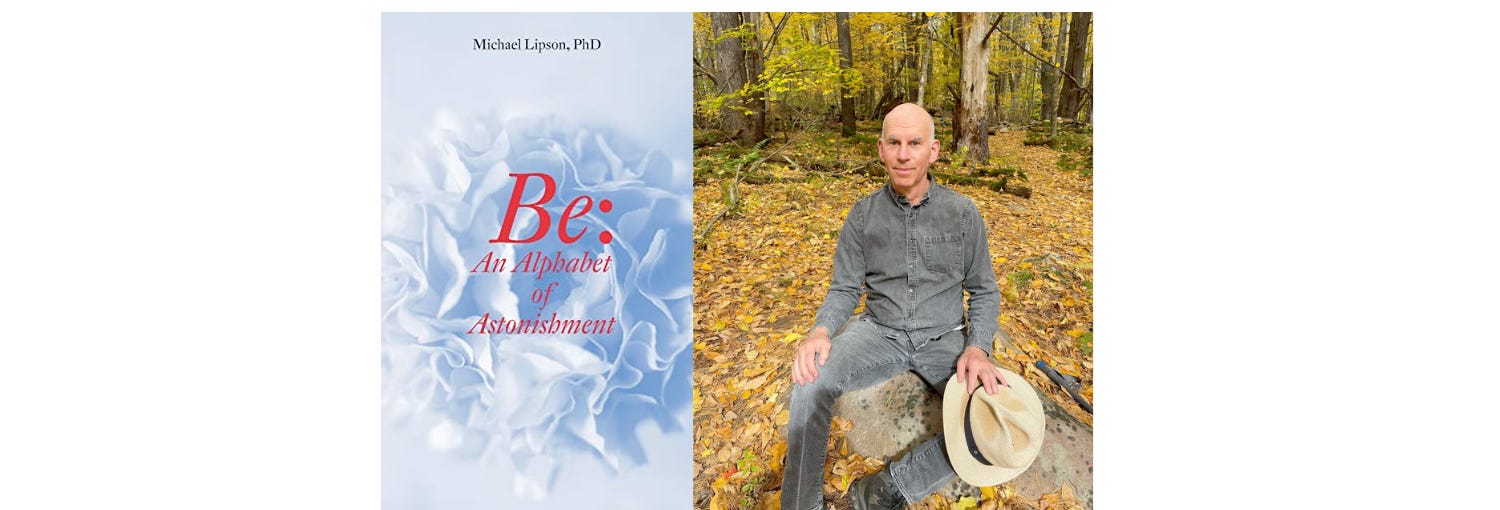
Michael Lipson, PhD is a clinical psychologist, author and translator living in Great Barrington, Massachusetts. He is the author of, most recently, Be: An Alphabet of Astonishment, Stairway of Surprise: Six Steps to a Creative Life, and Group Meditation.
Michael, thank you very much for accepting my invitation to this interview.
Thank you for inviting me. It's a luxury to be invited.
So I start, I don't think you know this, but I start all of these conversations with the same question, which I borrowed from a friend of mine who lives in Hudson. She's an oral historian. She helps people tell their story. It's a big, beautiful question, which is why I steal it, but I also overexplain it because it's so big. So before I ask it, I want you to know that you're in absolute control and you can answer or not answer this question any way that you want to. And the question is, where do you come from?
Absolute control, what would I do with that? Go ahead, what's your question?
The question is, where do you come from?
Ah, well, that's a very Zen master kind of question. They often said that, trying to plumb the depths of where the other monk, for instance, was coming from, not geographically or biographically, but sort of from their spiritual source.
I don't know if you ever read "From the Mixed-Up Files of Mrs. Basil E. Frankweiler." Well, of course I did. And in there, there's a little boy who's hiding in the Museum of Modern Art or the Metropolitan from the guards and the boy and a girl. And at one point, the boy is hiding. He's standing, I think, on a closed toilet. But the guard opens the stall and sees him and says, "Where did you come from?" And he says, "My mommy always says I come from heaven." And then he runs away.
So I guess that's where I come from, just like you and everybody else.
Where do I come from? Sure, I could just answer that in so many ways. To be more down to earth, I was born towards the end of the 50s, a baby boomer in New Haven, Connecticut. My father was a professor at Yale, which certainly had a big effect on me, not only because my mother also was a professor more briefly. And at UConn, she got her doctorate in American history. My father's field was law, in particular, international and Soviet law.
It had a big effect on me because of a kind of a reading, academic orientation, fundamentally, and the people we knew and so forth. But also because though I was Jewish and raised in an agnostic background, my dad, to a lesser extent, my mom, but definitely my dad had an early interest in Zen Buddhism. That was like an academic, fashionable, almost intellectual thing. Back in the day, he wasn't a sitter in meditation or an attender of workshops and so forth, but he was a reader and thinker. So, I grew up hearing stories of the Zen masters and the wonderful old Hasidic rabbis, sort of as if they were all one group of fascinating people. And I think that had an effect on my siblings too, but it took a little more in me.
So, I think that early wondering about the nature of the mind, the nature of our project of being here, what this is, the Zen people talk about the great matter of life and death. I would say also the fact it's a spiritual kind of a background or, I don't know, psychological background that's very fundamental is that my parents' first child died when he was just three months old in a car crash. And so, my parents were driving. My mother was holding the baby on her lap. This was before car seats. And my dad swerved to avoid a dog in the road. The car hit a soft shoulder, flipped over. My mother fell on her firstborn child and killed it, as she said, with her weight. So, that was a kind of untalkable about thing, you know, and a grief that I think pervaded my family when I was growing up. And one of those things that's an open secret, where to some degree people know about it, but it can't be talked about. And I think that had an effect on all of us, sort of making us have some kind of relationship, mostly not a cheerful relationship, to the great matter of life and death. All those are ways I could answer the question, where do I come from?
Yeah. You said that it kind of, the Zen, the masters took with you, more so with your siblings. Can you tell me a story about that?
Well, like the kinds of stories I would hear from my dad? Or what makes you say that? Is there a moment where you realized that it had took, I guess I love that word, that it struck you differently than your siblings?
Well, not a moment, but for instance, I doubt my brother and sister did what I did when I was seven. I remember sitting on the stairs in my home, in our house, and really trying to penetrate the question of mu, which is a Zen koan, a kind of early koan in a series of koans. And it just means nothing in Japanese. And I remember thinking, how can I have it in my mind? How can I focus on it if it's nothing? If it's nothing, there can't be anything to get about it. So I just had an affinity for these kind of puzzles.
And do you have a recollection of knowing what you wanted to be when you grew up? What did you want to be?
Oh, sure. I wanted to be lots of things. But they weren't a psychologist who writes books on spirituality. They were, I wanted to be, gosh, well, I wanted to be Sir Galahad who occupies the perilous, you know, around the round table in the Arthurian legends. And I wanted to be a cowboy. And what else did I want to be growing up? I wanted to be a poet from very early on. And I wrote poetry into my 20s. Byron said, to be 20 and a poet is to be 20. To be 40 and a poet is to be a poet. By the time I was 40, I was no longer a poet. So he was right about me, he nailed me hundreds of years before I was born.
You described yourself as a boomer. Does that word or idea mean anything to you?
Yeah. Well, sure. I mean, it's got a pejorative slant since people started saying, "Okay, boomer." But it was, sure, it's, I recognize as a grown up, how insanely privileged we were, growing in a time after the Second World War, where America was increasingly wealthy, increasingly, you know, hugely respected. And it was, you know, as a white, upper middle class American, I was just in an incredibly privileged position, male, which I certainly didn't appreciate at the time. But now I see sort of what this amazing, you know, kind of bolus of a generation, enjoying an unprecedented, and probably never to be repeated standard of living was. So, and then, you know, realizing my cohort is aging and dying, that's, now that certainly is something. And feeling that we were sort of central to the universe, and now no longer. So, that's an interesting trajectory that a lot of people in that cohort are going through.
Yeah. Can you tell me a little bit about where you are now and what you do now?
Sure. Yeah, I live in Great Barrington, Massachusetts. I'm a licensed clinical psychologist. I've been here many years now. And in full time private practice. Since COVID, a little bit before COVID, I no longer see clients in my office sitting down. I much prefer and insist on seeing them walking in mostly in the woods or talking on the phone while I'm walking. So, all seasons, all weathers, some people want to accompany me, about half my clientele accompanies me, and the others, it's phone or Zoom, but I don't like Zoom. It's better for me to stay awake, to walk in the woods. It's better for my, I have, you know, spinal issues. But also, it's a big revolution in how it feels to be with people.
I guess I've always had a kind of democratic, small D and big D tendency. So, there's something very equalizing about negotiating the same fallen log together, or the rain together, helping each other out through going through a puddle or dealing with bug spray and ticks and mosquitoes. You know, you just, it has an equalizing, democratizing quality. And then, too, there's a kind of third interlocutor, which is the surround. Coming up through a psychoanalytic and also, to some degree, family thera…