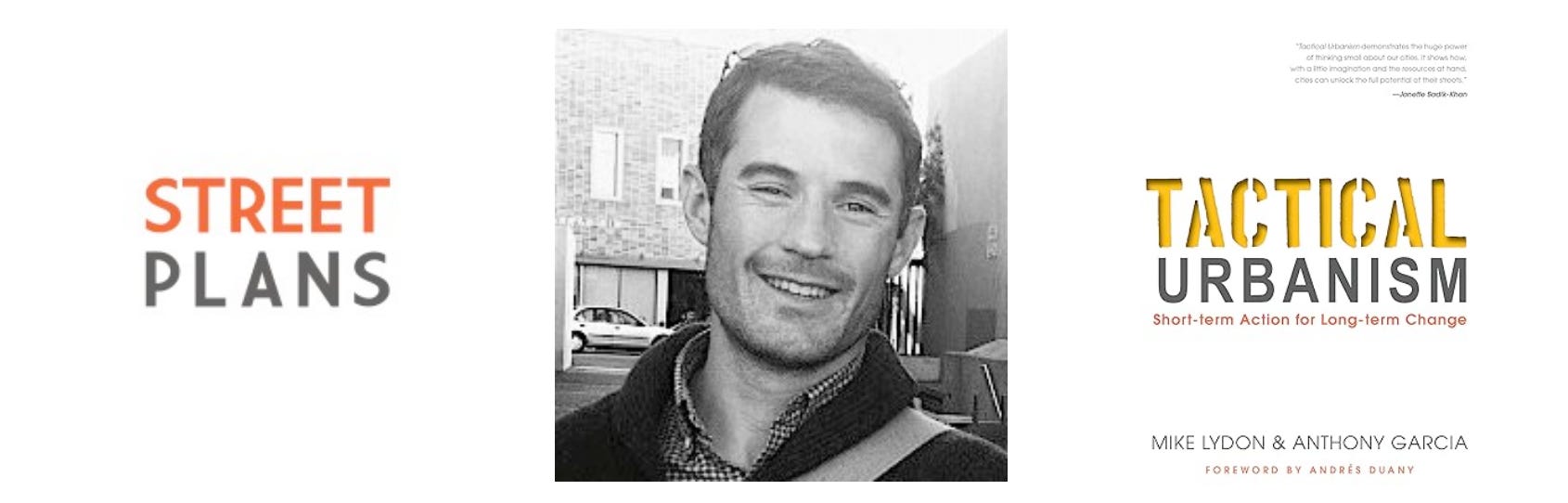
Mike Lydon is Co-Founder and Principal at Street Plans, leading the firm's New York City office, and is an internationally recognized urban planner, writer, speaker, and advocate for livable cities. As the creator of The Open Streets Project and co-author of the Tactical Urbanism series, Mike is a founding member of the Congress for the New Urbanism and serves on Transportation Alternatives’ Executive Committee for the New York City Harbor Ring project.
I start all these conversations with a question I borrowed from a friend of mine. She lives here in Hudson, she's an oral historian, and she's got this question that I think is really beautiful, so I stole it from her. Before I ask it, I want you to know that you're in total control, and you can answer or not answer any way that you want. The question is, where do you come from?
I guess my most immediate response would be I come from Maine.
What does it mean to be from Maine?
I think it means to be self-reliant, independent, and in some ways, creative. There's an ethic of you do all you can with what you have in Maine. I think that's really important. There's sort of a humbleness there, and there's a really good sense of humor. I feel like all those things in Maine are qualities I don't embody, but I aspire to them.
Can you tell me a story about the creativity, or what growing up was about? How did that show up?
I think it's creativity in work - getting by and knowing how to maximize what you can do in your job, and to do well by people. What you observe a lot in Maine is people have to get creative around their work schedule. In the summertime, I do this, and in the fall and spring, I do this, in the winter, I do that. There's a flexibility of how you go about work and getting by, using your own creativity and will to do that. It's a long-term ethic that's part of Maine.
There's a novelist I know - I love all of his work - David Carkeet is his name, and he wrote a book called "From Away," set in Maine. Is that a Maine expression?
[Note: It’s not set in Maine. I was wrong. It’s Vermont.]
Yeah, anyone who's not from Maine is "from away." I'll tell you a quick funny story that speaks to that. We were just up visiting my parents with my two sons and my wife, and there's this annual pumpkin festival that started in our town maybe 10 or 15 years ago, long after I moved away to New York City.
One of the penultimate events of many over the course of this weekend, which attracts thousands of people now, is they take these big pumpkins and raise them up with a crane, then drop them on my old middle school soccer field. The first one is like a 500-pound pumpkin, and this crane goes up 200 feet, and they drop it. The whole crowd is encircled at a somewhat safe radius from the explosion of the pumpkin. Then they double the size of the pumpkin, and they bring out this beater car and park it in the middle of the soccer field, lining up the crane and the pumpkin to crush this car.
The announcer remarks that the car is from Massachusetts, not Maine, and everyone cheers. So there's just this "us and them" mentality, which is not always the most healthy thing, but it's definitely an ongoing kind of running joke about whether you're from here or not.
Do you remember as a kid what you wanted to be when you grew up?
I wanted to be an NBA point guard, or I wanted to be a city planner. I was pretty good at basketball, but I'm 5'9" - I'm not that good. And I went the other path and became a city planner.
How did city planning show up in your life as a kid? What was your experience in rural Maine? How did you know that it existed? I feel like I had a city planner awakening at like 39.
Being from small towns in Maine, they have these really lovely main streets where it's the center of life, and you hardly go a day without being in that environment for some period of time. I was just always fascinated by going to town and what town offered. That draw to those types of environments - I couldn't put real language to it at a young age - was a really strong baseline for me on what I enjoyed about public life and places that one inhabits.
It was somewhere around fourth or fifth grade where I got access to SimCity, the video game. To this point in my life, I was obsessed with sports. I wanted to play sports outside most of the time. If I had access to a video game on my Tandy 1000 computer, I had sports games, except for SimCity. And I was obsessed with it really quickly.
Then I started doing academic project fairs or science fairs in fifth grade, investigating city planning. I read books from the library that talked about Roman cities and how they started and grew and the life that became part of those cities. It was super inspiring to me. I just continued that thread all the way through the end of college when I did a thesis on an urban planning issue in Maine that also was about Native American history, economics, and culture.
It just grew with me. And then in college, I did a lot more research on who are my North Stars in this field and what's the kind of work that I want to do. It all just sort of snowballed from there.
And tell me where you are now and what your role, what your work, what you're working on these days.
I now live in Brooklyn, New York, which I like to say is basically like one big downtown Maine village. The urban form is actually not that much different. If you were in downtown Brooklyn or Manhattan, then yes. But if you're on Fulton Street or DeKalb Avenue, Fort Greene, these places that I inhabit a lot - two, three, four-story buildings, mixed-use commercial apartments above - it's very similar to downtown where I grew up. It's just there's a lot more of it, which is awesome. It just goes on and on.
We do consulting work all over the country. Since having kids, I've focused more of my time and energy from DC up to Maine on the East Coast. That's everything from developing active transportation plans for communities to installing street improvements. We do a lot of work where we literally transform environments temporarily to show what's possible and to learn from those changes and how people respond to them, both with their behavior and their support or not.
A lot of our focus at the moment is on two things. First is street safety and really helping communities drill down on where they need to spend their limited resources to get the biggest outcomes when it relates to people of any age or ability being able to move around their city safely. Second is public realm activation or enhancement. We've got fascinating projects on the San Francisco waterfront, the Cleveland waterfront, the West Palm Beach waterfront, and 14th Street here in Manhattan, where we're looking at something more permanent than the temporary work we did together in Hudson - something that can last five, 15, 20 years, really be that interim change, but provide immediate spark or improvement to the way people experience streets.
How has the field changed since you entered it? You're sort of responsible for tactical urbanism, which is this approach to community engagement that's revolutionary. There was maybe a behavioral revolution in marketing too, where we could learn differently by focusing on how people behave as opposed to what they say they're going to do. But I'm curious, how did tactical urbanism arise for you? And how did that change how urban planning works?
I think for me, it was just being an impatient 25-year-old and wanting to see the change in the world happen quickly. I went right from that thesis I wrote in college to one year working for an advocacy organization in Boston around cycling issues to then going to grad school. All the way through that process, I didn't understand the politics. I didn't understand how important moving the needle is of public opinion and being able to cut through some of the debate sphere where we can talk about these things until we're blue in the face. But wh…