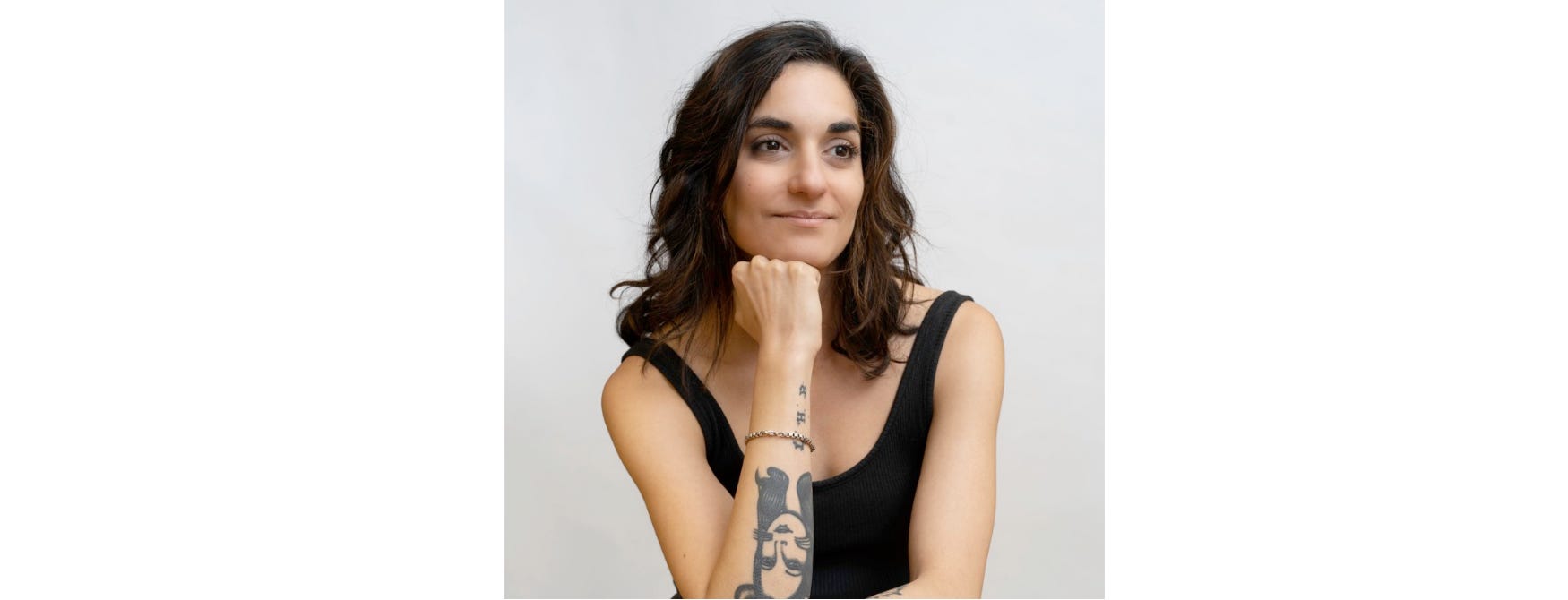
Nazy Farkhondeh is a Brooklyn-based writer and brand strategist working freelance. She previously held positions at Reed Words, Trollbäck+Company, and VICE Media, where her work earned two Clio Awards. She has also worked with Interbrand, served as a D&AD Writing for Design judge, and holds a BA in Communications from the University of Michigan.
So I start all these conversations, and I’m not sure if you know this or not, but I start all the conversations with the same question, which is a question that I borrowed from a friend of mine. She’s a neighbor too. She helps people tell their story. And I stole this question from her because it’s big and beautiful. It’s a great way to enter into a conversation. But it’s really big, so I over-explain it the way that I am right now. So before I ask it, I want you to know that you’re in total control and you can answer or not answer any way that you want to. This is probably the biggest lead-up to a question ever. But the question is, where do you come from? And again, you’re in total control.
Okay, cool. Yeah, that was a big lead-up because I already know this question and have thought about how I’m going to answer it. But thought a little bit about how I’m going to answer it, because I do love this question, and I think it can be digested in so many different ways.
But yeah, I think I have two answers. The first is, I say I’m from Los Angeles, and I really mean that in the from and to sense. I feel like where I am now is the result of growing up in LA and trying to be the antithesis of that.
I always felt so restless there. Everything felt so artificial to me, like the weather, the people. And I don’t know if it was home, but I had this feeling of entrapment growing up there.
And my family moved around a lot because my dad was an architect for LA Unified School District. So we moved around based off of what project he was working on. And I never felt happy there.
I always felt bored. I always felt stuck. Everything felt really monotonous.
And it was supposed to be this really exciting place that everybody wanted to be. And I didn’t feel that. And I moved back there after college because I wanted to work in the film industry.
And I did work in the film industry for a little, and that quickly made me realize, wow, I really don’t want to work in this industry. And so coming to New York, I live in New York City now, and I’ve been here for almost 10 years. And it feels like a huge breath of fresh air.
I really feel like an East Coast person. And I don’t know why. I think it’s the seasons.
And there’s more texture that you experience on the East Coast, I feel like, you don’t get on the West Coast. And so, yeah, I really, in terms of where I’m from, I really think of that as like, that’s where I’m from. And that was a before.
And then I think the second answer to the question obviously is, my family’s, I’m first generation, but my family’s from Iran. And that’s something that as I get older, I feel more and more removed from because the relatives that I have there have all passed. And I haven’t been there since I was 17, and it’s not really safe to go there right now.
So hopefully it is one day. And so I think I like to acknowledge that because the older I get, the more removed I feel from it, and especially what’s happening in the country right now. It’s, I, as I get older, I feel more compelled to honor that.
What is that? How do you notice that, the remove? I thought that’s an interesting way of talking about it. You feel yourself removed, feel at a remove from this thing, even as you’re sort of acknowledging it. Is there something, can you tell me a story about that? Like, how does that happen?
Yeah, I think, honestly, I think it really hit me in the face when I got married, and me and my husband started talking about family planning, it, I really realized, I was like, oh, wow, this is gonna die with me if I don’t try to carry it forward. And, and I think being first generation, or being born here, and I think my, my family was, my mom and dad were born in Iran, and came here when everybody else came here during the early 80s during the revolution.
It was such a stark departure. And only being one generation removed from it, I feel so removed from it. And I think getting married is the thing that made me realize how removed from it I feel.
And I have one aunt that still, I have some aunts and uncles that are still around and not being able to carry a conversation with them in Farsi, when I was able to do that as a kid, was very jarring. So I started taking Farsi lessons again as an adult. So I’m trying to figure out ways to incorporate and honor that more as I get older.
And I feel like a responsibility and also this intense desire to do that because it’s so much a part of where I’m from. It’s not like my family was from there generations ago. It was literally the generation before.
Yeah. To what degree did it play a part in your childhood?
I think as a child, I was trying to get away from it as much as possible. I grew up wanting to blend in and be white. If that, and I still don’t even know if I’m like the, whether or not Middle Eastern people are white is something that’s very unclear.
I’m still very unclear about it. But yeah. But again, growing up in LA, I wanted to blend in and I wanted to not stand out.
And I was a little bit, and I hate admitting this, but I guess ashamed of my background and wanted to be as American as possible. And now that time has gone on and I’m like, Ooh, America is not that great. I’m like, why did I do that? So I think, yeah, I think it’s a combination of age, maturity, and political circumstances, obviously seeing my people get continuously, for lack of a better word, massacred by their own government and their tenacity and drive and grit and courage and all of that makes me really proud the older I get.
And so I feel more compelled to be in touch with that side of myself because I think it’s really important.
You mentioned it a little bit, but I always ask this question of what did you want to be when you grew up? I’m thinking of a Nazli in monotonous California, artificial California weather. What did you want to be when she grew up?
Yeah. I wanted to be an archaeologist really bad. I think I saw Jurassic Park and talk about novelty. I think that was the ultimate form of novelty. And then, and I was always interested in animals and nature and other worldly things. And I think that’s something that faded as I got older.
And I think I’m rediscovering now as an adult, we mentioned before we started this call that my honeymoon was back country snowboarding in the French Alps with my husband. So looking for out of this world experiences. And then when I got a little older, I wanted to be a screenwriter.
I was always a writer and growing up in LA that seemed like a natural extension of writing, being surrounded by the film industry and then working in the film industry for a year after college. I quickly realized, this was pre Harvey Weinstein as well. So it ruined the magic of movies for me.
And I was in an environment where I was working for an independent producer and I was like, okay, I can be this person’s slave for 10 years making $20,000 a year only to become this person. I don’t want to be this person. And so that dream died, and then also seeing the level of disregard and the lack of consideration, all these screenwriters put so much time and love and effort and sacrifice, sacrifice everything to write these stories.
And they, before they even go to anybody important, they go across an intern’s desk. And depending on how the intern is feeling that day and may or may not go up to their boss. And, and honestly, anybody can read a script, but seeing the interns and the people that I was with, it’s like, some people were there.
It’s like, they weren’t that passionate about film. And I was like, wow, these scripts are being read by unqualified people. The people writing these scripts know way more about movies and good writing than the people reading on them and passing judgment on them.
And so I think that quickly shook any desire I had to be in that world.
Yeah. I love what you said about, I thought it was interesting that the, oh, an archeologist.
So who was an archeologist in your mind?
No one. I think I saw it. I watched Jurassic Park and I was like, that looks really cool. I want to be somewhere that feels so removed from the world, finding something extraordinary. I think there was literally no model. I think watching Discovery Channel and that was it.
I was like, I want to be there doing that.
So catch us up. Where are you now? And what are you doing?
I am a freelance strategist and writer. I hate using the word copywriter cause I feel like it’s so reductive. And especially now with AI, it’s like, people think of copywriter as headlines or web copy or the executional stuff. And I never wanted to fit myself in that box because I think of language a lot more holistically.
And I think of language a lot more strategically. And so I always say that I’m in this middle area between writer and strategist. I’m not a full blown ethnographer.
I’m not a business strategist. And then I do copyright, but that’s the last stage of the work that I’m doing. I always, I don’t know.
I think good thinking is good writing and good writing is good thinking. You can’t really separate the two. And so so yeah, so my work has been at the intersection of where these two disciplines live.
Sometimes I do brand positioning work, research and positioning work. And then sometimes I’m developing a tone of voice for a brand and then executing that across platforms. So my work lies in that spectrum.
When did you first discover you could make a living doing this?
It was really by accident. My career was so windy and it felt so nonlinear at the time. But now looking back, I think it does make sense.
I told you I wanted to work in film. And at the time it was 2013. So it was the new golden age of television where other cable networks outside of HBO and Showtime were creating very premium and prestige shows.
So television was having this revival. And I was, and I was working in film development and I was like, well, let me go to a TV network. There’s, it’s going to be a little bit more corporate.
There’s going to be more fluidity and ascension in terms of how you move about the company. There’s going to be more of a ladder up to growth. And so I randomly found this program through this organization called Pro Max.
I think they’re still around, but it’s basically an organization within the entertainment marketing space. And it’s a space that people normally fall into when you think of the 30 second promo spot, the trailer for the trailer for a TV show that’s playing within linear TV airtime. And that’s not a career that people seek out.
It’s something that people fall into. And so this program was designed to help people become, the term at the time was predator. It’s producer, writer, editor.
So the people that write those, yeah, I know it’s so specific. And so I found this program and I was like, well, I’ve always been interested in advertising. And this seems like a great way to get into a TV network because the program, it was a certificate program.
And the teachers were people that were executives at the Fox’s and the ABCs and the Disney’s. And so I was like, I don’t even remember how I stumbled across it. I think my older sister was dating the guy who was the president of this company at the time.
Random and I just needed a change. I was fine, I’ll do it. I did this program and got great exposure to all of these heads of marketing at brand at these big, big networks.
I got a job while I was in that program at the small TV network called Pivot. It was participant media. It was their TV network.
I got a job in the creative services department, logging footage for on-air promos, writing scripts, doing treatments for branded content and interstitials when advertisers wanted to come and advertise on the TV channel. Then it was the rise of streaming was happening simultaneously. I freaked out and I was oh, well on-air promos are going to die because TV channels aren’t going to exist anymore.
I freaked out and I was I just need to go into marketing, larger marketing. I want to be a marketing executive. I transitioned into just the marketing department there for the TV channel.
Then that the TV network went under and I got a job opportunity. That was a dream job opportunity, the opportunity at the time to go help launch Viceland, the Vices TV channel in New York. I was 25 and it was just a dream job opportunity, moved to New York and go launch this really cool thing.
I think that was my first big exposure to the power of brand. I don’t know if you remember what OG Viceland was like, but the entire viewing experience on the channel was branded. Most of their, I think 50% of their commercial time was filled with their own interstitial content.
Watching Viceland felt like you were transported into this whole other universe. It really didn’t feel like a traditional linear TV channel. It felt like this whole other branded viewing experience.
I was there for a while working on the consumer brand side of things, doing a lot of program and marketing strategy for the individual shows and the channel as well. It was a lot of events. Traveling to Art Basel and South by Southwest and Comic-Con and throwing these really insane parties.
This was at peak Vice time, I think before it started going downhill. Anyways, it was my first big exposure to the power of brand and how powerful a brand really could be. I mean, everybody was trying to emulate Vice at the time.
Over time and vice had a really big creative department. The TV channel had a really big creative department. I think it was a 50 person creative team doing stuff exclusively for the TV channel, not revenue generating content, but just branded content that lived on the channel that created the Viceland experience.
I was very intrigued by that. I also just, having gone through the producer, writer, editor career trajectory, I was oh, it would be cool to be on the creative services team here. But I was in, but I had already transitioned into marketing.
I was on the marketing team. But then as you know, they started doing cuts and restructuring and it was just five constant years of that. I got to make my job what I wanted it to be.
I became close to the creative director there and he let me write and produce some spots for the channel. Then I started doing a lot of RFP work for advertisers. I just slowly started building up a creative portfolio.
I knew at that point, I was I don’t want to work on in media anymore. I want to go to the agency side. I think at that point, people were usually doing the opposite.
They were working at an agency and then going to the brand side. But I wanted to go work at an ad agency and explore the quote unquote creative route. After a while at vice, I landed at a branding studio called troll back and company, which was my first quote unquote agency job, although they didn’t call themselves an agency.
They specialized in entertainment rebrands. Because I had an entertainment background, it aligned quite well. That’s when I realized, oh, writing and strategy is a thing. Brand strategy and brand writing is a discipline.
Then, grew from there. I just got, I was there for a while and then got another job at this company called breed words, which was exclusively brand strategy and copywriting. Then from there started freelancing and yeah, that was a very long winded way.
We got the whole, we got the whole arc, the whole arc of your professional journey. I wanted to, I was really tempted to interrupt, but this encounter you had with the Viceland where you just said, you know, why you just, it was your first encounter with brand. I was really curious about that.
What did that mean to you? What did you see or what, I guess, what did you learn about brand in that move into Viceland? It was such a special time and a special entity, right? What is brand or what did you discover about brand in that moment?
I think, I wish you did interrupt me so I didn’t go on such a long tangent, but I don’t know. I think it was something that felt really intangible.
It was just this visceral feeling, the brand just had this je ne sais quoi. And it’s you didn’t know where it came from, but everybody was trying to emulate it. Everybody wanted to work there and it didn’t really.
I think at the time, because there was nothing like vice before in terms of the journalism that was coming out of there, the brand was an organic extension of that. I hate to use the word authentic, but it felt very authentic to, they didn’t have to articulate who they were because they were just out there and they were doing it and they were creating all these shows and doing all this journalism about stuff on the fringes of society that nobody else was covering. Then I think as the brand evolved and nothing was articulated on a foundational level, it started falling apart.
Instead of being relevant was trying to chase relevance or rest on their laurels of the things that they had done in the past. I think it was just a lesson in branding one-on-one of what makes a brand tick and what makes them authentic. Then I think a crash course and whatnot to do if you want to scale that brand over time.
Yeah. What do you love about the work that you do? Where’s the joy in it for you?
That’s a good question. I think about this a lot because I don’t know if I’m not, I think I’m passionate about the work, the work itself when it comes to the output and what I’m putting out in the world.
I don’t care about it that much. I don’t think it’s that important. I mean, I hate to say that, but it’s true, but I think the process of the work and the things that it requires the curiosity and the thinking and the discovery and the simplification of complexity, all of that is just very intellectually stimulating for me.
And it feels very gratifying. I think as somebody who always wanted to write and failed miserably to complete my own writing projects, whether it was a work of fiction or a short story or whatever, I struggled with that. I feel for some reason doing that process at work, I just find it much easier.
I think it tickles the same parts of my brain that want to be activated when I seek out to do a personal project. But for some reason, the personal projects or torture the work projects or not. I always wished I could wish I could be that person.
That’s oh, I have to create for myself. It’s my therapy, but I’ve never been able to be that person.
I loved how you talked about language early on, and you’re very clear about living in between in this world, between writing and strategy and how words are related to the ideas and brand, I guess. I’d love to hear you talk more about your process in terms of the role that language plays. If that’s a too broad a question, I can narrow in.
No, I mean, I think I’ll try to answer that. One of the first studio that I worked at had this mantra of discard everything that means nothing. I always appreciated that when it came to language. I think it’s the process of simplification is something that I constantly go back to.
With language, it’s I just constantly asked myself, is this expression making things more complicated or less complicated? If I have to add some modifiers to get the point across, then the idea is probably not right. I think that I use the process of simplification in my writing a lot. I think that’s the thing that I enjoy about it is how do you capture the true essence of something, whether it’s a strategy or a voice persona or a campaign idea, if, how do you make it robust and rich in as few words as possible? I think that’s the challenge that’s the challenge that I live for.
Yeah. What’s your, what do you, what do people come to you for? I feel like everybody’s got a little bit, at least in our minds, sort of the red phone. I mean, that’s an old, it’s an old Batman reference, but what’s the red phone for the work that you want to do? When do you want people calling you? What are the problems you love to solve?
I mean, honestly, I’m still figuring that out. It’s been ongoing for me. I think only having done the freelance thing for a little bit over a year and just with the time that we’re in, it’s scary with all these agencies imploding and shutting down and the freelancer market getting more and more saturated and everybody wanting things done faster, cheaper, quality that you can’t have all three.
Now people expect all three. It’s been hard to me to, it’s been hard for me to trust that I can be in a space where I can start to say no and cultivate the body of work that I want to do. I don’t know, I guess to answer your question, this is kind of sad to admit, I haven’t let, I haven’t allowed myself to get to that spot just because I don’t feel liberated enough to do that.
I mean, I hopefully that changes. But I mean, I think right now it’s less about the type of work that I to do. It’s more about the stage in which a client is in when they need help that interests me the most.
It’s usually when I’m a bigger fan of coming in, not necessarily when something is being built from scratch, and they’re trying to, and a brand is trying to be defined from scratch. I to come in at the moments where there’s a bunch of different factors. It’s okay, we have this foundation, but then we have this variable that’s happening in the background business wise.
Then this is happening out in the world contextually and culture wise and we need to, but we also need to move this direction. It’s what is the answer? I think that that kind of work fulfills me more is the juggling of different variables to reach a certain outcome versus building something from scratch. I think it’s mostly just because when you’re building a brand from scratch, I did this recently and it’s, there’s many unknowns and usually you’re working with a founder that’s in a very early stage and they have a lot of anxiety.
I find that, I find that the sky’s the limit can be kind of limiting. I think, I think the more, I think I think the more variables you’re playing with, the more creative that you can be and the more satisfying the work is. Yeah, I usually to come in at a point where a brand is trying to shift perception or change their personality a little bit, figure out how to be edgier, figure out how to be more playful, more whatever.
Figuring out how to strategically implement that. That’s the work that I find most interesting. Yeah.
What’s your process for learning? We all have our own sort of way of learning and what, how do you, how do you learn about, let’s say you get invited on a project in that condition, how do you begin to learn? Do you have a discovery process? What are the tools you use? I’m just always curious how people orient themselves within culture and within the brand in order to be, to do that kind of work.
Yeah. I mean, I think I’m just patient with the materials.
I know that sounds boring, but I spend a long time on discovery, just sitting with any relevant documents or research. You and I are both in exposure therapy. I’ll go back through that slack and see if there’s any relevant thinking or conversations within that, that industry or that discipline that I’ll go back to.
I usually always start with, I think the first instincts that come to mind, I think the work we do is very instinctual and it’s this work is about the process is what leads you to the answer. It’s not you’re making a calculation and ending at point Z. It’s the, the insight is in the discovery and in the process. I’ll always write down some initial thoughts on, if let’s say I’m doing a strategy exercise, what is if I’m, and I need to write positioning, okay, what do I think the purpose of this brand is right now? And just kind of, as I’m going through discovery, just write simple articulations of that at various points in the discovery phase, and then kind of look back and see how it’s evolved.
Usually I can, from the way the articulation is evolving, I can kind of gain an insight as to okay, in how the discovery is evolving. It’s if it’s trending a certain way, then I can kind of gauge okay, this, this path is telling me something about where, where it needs to end up. Yeah.
What do you, or what role, if any, does, I’m always interested in getting into a conversation about qualitative and face-to-face discovery and if it plays a role for you or not, and what role does it play in your work and what value does it bring?
I mean, I think it’s the most valuable thing. I mean, you can only gain much from looking at old positioning documents and messaging A-B testing and things like that. That’s great.
But I don’t know. I find that mostly when people are on the client side of this work, they’re just, they’re managing many different factors and variables. They’re just trying, they’re just looking for somebody to make sense of the things that they’re thinking.
Qualitative plays a huge role because the answers are usually already there and what they’re, and what they’re, when, what they’re talking about. I, and I want to get, it’s something that I’m always trying to get better at is how do I design the most insightful questions. It’s something that I’m always trying to get better at rather than just regular stakeholder questions.
Just I’m trying to always get better at how to architect those questions. I’d love to learn from you too, because I know that that’s the core, the core of what you do. But I always do, I find the best work always comes when there’s at least some interview sessions being done with the client.
Otherwise it’s just, you’re just, otherwise, I don’t know, the work feels, can feel a little soulless and I always to be reminded that I’m helping a human out. It just makes the work more gratifying. I think I, I to be oriented in that this work is helping out a human, not just a business.
I think qualitative plays a huge role in that. Yeah. Yeah.
That’s a beautiful, I mean, yes. Questions. Let’s talk about questions.
What’s, when you’re thinking about better questions or having better questions, what are you thinking about? Yeah. I mean, I don’t know. I’d love to ask you that because you have more experience with it than I do.
But yeah, I think I’m always trying to find, going back to a branding exercise, let’s say we need to articulate what a certain brand is in a traditional positioning sense. I think trying to uncover the spirit of the brand beyond general adjectives. I think a lot of times, trying to uncover the nuances that actually make it different.
I feel like a lot of times in positioning work or honestly in voice work, especially tone of voice work, always go back to the same adjectives. We want to sound human. We want to sound authoritative. We want to be clear. And it’s like, that’s not a unique brand. That’s a good brand and that’s good copywriting.
So I’m always trying to figure out, okay, what makes a, what’s the difference between, let’s go to copywriting for a second. What makes, what’s good copywriting and what’s distinct copywriting. And I think trying to figure out, trying to uncover the nuances that get to that distinction. That’s what I’m always trying to uncover in my questions. And I find it, I always find it very challenging. So I’d love to hear from you about how you get there.
Well, I mean, I identify completely and I feel like that’s the whole thing, isn’t it? You know what I mean? Both the idea that there’s some perfect question that’s going to unlock something and the hunger to get into a space where you’re discovering something. I mean, I feel like that’s the whole attraction to the work, right? So I’m identifying with you that that’s, I feel the exact same thing. I think a lot about questions of course, but it lands right on top of what you said about the process, that the strategy is in the process.
You don’t calculate your way through. You get lost, you have to get lost in something that’s not you in order to find, discover whatever is going to be discovered. And I think that, I think of that at the level of conversation is true too.
And I remember somebody correcting me on this. I remember being like, what are your questions that you love? And they were like, well, I don’t know. I mean, it’s not really the question. It’s whatever’s happening, you know, between me and the person I’m talking to. Maybe it’s not the question. Maybe it’s my facial expression. Maybe it’s, right. Maybe it’s the weather. I don’t, you know what I mean? It’s stuff there that we have no idea about.
Yeah. That’s why I love being in an interview. When someone goes on a tangent, I love it. I’m like, keep going. Keep talking. I think that’s, I mean, unless they’re going completely off the rails, obviously you have to direct them back a little bit, but I find the most insightful insights when people start talking about something and then they can’t stop talking about it.
And going back to the process, I think this is what my biggest gripe with AI is. It’s like, it makes us more efficient at the process, but it also shortens the process. And so that’s something that I have to constantly balance in doing the work. It’s like, how do I make myself more efficient without shortcutting my way out of the thing that’s the most important thing. And I think that’s been my biggest issue with these tools that are supposed to make you better at your job. Yeah, that’s right.
What’s the most important thing you said? You said it’s, you said, I want to do the, I want to use these tools to make me better at my job without losing the most important thing. What were you thinking about?
Yeah. I think going back to what we were talking about in terms of the insight being in the process of discovery.
And I think that sometimes the idea or for lack of a better word, the answer comes in the most unexpected places in the research process. And so it’s the biggest contradiction in the work because we’re always, we’re in the work itself. I feel like in the process of discovery, we’re searching, we’re sense-making, we’re trying to find patterns, we’re logic-ing in a way, but the best insights don’t really come from logic.
They come from instinct and they sort of appear. And so it’s, and that’s what AI is. It recognizes patterns and it’s, and logic and that’s what it’s good at. And so I constantly, it’s really underscored a huge contradiction in the work that we do. It’s like, we’re signing, we’re simplifying, we’re sense-making, we’re identifying patterns, we’re making sense out of complexity, things that feel very logic-oriented and almost mathematical, but the output itself and the core idea that is the idea usually comes out, usually appears out of thin air from some point in the process. And I find that part of the work, I think the most interesting is that it seems so methodical and logic-based and it is to many degrees, but that’s not, but usually the answer doesn’t come that way.
No, I really love what you said. And I mean, I feel like the AI, working with AI has really been a challenge in that it’s trying to find that line and protect those boundaries between what I’m doing and what it’s doing. And somebody articulated, and I want to hear you respond to this, that what AI is really good at is it takes the patterns, it identifies patterns, and it can scale these patterns.
It’s basically scaling patterns in any direction you want unbelievably fast, but it’s always working with an existing pattern. So if you, and what we do, I guess, is we identify things that break the pattern or that somehow, or that somehow aren’t, don’t fit. But somebody articulated that in a way that made, it made sense to me that it seemed to make the limitations of AI really visceral, but how have you been using it and what, and I have a broad sort of idea.
I mean, how do we, how do you work as a strategist in discovery now with all the, you know what I mean? The time constraints, these new tools, what have you, what have you found that works for you?
Yeah, I mean, I think it’s, I think the most helpful thing that it’s done is that it’s removed the fear of a blank page. I think before these tools existed, initiating the starting point, I think was always the biggest challenge. So much time for me, at least personally, was spent in mustering up the momentum to initiate. And I think that AI has allowed for very easy access to a starting point.
And I think that, yeah, I mean, it’s so much easier to, you know, let’s say you have a transcription of an interview, it’s so much easier to put that into Claude or chat GPT. And they’re like, what are some key themes that keep coming up, you know? And I think it’s helpful to do that, though.
And then again, you said, break the pattern, go back through the actual transcription with these patterns and be like, okay, how can I push this theme even further? How can I break this theme and make it, you know, and make it more interesting? And so if anything, for me, it’s been a really great starting point.\ And I mean, I hope, hopefully, I can keep it that way. Hopefully, it stays that way. What about you?
Well, yeah, I mean, I’m with you on everything you’ve said, and what occurred to me as you were talking is, and what I think I’m learning is that with the time constraints, it’s very easy to offload a lot of that work early to Claude and have it do a whole bunch of different sort of analyses on transcripts and all these other things.
And what I’m learning is that I need to, and I think as I grew older, I realized, my mentor told me in the beginning, he’s like, listen, you need to discover what you’re curious about. Your curiosity is your guide through this process. I really came as a young person feeling like there was a right answer out there I needed to find.
Yeah. So sometimes, I think I’m not giving myself enough time to really understand what I think or feel about, and in quality, about what these people have been telling me. You know what I mean? I have the language, and I can treat the transcript as the data set, but I have a giant piece of, I’m a, I am a data set that I haven’t fully processed in the time constraints that I’ve been given.
Yeah, I love that framing so much. It’s, you don’t realize that you’re an entire, you’re an entire qualitative entity, and your reactions are part of the data as well. Yeah, yeah.
And this is the thing I feel like I’m always really fighting for in a way, and it’s sort of, you know, I mean, it’s probably revealing at a psychological level. I’m always wondering, does this matter? Does this, does this matter? You know what I mean? Does this work matter? And so AI is an interesting challenge. I’m curious, because I mentioned my mentor.
Do you have any mentors or people, I always ask this question, I don’t know why they’re together, but what mentors have you had that really shaped you? And then are there touchstones, ideas, or frameworks that you keep returning to as a, in your work?
Yeah. I think mentorship wise, I mean, there is definitely a lot more when I was much younger, I think. And, you know, the bosses that believed in me and commented on the quality of my work or my drive or whatever.
And I don’t know, I wish I had, sorry, I wish I had more mentors now. Working independently, it was something that I fell into very quickly. And I wish I had more mentors in terms of, you know, and guidance in terms of seeing where my future in this lies and then how I want to, I guess, I don’t even want to say achieve my personal ambitions, but it’s like, how do I discover what those ambitions are? I feel like I need a mentor that can help me.
I feel so uncertain in terms of what I see for myself long term. And I the variables that we’re living in, but sorry, were you going to interject? No, no, no. I’m so curious.
What would you ask the mentor? What’s the, what would it look like?
Yeah, no, that’s a great question. I think I would, I mean, in a simplest sense, I would want to completely dump where I’m at in my life and be like, this is where I’m at.
This has been my trajectory. This is what’s going well. This is what’s going bad. Tell me what to do. Yeah. Yeah.
That’s right. I think that’s right.
Yeah. Tell me what to do.
I can never resist every time the word mentor gets brought up, because I didn’t know this until I was, I was old. And that somebody told me that mentor, I’d been using this word a lot was, is the name of a character in the Iliad. And the mentor was the man that Ulysses, Odysseus left his son with when he went on his journey. And so mentor is, was, that’s why. And then I think the French ended up making it a role. So mentor has a real grounding in that idea of bringing somebody up in that way. So, and yeah, I feel fortunate that I’ve had mentors. So I’m, I’m touched by your, your awareness of an absence of mentors.
Yeah. Yeah. I mean, I definitely, and I think right now, I mean, my biggest mentors have been, again, cause I fell into freelancing not by choice, but it ended up being one of the best things that have happened to me. It’s my biggest mentors right now have been the clients that have trusted me and been like, you know, and have facilitated, have given me their trust and sort of facilitated me going off and doing the work.
I think the trust in and of itself has been maybe not the most direct definition of mentorship, but I don’t know. I find that clients trusting me and taking on their work and going on the process of discovery has been, has been good guidance for me and good affirmations that, you know that, that I am on the right path and that there’s more to be discovered, but yes, I would love more traditional mentors. Sort of help guide. Yeah.
And then the second question, I don’t know that it ever lands really, but this idea of touchstones, I feel like I returned those ideas that I’m sort of, and I’ll be endlessly fascinated with metaphor. You know what I mean? I can never stop thinking about this. Are there touchstones that you return, keep returning to ideas?
Yeah. I mean, I think about identity a lot and I think my perception of that as an idea comes from being an identical twin. And so growing up as an identical twin, I’ve always been fixated on the idea of identity and how do I create an identity that’s differentiated from this person that other people constantly associate me with. And so, it comes through a lot in my work as well, because I think identity can be, I mean, there’s two variables to it.
It’s who you are and also who you’re not. And I think you can, and the, who you’re not part is the thing that’s been Oh, a lot of times. And I think back about my childhood or growing up, the sense of identity that I was creating for myself was done to intentionally foil somebody else’s.
And so, I always think, you know, try to think of okay, what is this not? And that usually helps me figure out what something is, because that was the way that I’ve for better or worse cultivated my sense of self. So yeah. So I mean, that’s usually something that I, that’s usually an easy process for me to go back to is if I can’t articulate what something is yet, what is it not? Yeah.
Yeah. Amazing. I didn’t know that about you.
Yeah. Yeah. It’s a huge thing. People don’t talk about, people don’t talk about, I feel like identical twins are totally sensationalized. It’s like they’re either in media and entertainment and documentaries and stuff. It’s they’re either attached by the hip and best friends, or they’re estranged and it’s very unfortunate and there’s no in the middle.
And so, I’ve always been looking for somebody else who is an identical twin, as part of an identical twin ship that relates to identical twin ship in the same way that I do.
What was it like growing up as an identical twin? When did you realize you were an identical twin? What did it mean to be an identical twin?
Yeah. Oh my gosh. We can have a whole other conversation.
We got five minutes.
Yeah. We can get, well, I’ll get to what I can get to in five minutes.
Yeah. I think it was growing up, especially growing up as a child of immigrants and feeling othered. I found a lot of comfort in my identical twin because it was nice to have a buddy and a companion throughout that hardship and somebody that I could relate to.
It’s like that person that I was relating to was almost a reflection back of who I was. So it was comforting, but it was also reinforcement of these things that I was struggling with because this other person who is a copy, a carbon copy of me is also struggling with them. And now me and my identical twin have lived in separate continents for the past five years. And I think it took us being geographically separated for a while to cultivate our own sense of selves and really lean into our differences and our idiosyncrasies.
And now I’m like, okay, we’re very similar in a lot of ways, but we’re also very different in a lot of ways. I also recently figured out that me and my identical twin of completely different blood types. So it’s like somewhere along the way, there was some sort of mutation that led to that.
And so yeah, I think I’m learning more and more every day the ways in which we’re different. And yeah, I think that comes with time and maturity and establishment of a sense of self. And I think that comes with time, but when you’re young and you’re constantly being associated with somebody else and this person is obviously you love this person. They’re very important to you. It’s like, but at the same time they’re indirectly causing you some strife. It’s a very challenging relationship to navigate.
It’s like being born into a marriage. You’re literally being born into a marriage and you don’t have the tools to be in a healthy marriage.
I had this sense, and I could be totally wrong when you were talking of really wanting to have a clear view of the world that wasn’t attached to where you came from. And then having this sort of mirror in front of you, having this abstract view of somebody that was like you, that wouldn’t let you forget where you were from.
Yeah. Yeah, totally. You articulated it perfectly. Yeah. Let’s see.
So, and that there’s a cliche about the superhero stories that these, the origin stories that our biggest wounds are our vulnerabilities become our superpower. Is there something about that experience that you think gives you, what does that do for you today? How does that help?
Yeah, no, that’s, I love that question. I think it’s given me a very extreme sense of empathy because I’ve had to, it’s really hard to view this, to have empathy for somebody who you’re trying to other yourself from, but that person is also you.
And it’s like, they’re your worst enemy and they’re your best friend. And so it’s like, it’s really hard to have empathy for somebody that feels, and in the same way, it’s really hard to have empathy for yourself. I think that it’s really hard, it was difficult for me to have empathy for her and vice versa.
It’s like, I had to get through this emotional block of letting go of my ego and all this stuff in order to find true empathy for this person I love very much. And I think she would say the same thing. And it’s weird because at times it’s like, there’s like, it’s extreme empathy and codependency or it’s completely muted.
And so finding a healthy level of empathy for this other human being who’s a part of me has allowed me to be really empathetic towards other people, even when I don’t want to be. Yeah. Beautiful.
I want to thank you so much. This has been a real joy. I appreciate it.
Yeah, of course. Thank you.