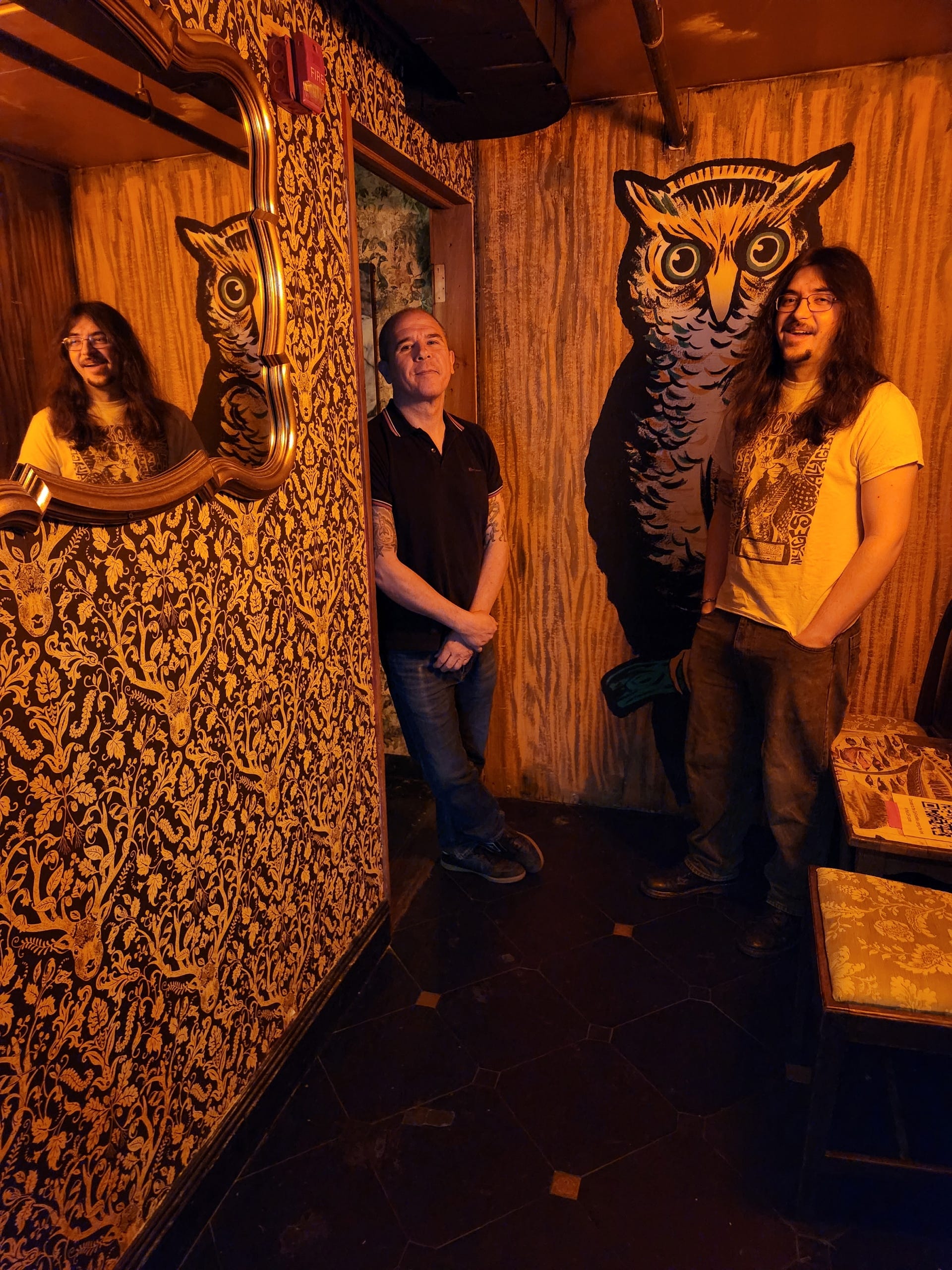
Nick Bodor is the founder and owner of Baker Falls, a live music venue and bar at 192 Allen Street on the Lower East Side of Manhattan. He previously created some of the East Village’s most influential independent spots — alt.coffee, Library Bar, and Cake Shop, which booked early shows by MGMT, Vampire Weekend, and the Strokes. A first-generation Hungarian-American from rural Connecticut, he’s spent 30 years building communal spaces in downtown New York where emerging bands, downtown clowns, and anti-folk musicians find a home.
Nick is building the kinds of spaces we need. This piece makes the case we should be subsidizing this kind of social infrastructure: “Why ‘Cost Disease’ is The Secret Froce Behind America’s Toxic Solitude:’
There is a strong economic argument for subsidizing health care, education, and even child care. But should we also subsidize sit-down restaurants? Bowling alleys and the local dive bar? Coachella!
Of course, I’m joking about Coachella. (Kind of.) But my serious point is that if solitude has a social cost, it’s not crazy to think that local, state, and federal governments should be thinking about creative ways to make it cheaper to hang out. Some policy solutions would be familiar, such as local governments providing more public pools and community spaces. Others might sound a little odd, like making pro-social businesses, such as restaurants, qualify for tax-deductible donations, the same way that Puccini fans can write checks to their favorite opera house.
Cost disease is real, and it has a known cure. Today we’re seeing that one price of a successful economy is the rise of anti-social businesses. But if we want our rising living standards to include friendships and shared experiences—and not just a nation of couch potatoes scrolling on their phones for 10 hours a day—then we’ll need to choose our social future. And pay for it.
So I start all these conversations with the same question, which I borrowed from a friend of mine. I use it in all my conversations because I haven’t found a better way of getting into one of these conversations out of the blue. And it’s a big question. So I over explain it the way that I’m doing now.
So before I ask it, I want you to know that you’re in absolute control and you can answer or not answer any way that you want to. And the question is, where do you come from?
Yeah, it’s interesting because it is so open-ended. Where do I come from geographically? Where do I come from on my parents’ side that was somewhat formative? And full disclosure, it’s this funny thing that as...
I basically came to New York City in the early 90s and I’d been hanging out there since the 80s. And I opened this coffee shop on Avenue A in 1995 across from Tompkins. And everybody was like, hey, Nick, where are you from? What do you do? Well, it was such a what I call exploratory question for people you don’t know.
So with the backstory of I opened this coffee shop when I was 27, I think 27 years old. And it was just me and a business partner. We weren’t well funded. It was this very back in the day, we call it do it yourself, DIY coffee house that happened to have internet access. So we were very early internet cafe, but we wanted to be the cool internet cafe. I always called it an online coffee house, not a cyber cafe, which we were opening up at the time.
So when people asked me that question, I was very gun shy because I was very proud and I had worked since I was 13 years old, working in restaurants and having coked out chefs throw pots at me, but then bring me under their wing and mentor me. To answer the question where I’m from in that environment was I was like, I’m in New York. I’m a New Yorker. And that doesn’t fly.
To answer the question realistically, I think this will be me almost coming to terms with it is I’m from Connecticut. And when you say in 1990s East Village, Avenue A, gritty rock and roll and cool alternative culture, you’re from Connecticut. Everybody just thinks you’re from Westport or Greenwich and you’re a rich kid. Especially being a younger person that opened a coffee shop.
Everybody would just assume you’re a rich kid if you say you’re from Connecticut. So I always had this chip on my shoulder about answering that question. But ultimately, it formed me and it formed a lot of what I’m doing now in 2026, many decades later, 30 years later. Yeah, so the way I explain it is not being from Westport or Greenwich.
But from an area that’s much more rural. People don’t realize that Connecticut has rural populations like Easton and Georgetown. Where I’m from had literally an abandoned wire mill in the town, and my road was called Old Farm Road. So I grew up thinking everybody had a backyard with woods and an abandoned farmhouse that you could just walk across two neighbors’ yards and be in this giant field that was abandoned and fly kites and make model rockets that we would shoot off and just be young kids in the 70s and 80s. Your parents just said see you for dinner time and you just roamed around. And I thought everybody could kick in the door of an abandoned farm outbuilding and fall through the staircase with rusty nails and everything. Super lucky we didn’t get killed. But that formed a lot of an aesthetic of the woods and abandoned buildings and just exploring and just walking around.
And that transferred into New York City, which was a choice that I made to move because I was inspired by the East Village and Lower East Side when I was part of my growing up where I’m from.
I’m first generation. My father escaped in a revolution in Hungary in 1956 and came to Bridgeport, Connecticut, which is a factory town. And the Upper East Side had a Hungarian enclave. And the other one was in Youngstown, Ohio, which Jim Jarmusch made a movie about called Strangers in Paradise about Hungarians, New York, Hungary, downtown Hungarians going to a Hungarian enclave in Ohio. All of that formed a lot of what I’m doing these days.
And I started working in a restaurant when I was 13 called the Georgetown Saloon. That was where all the working folk, all the working people hung out. But it was also, there was some people that had some money. But it really was the place where people had Harleys and they cut the lawns for the rich people and had really successful landscaping businesses. But they drove Harleys and wore leather vests and stuff.
Honky tonk in the middle of everything. So that’s where I’m from. A lot of it, that restaurant, the Georgetown Saloon formed me because there was always one of the owners in the kitchen, one of the owners on the floor, one of the owners behind the bar.
And I worked for them for 10 years and they really brought me up. And when I was 18, I said, by the time I’m 28, I want to open a restaurant. I put myself long-term goal there that again is all where I’m from. And if I didn’t have that job at Georgetown Saloon, I probably wouldn’t have been inspired to do my own thing. I probably would have tried to get an office job or something that was the norm if you could make it happen. That really influenced where I’m from.
And put me in a position to open. I started getting really into coffee culture when I moved to New York and what I would call a coffee house versus cafe. I was romanticizing 1950s beatnik Greenwich Village coffee houses, but then I would travel to Montreal and I loved the coffee house scene there. And so when I moved to New York, 1992, I was 21 at the time and I got into the coffee business and I was like, oh, I don’t need to open a restaurant when I’m 28. I could open a coffee shop. And so I was able to put myself in a position there where we opened up Alt Coffee when I was 27. But I don’t know if that’s a long answer to that first question or if I should break to let you ask me a question.
No, I mean, the answers have their own, they come to their own end. I mean, it’s beautiful. But I do want to go back, because the next question I often ask is, as a kid, maybe before you got that jo…