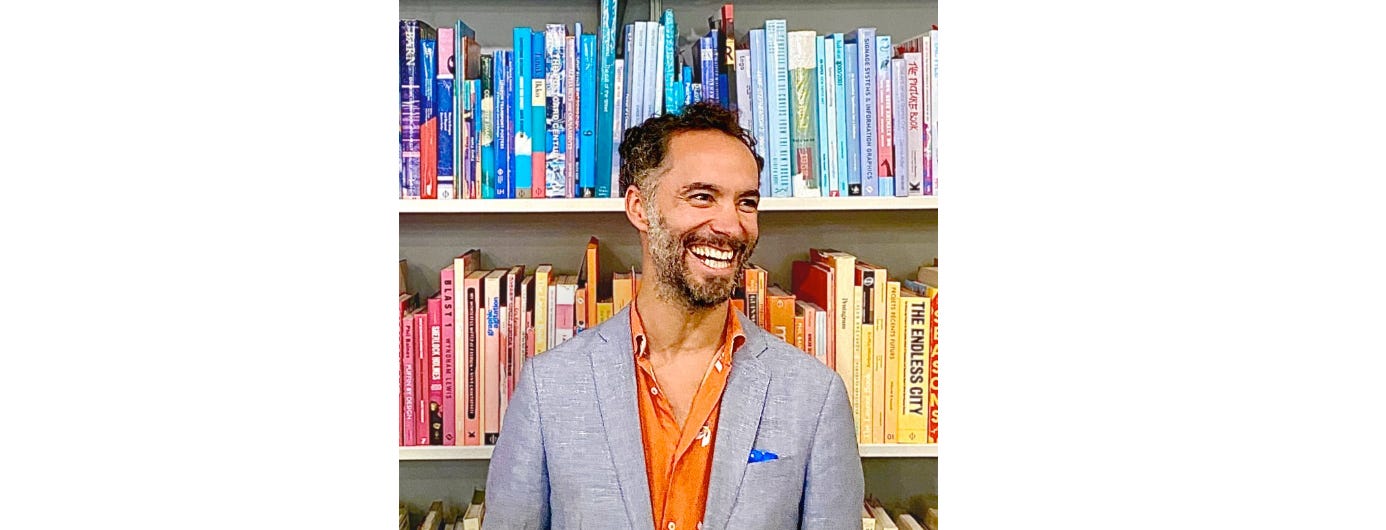
Nick Liddell is a brand strategist, author, and founder of Baron Sauvage, an independent consultancy based in London. Previously Director of Consulting at The Clearing, he has over 25 years of experience working with brands including Google, Prada, McLaren, and Samsung. His most recent books are You Are a Fish: The Truth About Brands and The Brand Architecture Book, which argues for understanding brands as coherent systems rather than singular entities.
So I start all these conversations with the same question, which I borrowed from this friend of mine, who’s a neighbor also, who helps people tell their story. And it’s such a big question and a beautiful question is why I borrow it, but it’s so big, I over explain it the way I am doing right now. So before I ask it, I want you to know that you’re in total control and you can answer or not answer any way that you want to. And the question is, where do you come from? And again, you’re in total control.
And I think it’s really great that you asked this at the beginning of all of these conversations because I had some time to prepare for it, although I’m not sure you’re ever fully prepared. Yeah, I think as with a lot of people, it’s a complicated one to answer.
I was born in Paris. I only moved to the UK when I was three years old. And I initially lived in the north of England near a place called Carlisle.
And then I moved down to London when I was 10. So if I just want to give someone a short answer to it, particularly given that London is a pretty great place to work, if you’re working in branding, then I’ll just say London. But from a personal point of view, I’ll always feel I come from the north of England.
I don’t sound remotely like I do anymore. But yeah, I’m a northerner spiritually.
And what does that mean to be from the north of England? When do you feel most northern?
Well, I think professionally, it means that it’s super easy to get sucked into the belief that everywhere is London.
You grow up or you live in a bubble, particularly when you work in branding or marketing. And so it’s a really healthy way to remind myself that most of the world is not remotely like London or any major city for that matter. And also just personally, it means that the further north I go, the happier I tend to be.
And what was it like growing up? Do you remember what you wanted to be when you grew up?
Well, certainly not a brand consultant. I had no idea a brand consultant was even a thing until I started looking for work. And then I saw in the list of things that aren’t being an accountant, a management consultant, a doctor or anything else that I wasn’t remotely qualified to do.
Brand consultant was one of the few things left. And so it sounded fun and I went for it. I think I wanted to be a different thing every week when I did it, including ballet dancer and professional footballer and spaceman and everything.
And where are you now? And what is the work that you do?
So now I am, to all intents and purposes, still London. I’m just outside London. And I still do pretty much what I’ve been doing for the last 26.
So helping organizations of all sorts of shape and size understand how they can better use their brands to improve their relationships with the people that they need to have good relationships with in a way that ultimately benefits them and helps them achieve whatever it is that they want to achieve as an organization.
Yeah. And when would you say you first discovered that you could make a living doing this thing?
Only really when I started doing it. I went to a careers fair and there were a couple of sad looking types in a corner.
No one was speaking to them. They had an easel with a couple of British Airways planes with some funky tail fins on the back of them. And I don’t think anyone was remotely interested in speaking to them because they didn’t have a really snazzy stance.
They weren’t handing out free things like the Unilever guys and the P&G guys were. So I went and talked to them and asked them what they did. And they told me that they worked at a brand consultancy called Interbrand.
And I asked them about the type of work that they did. And it sounded semi interesting. And so I applied for a job and got it.
And that was pretty much the extent to which I understood what I was doing, what on earth it involved. I learned it all when I started doing it.
Yeah. And what do you enjoy about it? What do you love about it, actually? Or where’s the joy in the work for you?
I love — well, personally, what I love about it is and the reason that I applied was I started working in brand valuation. So I studied philosophy and economics at university. So that’s a really nice mix of numbers and thoughts.
And so what I initially liked about branding was that very often you’re looking at large data sets and you’re looking for some story or idea that you can extract from those data sets. And then there’s the bit on top of that, which you don’t get from an economics and philosophy degree, which is then you can start working with people who actually do things like designers, writers, creatives of all sorts of shape and size to actually make this idea manifest in all sorts of delightful ways that you probably couldn’t have imagined when you started thinking about that idea. And that for me is just a really lovely process that you go through from you can literally look at an Excel spreadsheet with a bunch of ones and zeros as input.
And then output is just this really beautiful, compelling experience that’s been really thoughtfully designed that is going to make the right people really happy and get something and want to engage in it in a way that creates value for them and creates value for the people who are serving it up to them. And that’s still 26 years later, just a really fulfilling thing to do with my time.
Yeah, I feel like maybe we started around the same time. And I always say that I feel like when I came into the work world, brand was the new technology. Do you remember on one level? I’m curious, does that resonate with you? Do you feel like that’s valid? And then secondarily, what do you look at 26 years later? It’s a long time has passed. What’s changed and what hasn’t changed when it comes to brand?
I feel like I have to apologize before I respond to that. I think the funny thing for me is just how little that resonates. And I think probably the interesting thing about doing something for so long is you get into it and you forget. You forget some of the fundamentals after a while because you’re just used to the process of doing things. And so once in a while, I just find myself thinking, actually, why do these things exist? We’re so surrounded by brands in particular.
Right. You can get up probably on a daily basis. You interact without really knowing it with thousands of brands.
It’s in the tens within about five minutes of waking up. If you’ve brushed your teeth, picked up your phone, looked at the shower, stared out of the window. And so I think it was about 15 years ago.
I just started thinking, well, hang on. Yeah, why? Why do brands exist in the first place? When did they start existing? And maybe I can just learn a little bit about how it all started. And there was a really interesting academic research paper that I stumbled across that basically said, you go back to the earliest civilization in the Indus Valley, something like 4000 BC.
There is evidence of what they call proto branding. But effectively, it’s the same thing as what we’re dealing with today. And you’ve got merchants who are putting bulls and fertility gods like images of things onto their wares to signify where they come from.
But also there’s symbolic value to those things. And that’s what we’re still doing today. So I would have — I used to go along with the story when I was at Interbrand. We always said the same thing. Brand comes from this Norse term to brand something.
So that’s how old it is. It stretches back to Viking times and it’s all about asserting…