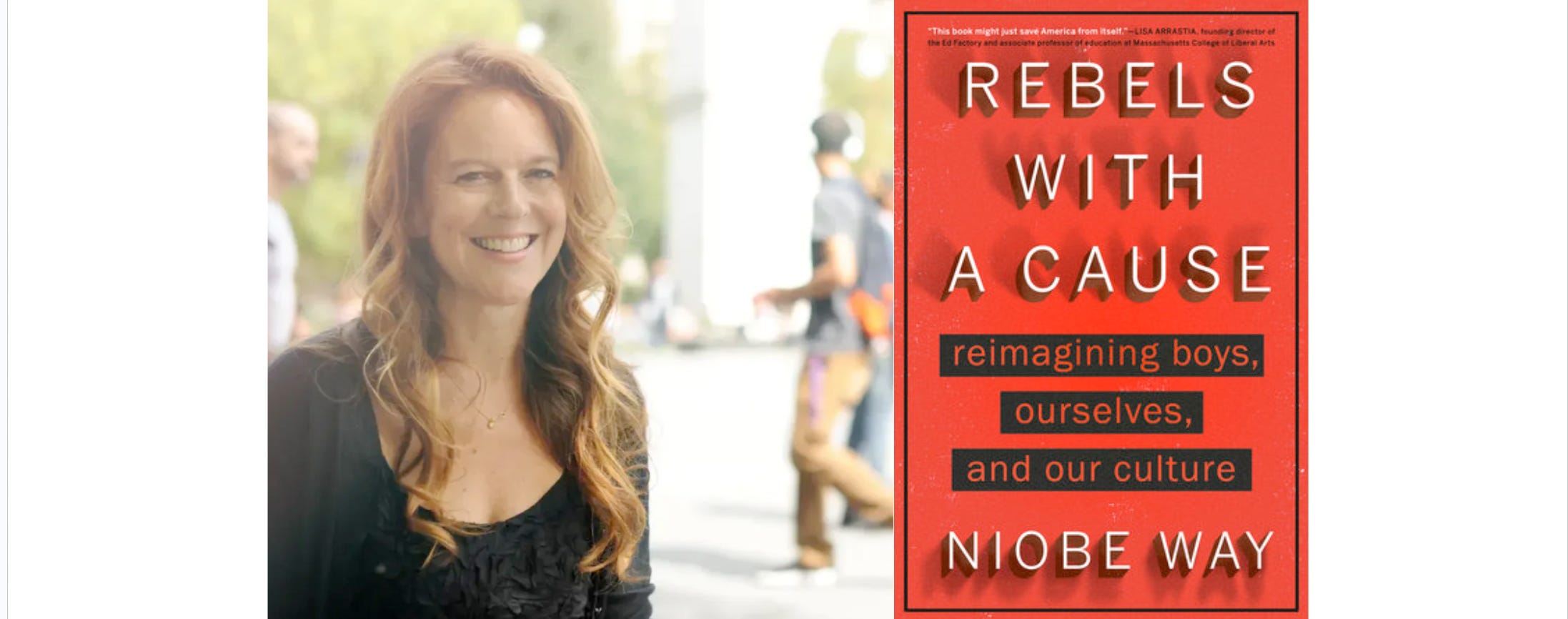
Dr. Niobe Way is a Professor of Developmental Psychology at NYU, the founder of the Project for the Advancement of Our Common Humanity, co-founder of agapi.teens, and the principal investigator on the Listening with Curiosity Project.
She is a leading researcher on adolescent development, with a particular focus on boys' social and emotional lives. Her groundbreaking books include "Deep Secrets: Boys' Friendships and the Crisis of Connection" (2011), which inspired the Oscar-nominated film "Close," “The Crisis of Connection: Roots, Consequences & Solutions,” and "Rebels with a Cause: Reimagining Boys, Ourselves, and Our Culture" (2024).
I start all of these conversations with the same question, which I borrowed from a friend of mine who helps people tell their stories. It's a beautiful question, which is why I use it, but it's pretty big, so I tend to over-explain it—like I'm doing right now. Before I ask it, I want you to know you're in total control and can answer however you want.
You're doing what a good interviewer does.
Nice. So, the question is: Where do you come from? Again, you’re in total control.
I love questions like that. It’s what I spend my life asking other people, but I rarely get asked myself. Where do I come from? Okay, I have lots of things to say, but I need to figure out how to tell the story.
I would say an important part of me is that I was born in Paris, France, to hippie parents. My parents had my older sister and me when they were teenagers. My mother came from a very fancy family in Greenwich, Connecticut, and my dad was from the wrong side of the tracks.
They got pregnant with my sister the first time they had sex, at seventeen. Then they escaped—he went to Oberlin College, she followed him with my sister, and then they traveled to Greece for a year, then Paris for a year, and that's where they had me.
They worked at an American diner in Paris. That’s how my life began—with parents who lived outside the box. My mother is a modern dance choreographer and runs ODC San Francisco, a world-renowned dance company. My dad was a classics professor who specialized in Eastern and Western traditions. He lived in China for ten years, and I lived with him there for part of the 1980s.
My life started in Paris. Then we moved to Oberlin, Ohio; then to New York; and then back to Oberlin. Oberlin is where I really feel my roots are.
If I had to sum it up. I wasn’t born in the U.S. I grew up with creative, unconventional parents. I came of age in Oberlin, Ohio, during the 1970s. It's important to say: I was born in 1963. That means my adolescence was very much shaped by the 1970s—a distinctive period. I don't know how old you are, Peter, but the 1970s were very particular. And then I went to college in the 1980s.
I noticed you used the word escape at least twice to describe your parents going to Paris. What were they escaping?
They were escaping very oppressive family situations, especially on my mother’s side.My grandfather was the vice president of Tampax Corporation. They came from a very wealthy, exclusive community in Greenwich, Connecticut—part of a country club that didn’t allow Black or Jewish members.
My mom married someone from a working- to middle-class background, which was scandalous to her family. When she got pregnant at 17, they wanted her to go to Mexico for an abortion. She refused.So, when she and my dad moved to Oberlin, she was essentially cut off from her family.
Oberlin College had never had a married couple with a child before. They didn’t know what to do with them, so they gave them a house because they couldn’t put them in a dorm. I’ve seen a photo of them: two teenage kids, standing in front of a house, holding a baby. It's so surreal.
They left Oberlin because it was too hard for my dad to be a student and raise a family at the same time. That’s when they decided to escape again, this time to Europe.My dad was studying the classics and felt this romantic pull to go live in Greece, the birthplace of so much of that tradition.
They tried to live "off the land"—though I think, in reality, it meant my mom was trying to make a living while my dad read a lot of books. They lived for a while on a Greek island called Skiathos, and when they couldn’t find enough work there, they moved to Paris and became managers of an American diner.
That’s how I came into the world: the child of two people who chose a life of creativity, defiance, and independence. And then my mom got pregnant with me. About a year after I was born, they moved back to New York because, you know, now they had two kids and they were just 20 years old.
So, they returned to Oberlin. My dad graduated, and my mom started dancing. Eventually, she became a professor of dance at Oberlin College—one of the first women faculty members there. I mean, there were a bunch of women, but still.
All of that is part of who I am. I was born in the sixties, and I definitely situate myself in that time—with hippie parents, always having a very global perspective. I come from multiple cultures. I’ve lived in China; I’ve lived all over the world. It definitely shapes how I do my work, how I think, how I take on the world, and how I see the world.
This is my biggest superpower, I would say. I love this phrase now—I used to hate it. My biggest superpower is that I am very good at what we call in developmental psychology theory of mind: I can take other people's perspectives very easily.
And the reason I think I can is because I’ve lived in different places, outside of my own culture. I’ve been an outsider many, many times in my life—not part of the mainstream at all, even in the American context, because my parents were serious hippies.
I mean, my mother wore mini skirts and all kinds of crazy stuff that embarrassed me. She was gorgeous—still is gorgeous—but it was hard having a mom wearing mini-mini hot skirts over in Ohio, you know what I mean?
I do. I mean, I love the idea of a serious hippie, number one. And number two: what about moving around, about being an outsider, develops theory of mind?
Oh, Peter, this is such a great interview. Thank you. It’s a gift for me to be interviewed in the way I try to interview other people. I would say that when you're an outsider—racially, ethnically, class-wise, culturally, in any way—it forces you to take the other person's perspective because you're out, right? You're in the minority.
And to me, what's interesting about women and people of color in this country—and men too, especially working-class men—is that when you're not at the top of the heap, you're forced to take other people's perspectives, whether you like it or not.
In fact, women have said this to me, and people of color too, across all ethnicities and races: You have to, because if you don't, you won't get your foot in the door. So you learn to take the other person's perspective literally as a way to survive.
Yeah.
Literally, to get into the house, you have to take another person's perspective. So you learn. I think that's partly why—I'm going to make a gross generalization, but I think it's true—people on the fringes of power tend to have better theory of mind.
Of course, there's variation among all groups. Some people might be a person of color or a woman and still not have great theory of mind. So I'm not generalizing completely.
But generally, I do think people on the margins are more likely to develop it, because when you're in the center of power, it's not demanded of you. You assume everyone will think like you—because why wouldn't they? It could also be a religious identity—Jewish, Muslim, Hindu. I'm not trying to limit it to non-religious differences; I'm just very American in that way. But being an outsider in any form helps develop that skill.And I do think it’s a positive skill.
I have to share a story because it was really interesting to me. In 2007, after getting divorced from my husband of 20 years, I wanted to do something adventurous. So I moved with my two young kids to Shan…