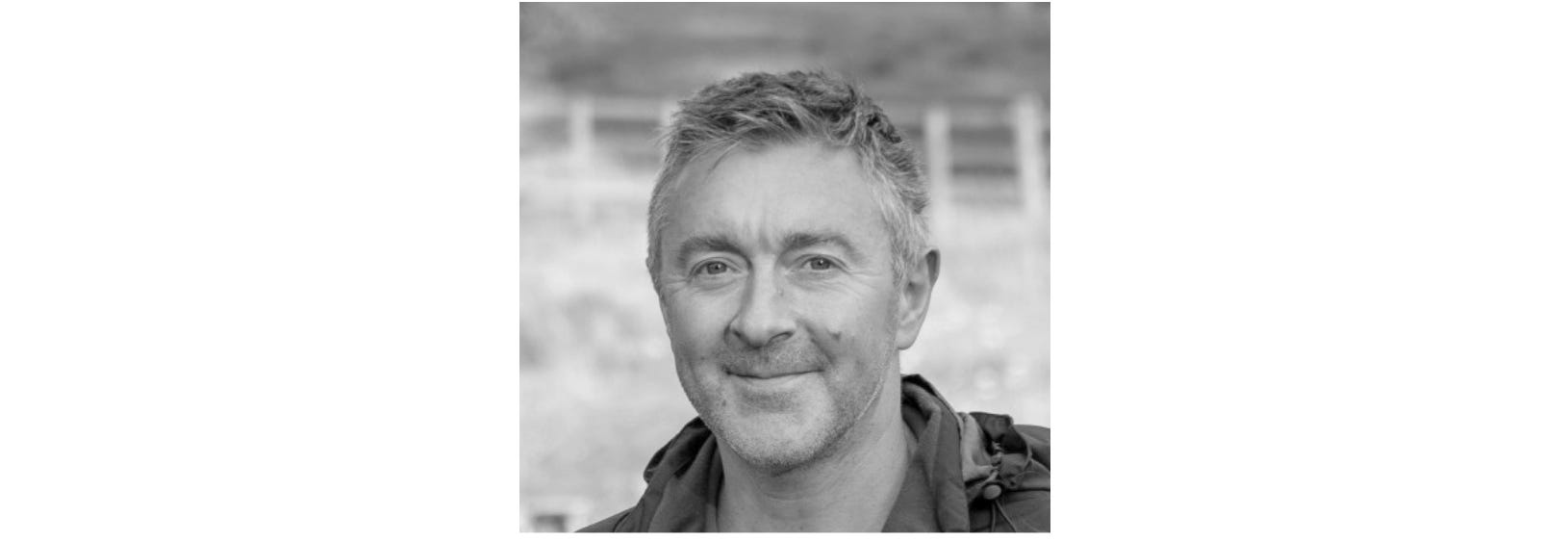
Phil Adams is a brand consultant based in Edinburgh, Scotland, practicing what he calls Lowfalutin Strategy. He has over 20 years experience as an account manager, planner, and managing director in the advertising business. He was Planning Director at digital agency Blonde, and then Managing Director at The Leith Agency. He has a wonderful newsletter here. I reached out to him because of this: “Mixtaping my metaphors.”
---
Beautiful. So, Phil, thank you for coming and being a part of this with me. I start all of these conversations with the same question, which I tend to overexplain. I borrowed it from a friend of mine, who’s an oral historian. She helps people tell their stories. It’s a big, beautiful question, but because it’s so big, you can answer it any way you want. The question is, where do you come from?
Yes, well, thank you for that. Forewarned is forearmed, because I knew it was coming, so I had a chance to think about this. Rather than giving you a standard personal life story, I think the best answer is that I come from two places: one called mischief and the other one called creativity. Looking back now, with hindsight, I think those are the places I came from.
Tell me a little bit about mischief.
Okay, well, something that stuck with me from an early age, and I try to stay true to this, is what my maternal grandfather once said: "The thing about Phil is he always has a twinkle in his eye." He meant that I’m always on the lookout for fun and mischief. I’ve never forgotten him saying that, and I try to live by that ethos—having a twinkle in my eye. I think that’s probably why, despite studying engineering at university, I made a sudden turn into advertising. It suited me more as an environment—a sparky, fun environment. That was the idea. I didn’t know much about it going in, but it turned out to be exactly that.
So was creativity the other place you came from?
Yeah, again with hindsight. Looking back on my childhood, there was a lot of creative mischief. For example, I used to play with Scalextric racing cars. I stripped the wires from the transformer and used it to run science experiments, like copper plating things. My mum freaked out once when she found out I was running experiments, like putting a lit candle in my cupboard and timing how long it would take to burn all the oxygen and go out. So, with hindsight, a lot of my play was mischievous but also quite creative.
Did you ever have an idea of what you wanted to be when you grew up?
Not really, no. It was all quite predictable, I think. I was a pretty good student across most subjects, with a slight bias toward the sciences. My dad’s a scientist, so with his encouragement, I narrowed down my subjects to maths, physics, and chemistry at 16. Not surprisingly, I ended up in an engineering degree, but not with any strong vocational drive to be an engineer. I’ve always liked understanding how things work, and that’s served me well in advertising as well. But I didn’t have a vocational drive until university, when I suddenly decided that advertising was what I wanted to do. That was at age 21.
What happened at 21?
I was in the changing rooms after a soccer game, and one of my teammates, who was studying chemistry or geology, decided he wanted to be an advertising copywriter. He was putting together a portfolio of ideas to show, and it looked really interesting. I’d always had a fascination with ads—my sister and I used to play a game where we’d guess the brand behind the ad quickest. So when I saw his book and Campaign magazine, it all looked really glamorous, and something about it appealed to me. I decided I wanted to go into advertising, not as a copywriter, but just in the industry. I had to re-engineer my CV, managed to get on a Procter and Gamble marketing course during an Easter holiday, and then worked for nothing in a small agency over the summer. By the time of my final year at university, I could demonstrate some enthusiasm for advertising. I applied to all the top agencies in London, got maybe five first interviews, and one job offer, which happened to be at BBH. So I landed on my feet, and my football teammate went on to a glittering career as a creative, including being executive creative director at BBH in the end as well.
Oh, wow. Were you together at BBH?
No, he was there after I was.
And where are you now? What’s the work you’re doing now?
OK, so I worked in advertising for about 18 years. I went through account management, account director, head of client services, and ended up as the managing director of an agency. In 2006-2007, I helped co-found our sister digital agency. I liked the guy we’d hired to run it so much that I jumped ship and joined the digital agency, effectively recruiting my own boss and reinventing myself as a strategy person. Most digital agencies then were run by technical people, so it was quite unusual to have a brand person in a digital agency. I did strategy in a digital agency until 2020, then jumped ship again to go freelance as an independent brand strategy consultant. Now, I work mostly with B2B and service organizations.
What do you love about the work? Where’s the joy in it for you?
The joy in the work is that it’s both an intellectual and a creative discipline. You kind of jump from one to the other, almost seamlessly, when you’re working on a problem. That suits me. The work I do now involves that constant combination of logical and creative thinking, one informing the other. That’s the joy that sustains my interest. People keep asking me, "When are you going to retire?" I have no desire to retire because I’m enjoying the work. Working for myself now, I can pick and choose who I work with, so I keep the joy of the work and lose some of the negatives that come with working in an agency. It’s great. And actually, the joy also comes from the fact that I feel I’m doing the best work of my career now, at age 58—work I couldn’t have done even when I was 50. I don’t want to sound overconfident, but I do think there’s been a blossoming in my late career. There’s joy in that as well.
Yeah, and how do you mean? In what way are you doing things that you couldn’t have done before?
I think it’s a new level of confidence. Not overconfidence—I hope I approach my work with humility—but I feel comfortable having conversations with founders and CEOs, having the confidence to price according to my ability, and to decline pitches where I’d have to give away intellectual property for nothing. I’ve either learned these things in the last five years or just reached an age where I’ve had to. I feel quite different from how I felt even five or six years ago.
The name of your company is fantastic, and it feels like it has a "lowfalutin" strategy. Is that right?
Yeah, that’s not the name of the company. It took me four and a half years of consultancy work to finally figure out who I am as a consultant and what my style is. I think I’m good at keeping things simple, pragmatic, and unpretentious. "Lowfalutin" was just an idea I had to describe that style, rather than being another consultant who talks about pragmatic solutions. It’s a slightly pretentious way of saying unpretentious, and I like it for that. It’s not the name of the company, but I did trademark it as my signature style. It’s wonderful. It’s a good filter because you have to know what "highfalutin" means to get it. And I guess I don’t want to work with people who don’t know what "highfalutin" is.
Well, I don’t know when I signed up for your newsletter or when I started seeing your stuff on LinkedIn, but you had this amazing post you called a "mixtape of metaphor." You really went deep and gathered all of these beautiful nuggets about metaphor into one post. That’s what inspired me to reach out and invite you here. So, talk to me about metaphor. Why create a mixtape of metaphor, and what’s the role of metaphor in your work?
Well, I’ve been collecting them for quite a while. I don’t know why I’m interested, but I do a lo…