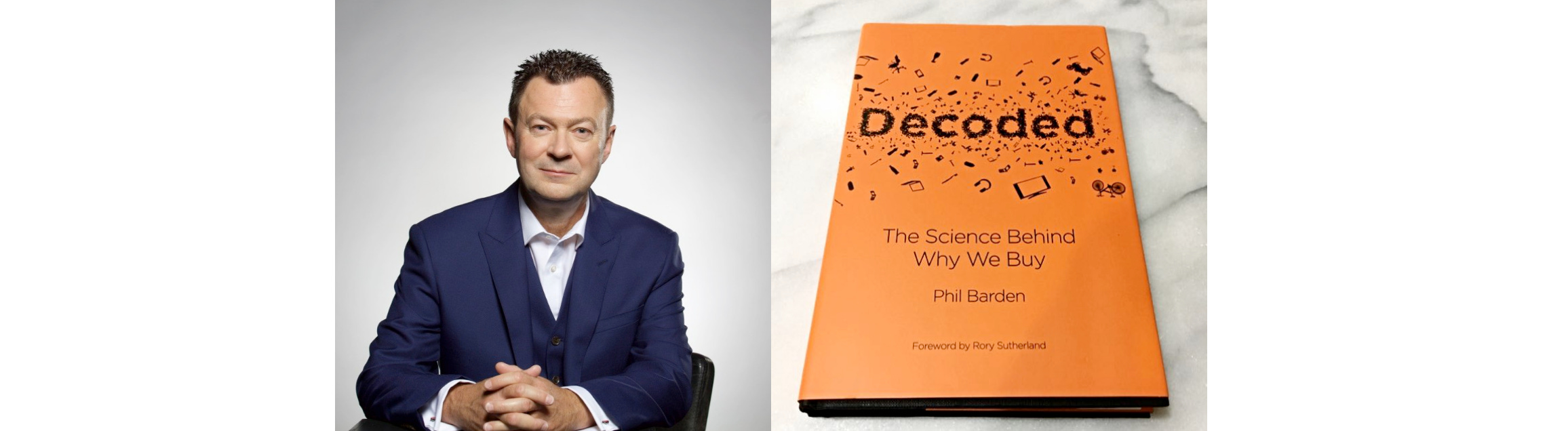
Phil Barden is the Managing Director of DECODE and the author of “Decoded: The Science Behind Why We Buy” which is a classic text about the behavioral science of marketing. Before going out on his own, he held leadership roles at T-Mobile, First Choice Holidays, Diageo and Unilever. As his profile says, “25 years client-side marketing + 10 years decision science = ‘Decoded.”
Okey-dokey. All right. Well, Phil, again, I really appreciate you accepting my invitation to come on here and talk to me. I'm not sure if you know this, but I start all of my conversations and even my interviews at work, actually, with a question that I borrowed from a friend of mine. She's an oral historian, and she helps people tell their stories. And she's got this beautiful question that I stole because it's really big and beautiful.
But because it's so big and beautiful, I kind of over-explain it. So before I ask it, I want you to know that you're in total control, and you can answer or not answer any way that you want to. And the question is: where do you come from?
Oh, wow. This sounds like I'm on a therapist’s couch. Where do I come from? You mean sort of literally or metaphorically?
However you want to take it.
OK. OK. So, where do I come from? The origin story. Very, very interesting. So, literally, I'm from the UK, born and brought up in the south of England. My parents were both teachers, and my mother exposed me to creativity. She was a music teacher, and I think that probably stood me in good stead for wanting to get into marketing. My father was a science teacher, which is where my worlds have collided in my most recent career. So I think that's probably where I come from.
Yeah, that's quite remarkable to have the science and the creativity. Can you tell me a story about the creativity? I listened to another interview where you talked about the role of creativity growing up. What was it like?
Hmm. Yeah, well, my mother insisted that all her children learn a musical instrument, and she exposed us to many various types and genres of music. She had a very eclectic taste, which I think is admirable because we were brought up not only with classical music, opera, and ballet, but also musical theatre, pop, and rock bands.
She was a huge Queen fan, for example. So she would listen to the entire album of *A Night at the Opera*, and then right after that, she'd put on the *Peer Gynt Suite* or some Rachmaninoff or something. So we were all taken from quite an early age to operas, to ballet, to the Proms, classical music performances, and also musical theatre.
So, Gilbert and Sullivan, a sort of light opera, and then into rock opera even. She loved Andrew Lloyd Webber's work—*Jesus Christ Superstar* and *Joseph and the Amazing Technicolor Dreamcoat*. She was the musical director for all the musical productions at her school.
And I grew up learning the flute, my brother learned the violin, and my sister learned the piano. So we all were instilled with a love of music from an early age. And I think that exposure to the arts in general, because I then joined a youth theatre group as well, and school friends who participated in that—we played in a band together.
So we were always into the creative side of making music. And one of the guys from school, who I'm still friends with, said, when we were at school, "I'm going to go into advertising," because he and I used to write stuff for a school magazine and sketches for a school revue show and things like that. So the creative process really appealed to me.
And when I first learned about marketing, and that was through the husband of a babysitter actually, who worked for a marketing company, I had no idea what it was. But when I learned that it meant that he got involved in creating advertisements and packaging designs and promotional materials, I thought, "This sounds amazing," because it was very tangible. And I liked the idea of creating something tangible, but it also spoke to that creativity, that spark and inventiveness that I found so exciting.
Yeah. And did you—I mean, how old were you when you discovered advertising? Was that—were you that young when the idea of working in advertising arrived?
Yeah, at school, teenage years. So this friend and I used to buy *Campaign* magazine and devour it and learn about all the greats of the advertising world, not just in London but worldwide, and the big agencies. He also had a friend of a friend who was a copywriter.
So we got to hang out with him a bit, and it seemed like a very glamorous lifestyle. So when I did my degree course, it was what was called a "thin sandwich" course. You spent six months at college and then six months working to get practical experience.
And you had to be sponsored by a business to do this course. So I got sponsored by a company called United Biscuits, which is now Pladis, a global company. And my placements with them included manufacturing and then the sales force.
And then the last placement was in the marketing department. And for me, this was like a dream come true. Because I'd heard about all this stuff, I'd been on the periphery of it.
But then to be in a marketing department, and actively involved in doing some of this stuff, talking about packaging and promotions and pricing and product changes and innovation—that was wonderful. So I knew that really cemented for me that I wanted a career in marketing.
Yeah. When did you first encounter the idea of the brand or the concept of the brand as an asset, or something to be managed or built or created?
I think it was after that placement when I joined Unilever. And I think it was the schooling and upbringing that I got there—that brands are the lifeblood of a business, that they create current and future revenues. And it was always this idea of brands having an intangible nature. A brand was a feeling, a brand was something in your head.
It was more than just the physical product and what it did, and the way it performed. It had some other essence to it that was always quite mysterious, but very exciting and intoxicating. So I think it was—I mean, obviously, we're all exposed to brands as we grow up, right, and adverts, etc., etc.
And, you know, kids from quite an early age become brand-conscious and brand-aware and very quickly decide that some clothing brands are cool and others aren't. And they wouldn't be seen dead in certain clothes, you know, from quite an early age, which is interesting. But then actually working with brands and having to make decisions that were not just in isolation, like, if we change the price of this, there's a financial calculation.
But over and above that, what does that do to the perception of the brand? Or if we change the packaging design or the materials used in packaging, we change the feel of it, the texture of it, what does that say? What meaning does that give?
So the idea that the brand was not just the physical components, but there was something else around it, this intangible equity, was something that was certainly cemented during my industrial placements.
Yeah. And you spent a long time managing brands, right? I mean, at high levels before, excuse me, the sort of the arrival of—you use the phrase "decision science." So I'm wondering, when did you first encounter decision science? And what did that do? How did that change the way that you operated?
Yeah, I guess that's the question.
Yeah. Well, I spent over 16 years at Unilever. And then I went to Diageo, which was also a real brand-centric company. And then I moved to T-Mobile. So I was invited by a former Unilever colleague. And it was a very exciting invitation because he said to me, "Listen, you and I know that businesses have to be based on consumer demand.
And we have brands that are running through our veins. We take them for granted. But I've joined a business which is technology-led, it's supply-led. And the role of marketing is very different."
It's about sort of chucking stuff out there and seeing what sticks. But the problem…