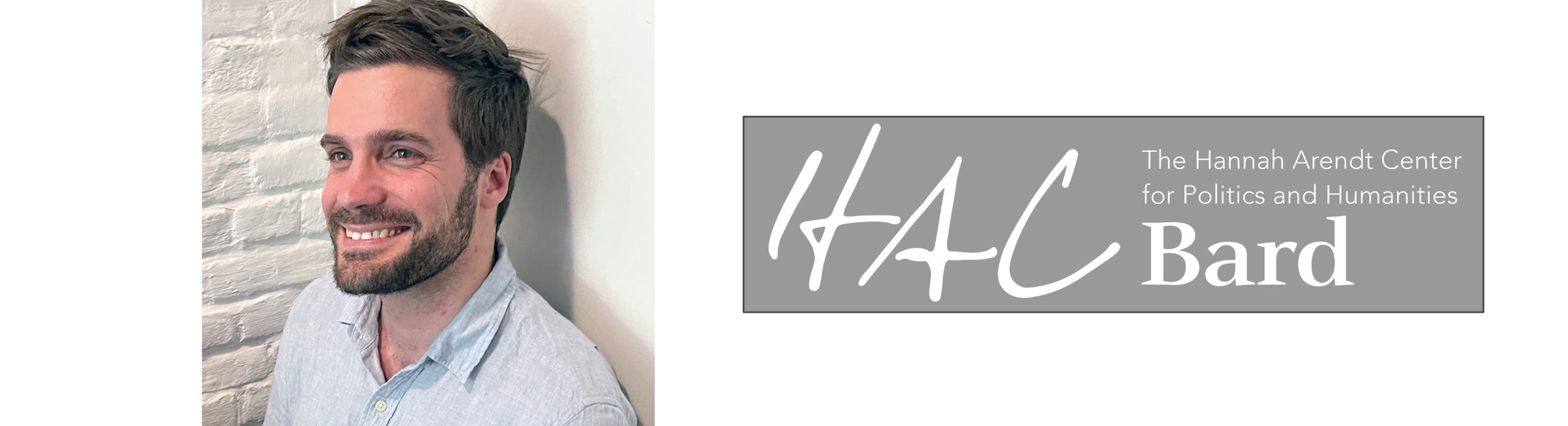
Philip Lindsay is the Democracy Innovations Program Manager at the Hannah Arendt Center for Politics and Humanities at Bard College. At the Hannah Arendt Center, Lindsay leads the Democracy Innovation Hub, where he conducts workshops for public servants and educators. He has been involved in initiatives like citizens’ assemblies, which aim to foster collaborative democracy by involving everyday people in governance through random selection and deliberation.
RESOURCES & LINKS MENTIONED:
More in CommonA non partisan research groups studying drivers of polarization, and producing reports that build social cohesion.
Braver AngelsAn organization that brings conservatives and liberals together for structured conversations.
Ground News A news service that shows how left, center, and right media cover different stories.
Alright, here we are. Philip, thank you so much for accepting my invitation. So I don't really know this, but I start all of these conversations with the same question, which I borrowed from a friend of mine. She teaches oral history down the street. And I stole it because it's a beautiful question, but it's really big, so I over explain it. So before I ask it, I want you to know that you're in total control, and you can answer or not answer any way that you want to. And the question is, where do you come from?
That feels like a very easy question to me. It's where I'm currently visiting - 10th and Carpenter in Philadelphia. I grew up in what I think is one of the most dynamic, rich neighborhoods in Philadelphia and in the United States. And I mean, rich in the sense of not monetarily, though it's not a poor neighborhood. The Italians in South Philly called it the longest living or still open-air market in the country. So you can still go six days a week. And most of the day, people are selling fruits and veggies and all kinds of foods outside under, you know, awnings. You've seen Rocky, it's where he's running through the time market and the barrels are on fire.
So I grew up a block away from that. And there's just a rich history, both connected to the market and various waves of immigration. And we're 15 blocks south of Independence Hall where the Constitution was written. And that's where I grew up. And it's a dense urban area that you can, you know, is a colonial America where you can walk anywhere. And that's where I grew up. And that influenced the social and political and economic dynamics of this neighborhood has greatly shaped me and exposed me to all kinds of things.
What does it mean to be from Philly when you're out in the world? Or what does it mean to you?
I think those connotations, like anything, it's, you know, one defines that word, the city, but the connotations of Philly are usually that it's working class and a little more humble. You know, it's always a comparison to a place like New York. But, you know, Philly usually doesn't, you don't think of glitzy, you don't think of, it's a little more rough around the edges.
And, but yeah, what does it mean to be from Philly? I don't think in general there's any defined meaning, but for me it's relating to the market, honestly. The market is that much of an influence and just a place of dynamism in exchange. Obviously, there's the history of American democracy that can be traced back to Philly.
And I would say, you know, I would say a few things. There's a Quaker tradition that I was exposed at an early age that's part of the state's history. You know, it's, of course, a majority black city and a big sports city.
But I mean, one thing that I always find interesting I tell people about Philly is that the city was losing population. I mean, this is true for many industrial centers in the United States, but after World War Two, every census showed population decline. So Philly still has less people than it did in 1950.
There were over two million people at that time. And now it's been creeping back up since the 2010 census. That was the first census since World War Two when the population actually increased. And it's still 1.6 something, I believe. So you've got a ton of housing stock, which means you have a ton of space. You've got a lot of community gardens. They get lots. You've just got more space. And that has kept prices down.
Again, a little more rough around the edges. But it's allowed for, you know, you still have a thriving art and cultural community that can afford to live here and experiment and do fun, do interesting community oriented stuff.
Do you have a memory of what you wanted to be as a kid, like what you wanted to be when you grew up?
Yes, I was obsessed with baseball until I was like 12 years old and absolutely just wanted to play major league baseball. I also wanted to own my own pizza place. Again, I kind of owed to the market, like the local pizza place that I would go to. And I remember telling my sister, like, I'm going to own a pizza place. And she just looked at me and she was like, you're better than that. Like she was so elitist about it. She was so elitist about it. But that's, yeah, pizza and baseball, essentially.
What was the magic of the market? What's the story?
Oh, you've got to come down and see it. It's still magic. It's it's and it's become more dynamic. I mean, you have it originates, you know, I'm not an expert on the history of the market, but you've got in the late 1800s, you've got the Italian population, you've got a Jewish population. I think you've got an Albanian population.
You've got a kind of maybe not Albanian. You've got a mixture of all immigrants, but it's more dominated. It wasn't always Italian. It's called the Italian market. It used to be called the Italian market. It was never always Italian, but it was a predominantly Italian neighborhood.
And so it was an open market modeled on, I guess, what was what was the old, you know, the 18th, 19th century open air markets. And, you know, just the efficiency of getting all the food to one place and having folks come to one place like before we had supermarkets, XYZ.
And, you know, this is like three story buildings down one long street, nine street.
So, I mean, it started off mostly Italian. And then of course, the 20th century has had successive waves of different immigrants who tend to bring their foodways, the Vietnamese, the Mexican, the Central Americans who have reinvigorated the market with their fresh culinary traditions, their small businesses, you know, their entrepreneurial spirit. And you've got that.
And then you've got the fact that it's just a place where people outside in the open talking to each other, bumping into each other. Even in the winter, they have a big fire, the big barrels that keep the outdoor market warm with these big barrels, metal barrels that they fill with wood. And so, I mean, it's just intimate and special and cozy and rough and in.
Yeah, if you watch, there's a hilarious Always Sunny and Philly episode where they go to Italian markets to barter. And that's a that's a. Yeah. So it's just dense and alive. You know, it's not no screens, no, you know, no electronics. So you're outside and asking people how much stuff costs. And it's still like that. So it's special.
Tell me a little bit about - I know you're visiting you’re back home for the holidays. But tell me a little bit about your work or what you're up to, where you're working and what your role is.
So I work at the Hannah Arendt Center for Politics and Humanities at Bard College. And my role for the past several years has been both on the communication side of the center, helping with our annual conferences that we put on that people should check out that are about different political and social themes every year. Always bring a mixture of interesting journalists and local activists and international experts and authors and poets there.
And that's open to the public. But since I started the Arendt Center, I've really been passionate about Citizens Assemblies, which is how I first heard about the Arendt Cente…