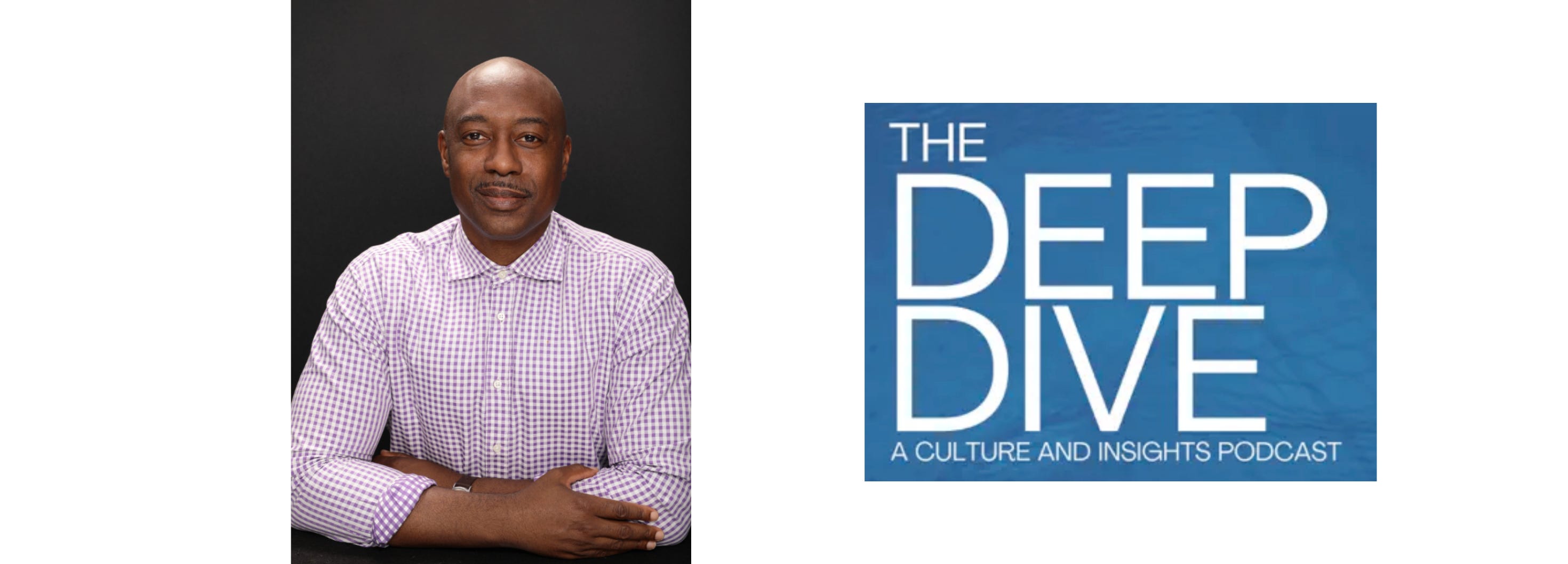
Philip McKenzie is a cultural anthropologist and strategist who founded InfluencerCon and hosts The Deep Dive podcast. A former Goldman Sachs trader, he has served as Chief Strategy Officer at MediaVillage, advises global organizations, and teaches at Hyper Island.
I think you know this already, but I start all these conversations with the same question. I actually borrowed it from a friend of mine who lives in Hudson. She uses it to help people tell their stories, and I love it so much because it’s such a big question. And because it’s so big, I tend to over-explain it before I even ask. So I want you to know you’re in complete control—answer however you want, or not at all. I just really love the question. And the question is, where do you come from? Again, you’re in absolute control.
Absolutely. Thank you for that. I think it’s a great question.
Where I’m from is Brooklyn. I talk about Brooklyn all the time, and I always very specifically introduce myself as being from Brooklyn—which I think is distinct from saying I’m from New York.
I’m a proud New Yorker, and I understand Brooklyn is part of New York, but anyone who’s a native New Yorker understands the specificity of the borough you’re from. Growing up, being from Brooklyn meant a lot. It shaped everything about who I am.
My parents are from the Caribbean—my mom’s from Barbados, and my dad’s from Guyana. I’m the only one in my family born in New York—born in Brooklyn. And Brooklyn has the largest Caribbean and West Indian population outside of the West Indies. All the islands are represented: Barbados, Jamaica, Guyana, Trinidad, Haiti—you name it.
That microcosm of being in New York, but specifically being in Brooklyn, feels very different from being in other parts of the city. So, long-winded answer, but: I’m from Brooklyn.
Beautiful. What part of Brooklyn were you from, and what was it like? Maybe tell me more—what does it mean to you to be from Brooklyn?
Oh man, it means everything. I grew up in Brownsville, then moved to East Flatbush. I grew up in New York in the ‘70s and ‘80s—I graduated from high school in 1990, which I kind of use as a clear demarcation point. That was actually the year with the highest murder rate in New York City’s history. Crime has been declining ever since—current narratives in the media aside. If you only watched the news, you’d think New York was the Badlands, but it’s definitely not.
Growing up in the ‘70s and ‘80s was just different. It was the New York people tend to mythologize, which, culturally, was very important to me—even when I didn’t realize it at the time. I remember Reggie Jackson, the Yankees winning in ’77 and ’78, the blackout... all of that.
I remember riots and looting in our neighborhood during the blackout in ’77. Those kinds of moments were just part of the world we grew up in. I joke with friends that graffiti was everywhere. The trains were covered in it. Back then, it was considered a crime. Now it’s a marker of gentrification—luxury condos feature graffiti murals to make them feel “authentic.”
It’s wild how those things come full circle. That’s part of the Brooklyn identity for me—watching culture shift. One era’s criminality becomes another era’s marketing aesthetic.
Yeah. That’s amazing. I mean, I remember all that too. We’re the same age—I graduated in 1990, but I was in the suburbs in Western New York.
OK, yeah.
But I definitely remember Reggie Jackson.
The straw that stirred the drink.
Do you remember what you wanted to be when you grew up? Do you have a sense of what young Philip imagined for himself?
Yeah, I think I went through a bunch of different phases—wanting to be different things without really knowing what it took to become any of them.
My parents got me a telescope pretty early—I must’ve been eight or nine. I don’t think I was ten yet. Cosmos was on PBS—the Carl Sagan documentary—and it just blew my mind. I didn’t understand all of it, but what I did understand was like, wow: space. The stars. That kind of wonder.
So in my mind, I was going to be an astronomer. But that faded as I got older.
I think I always had a curiosity, a desire to discover things. I used to go to work with my dad—he was a zoning consultant in the city. At the time, they were called expeditors, but zoning consultant is another term. New York City’s building code is a labyrinth, so architects and engineers would hire people like my dad to help them navigate their projects.
Each borough has its own Department of Buildings, and in the summers I’d go with him across the city. That’s when I first saw Manhattan during the day, saw people going to work. That made a huge impression on me.
My first thought was, “I want to be in business.” I didn’t know what that meant—I just knew I wanted to be a part of that world. My dad would be running around and I’d hang out at Barnes & Noble or Borders—back when Borders still existed. I’d get lost in the bookstores, reading, exploring.
But the thing that stuck with me was seeing people in suits, carrying briefcases. That, to me, was business. And I knew I wanted to be in those canyons of buildings, in and around Wall Street. And eventually, I did all that.
But I think the seed was planted back then—being in that environment, seeing those faces, and associating it all with success.
And that was Manhattan—you’re talking about the experience of Manhattan.
Yeah, exactly. Because the Department of Buildings used to be in the old municipal building. For those who might be familiar with New York City, the municipal building sits right off the Brooklyn Bridge. It’s this big, kind of Art Deco-looking building—like One New York Plaza.
The city, the police department is right behind it. You’ve got the court building nearby. But the municipal building is a big government building. It was probably more fully occupied back then than it is now, because, you know, things have changed.
Back in those days, the Department of Buildings was on the 20th floor. I used to spend a lot of time in that building.
Then there were all the bookstores I mentioned earlier, along Broadway. A bunch of other stores too—like Trinity Church used to have a bookstore. There were all these little outlets that had magazines, books—places I would just wander around. We lived in a different society then, where a 10-year-old could roam the streets of New York alone.
Right? And no one thought anything of it. Today, that parent would probably be arrested. But in the latchkey era? It was different.
I love that conflation of business and a bookstore. I am in the world of business. And the experience of being in the world of business... was a bookstore. That sounds amazing.
Yeah, yeah. Because walking to those bookstores was where I saw people doing things. Even the shoeshine guys—they always had magazines and stuff. That was a popular thing back then. If you watch an old movie from the ‘70s or ‘80s, you’d see someone getting their shoes shined on the street. I just attributed all of that to what, in my mind, was “business.”
Awesome. So, catch us up—where are you now, and what are you doing in the world of business? If you’re still in that world, how do you talk about what you’re up to?
Yeah, I’m definitely in the world of business. Officially, I’m a cultural anthropologist and strategist, and I’ve had my own consulting practice now for what feels like forever.
I kind of reject the term “futurist” because I just don’t like the word. But basically, I help organizations understand culture. It’s more than just trying to be predictive—it’s a practice rooted in rigor around foresight and applying that within a broader cultural context.
I use that to help organizations better understand their place in the world—not just to avoid pitfalls, but to identify potential opportunities. I’m happy with the work because it allows me to engage with a wide range of organizations. I always say I’m industry-agnostic—it doesn’t really matter what the business is, because it usually comes down to people.
There are some th…