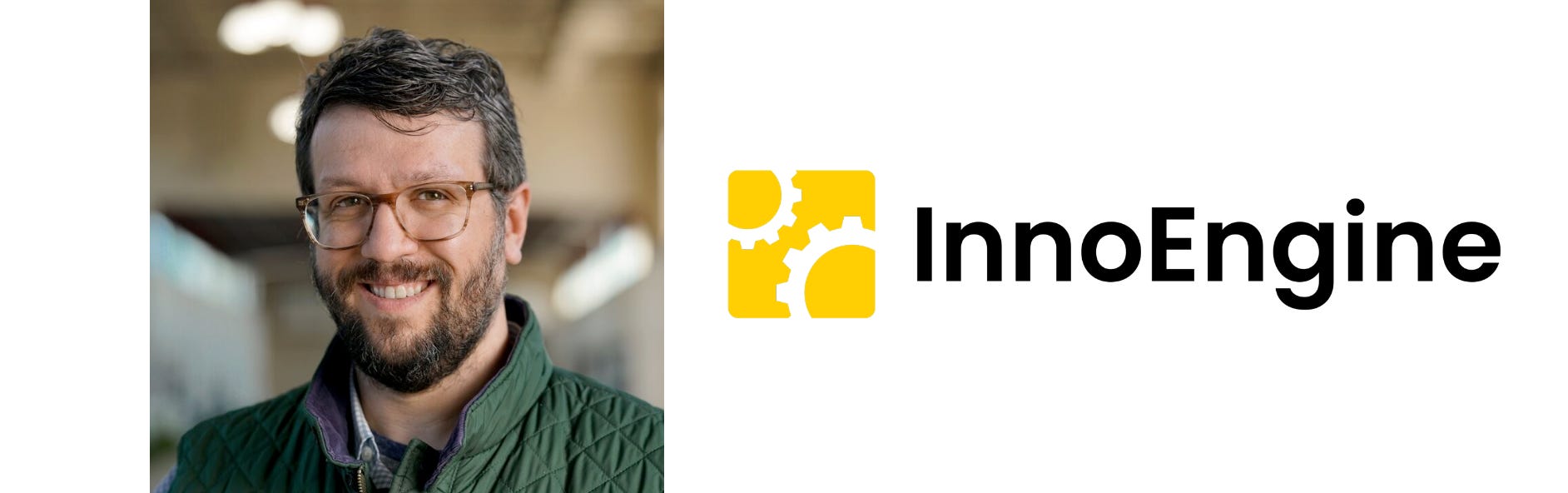
Sam Ford is a founding partner of InnoEngine, an innovation strategy firm based in Bowling Green, Kentucky. He serves as Fractional Chief Partnership Officer for the Metals Innovation Initiative, a nonprofit supporting Kentucky's metals industry, and as Innovation and Culture Fellow at Western Kentucky University's Innovation Campus. He sits on the boards of Canopy and Employward through AccelerateKY. He previously co-authored Spreadable Media and holds an MS from MIT. He lives in Bowling Green.
“Polarization Doesn’t Have to be a Self-Fulfilling Prophecy” Joe Karaganis & Sam Ford, and The Civic Imagination Project at USC.
I don’t know if you know this, but I start every conversation with the same question. I borrowed it from a friend who helps people tell their story. I overexplain it because it’s so big and beautiful. But before I ask it, I want you to know you’re in total control—you can answer or not answer in any way you want. The question is: Where do you come from?
Well, I come from what’s called the Western Kentucky coal fields—not the Appalachian side of my native state. It’s a coal mining and tobacco farming region. My family has a multi-generational background in those industries.
My Papaw CW worked at the coal-fired power plant in Paradise, Kentucky, which was made famous by a John Prine song. On my dad’s side, my grandparents had 15 kids in 16 years. I’m a first-generation college student and an only child. My dad switched industries and worked in manufacturing. None of those were industries I wanted to go into.
But on my mom’s side, my grandmother was a volunteer writer for the local newspaper in a small town of about 400 people. She was the community contributor for “News and Outposts from McHenry, Kentucky.” Her name was Beulah Hillard—everyone called her Memaw Beulah—and she managed that section of the paper.
This was pre-social media. So if you wanted to know who’d been on vacation, who was sick, or who had a birthday, you went to the weekly county paper and found the section about your neck of the woods. These community contributors curated that news.
I took that over when I was in middle school. There were a lot of 60- and 70-year-old women... and me, one middle school boy. But that helped me realize newspapers loved free content. By high school, I had written a serialized private investigator story with a friend. It probably added up to a novel’s worth by the end.
I also started a pro-wrestling news and rumors column. That’s what took me to journalism school. As a first-generation college student, I thought, “I’m doing this for free, but newspapers pay people to write. Maybe I can do that.”
I went to Western Kentucky University, about 45 minutes north of Nashville in Bowling Green. My wife and I moved here as college students—we got married in high school—and I worked my way through college at various newspapers.
And you’re still in Bowling Green now?
In Bowling Green. I’ve spent time outside of it—lived in Boston for a few years, then split time between New York City and Bowling Green ever since. Work takes me to New York, but when it doesn’t, we’re here. It’s a fast-growing area and an interesting place to be.
Can you tell me more about growing up where you did? What was your childhood like?
Oh, I loved my childhood. I was an only child, and most of my neighbors were older, so I spent a lot of time with my imagination. Being a kid of the 1980s, pop culture provided plenty of material. I collected G.I. Joe figures, and they had character dossiers on the back. That got me into what I later called “immersive story worlds”—narratives so large they’re bigger than any single story, with no sole creator behind them.
Pro wrestling fascinated me too—this fictional world layered on top of our real one, with shifting characters and leagues. It was a messy narrative world. My master’s thesis ended up being on daytime soap operas. I got really interested in fictional towns with dozens of characters. By the ’80s and ’90s, some shows had been on for decades. Characters would be referenced but not seen, or return after years, and you’d have to find an older fan to explain it all.
There was also the story world of my real community. My dad was a deacon at Minnebaptist Church. We went to the funeral home every week, it seemed—didn’t matter who it was, we knew someone in the family. And curating the community news helped me see how stories were unfolding all around me, not just in fiction.
I was certainly interested in writing and storytelling. Narrative was the key. When I became fascinated with these story worlds, I imagined there must be teams of people who write and plan them—maybe that could be my job. That was more on the dreaming side.
Journalism was more about tackling the real world and telling the stories of people, characters, happenings. That’s what took me down the journalism path—especially after getting married and needing to be practical. A fiction writer’s room job from rural Kentucky felt out of reach. But a job at a newspaper seemed tangible. I’d already worked at a few. It felt more real.
Of course, I ended up not doing either one of those things. But that was the path I was on when I headed to college.
I’m back in Bowling Green, Kentucky—Kentucky’s third-largest city. It’s a college town that’s grown fast over the past several decades. Advanced manufacturing, automotive, food and beverage—being located along I-65, one of the key corridors in the manufacturing supply chain—has brought a lot of growth.
It’s also close to Nashville, just 45 minutes north. And when a city like Nashville starts booming like it has—attracting talent, investment—that ripple effect helps neighboring cities grow too.
In 2024, I co-founded a company called InnoEngine with two partners. We publicly launched in early 2025, so last year was our first full year. We help organizations design and implement innovation projects—especially when they’re trying to do something they’ve never done before, or in a way they’ve never done it.
How has it been going - a year in?
It’s been going well enough to keep going. When you’re positioning yourself in a way that intentionally doesn’t duplicate an existing market sector, it’s always a bit of a challenge. We don’t consider ourselves a consulting firm. One of our unofficial taglines is: “If you know exactly what you need, it won’t be us.”
If you’ve already figured it out and just need someone to execute, there’s probably a firm that does that better. We’re interested in the messy area—when you know you need to act but don’t know exactly what to do yet. We want to be your partner from figuring it out to implementing it.
We work with everything from early-stage startups to large multinational organizations. Also, public and nonprofit sectors. Even multi-organizational projects.
A simple example: we’re working with several tech startups right now. One is integrating tech systems into their operations for the first time, trying to do it in a way that maximizes value. Another has proven the value of their product and is moving to market—but in several sectors with different sales cycles and value propositions. So we’re helping them think through positioning and strategy for each segment.
Another client is a long-established tech company that’s bootstrapped its growth and become a formidable player, but they’ve never raised money. So they don’t have the same public profile, thought leadership presence, or traditional growth milestones. They’re asking: how do we build visibility that matches the heft we already have?
On the more complex side, we’re working with multinational companies rolling out products across several countries. Lots of moving parts. Lots of help needed in the middle.
Then there are multi-organizational projects, which tie into civic engagement work.
One example: we’ve worked closely with a group at MIT Sloan School of Management called the Regional Entrepreneurship Acceleration Program, or MIT REAP. They’ve studied what makes an innovation ecosystem thrive—what preconditions need to exist for growth to take off, and what steps regions often take to realize their potential.
About a decade ago, while working on some pilots with MIT—my grad school alma mater—I got involved. MIT was thinking about the future of work, AI, automation. This was back in 2016–2017, before it was as widely discussed as it is now.
We built a team across Kentucky and became the first U.S. mainland region to get into the MIT REAP program. It’s a two-year accelerator for regions that have some growth and alignment, but want to go further. One core idea is you must have stakeholders from across government, corporations, entrepreneurs, capital, and higher education all at the table—with shared interests and goals.
We fielded that Kentucky team in 2018. I helped put the team together. They graduated from REAP in 2020 and formed a nonprofit called Accelerate Kentucky, focused on strengthening the region’s innovation ecosystem.
One big opportunity: Kentucky is at the center of the U.S. metals supply chain—aluminum, steel, copper. Automotive and food manufacturing activity has shifted south over time, while the Midwest remains strong. Kentucky sits at that intersection.
There’s been growing national interest in reshoring manufacturing, both for job growth and national security. So, in late 2022, we helped start the Metals Innovation Initiative—a public-private partnership between the Kentucky state government and major industry players. It focuses on identifying shared challenges and working on collaborative innovation projects.
That could be talent and workforce development. Recycling is a huge area—it’s more expensive to import new metal than to recycle what we’ve already used. Energy innovation is another.
We created a platform where more than 30 members now work together. Instead of everyone tackling the same problem alone, we de-risk it by working on it together.
One of my partners and I at InnoEngine wrote the white paper that kicked it off. We helped get it started, and we’re still helping run it.
It’s funny. I’ve been trying to remember when our paths first crossed. I think it was a long time ago—back when you were at MIT, working with Henry Jenkins. I believe it was through Grant McCracken. Then we reconnected when you’d done all that civic assembly work. Where does all this civic engagement work come from? What drives you?
I wanted to be a journalist, but I didn’t really get started until the newspaper industry was already falling apart. Everyone was saying, “We don’t know what’s going on.” As a first-generation college student, I got nervous about putting all my eggs in that basket. That’s what led me to grad school.
I ended up at a program at MIT that studied media change and transition. I moved to Boston in 2005—around the time Facebook was rising out of the area, YouTube had just launched, and Google was moving into Cambridge. If you compare Cambridge and MIT in 2005 to now, it’s been completely transformed—biotech and tech campuses everywhere.
At MIT, I had two key mentors. Henry Jenkins focused on audience and culture—he’s now at USC. The other, William Uricchio, is a media historian who describes himself as a historian who studies the future. He looked at how new technologies—radio, photography—were once undefined, and how people tried to commercialize or understand them. Studying that history gives us tools to understand cycles of technological change today.
During grad school, we launched a research group. When I moved to New York, I joined a PR and strategic communications firm called Peppercom. They created a new position for me. Later, I worked in-house at Univision and Paramount, doing innovation and venturing roles—also newly created.
Over time, I got comfortable identifying fuzzy challenges and helping bring clarity. That might be for one organization or for an industry. At MIT, we started the Convergence Culture Consortium for the media industry—trying to tackle Web 2.0, social media, and how distribution and audience engagement were changing. It was about saying, “Let’s not all work in silos. Let’s come together and think about how things might change.”
Something like the Metals Innovation Initiative is similar. It’s not media, but it’s the same principle: we’ve got a shared problem that nobody gets a competitive advantage from solving alone. So what’s the piece we can work on together?
There’s a symmetry in all of this. You were at MIT during the rise of social media, and now we’re in the middle of another transformation—with AI. It’s already happening. I feel like you get old enough, you recognize - I am a dog chasing the same bone. Is there a question you find yourself always trying to answer? Something you’re constantly chasing?
For me, it’s this: there’s all this potential value out there—problems that could be solved—but they’re not being connected. In academia, there are high-probability solutions. In industry, there are urgent problems. But the two sides don’t connect. The chasm between them is wide, and no one owns the responsibility of crossing it.
I’m less interested in inventing something no one has ever thought of, and more in identifying existing ideas that could be connected in a way that unlocks value. All the pieces are there—if someone would just name it, gather a team, and get to work.
Sometimes, the result is launching something new. Sometimes, it’s deciding it’s not feasible and walking away.
At InnoEngine, my two co-founders and I all come from different backgrounds. One worked in developmental education, SaaS, and healthcare. The other in engineering, IT, and manufacturing. I hadn’t worked in either of those sectors in any real depth. But we realized we were chasing the same questions—and we had independently developed similar approaches. We’d seen what made the difference between innovation projects that went somewhere and ones that never moved.
We started InnoEngine to support people who want to do this kind of work, but need help. They might not have the internal support, vocabulary, or structure to do it alone. So we create the space.
You were involved in the MIT REAP program. That was connected to your work around AI?
It actually started with the Open Documentary Lab at MIT, founded by William Uricchio. They looked at how emerging technologies—AI, robotics, automation—could be used to tell nonfiction stories. They created something called the Co-Creation Studio to explore how professional media makers could collaborate with communities to tell those stories.
MIT as a whole was thinking a lot about the future of work. This was about ten years ago, in collaboration with the Computer Science and Artificial Intelligence Lab (CSAIL). We wanted to explore how to document these changes, not just in the lab but in real communities.
The technical capabilities of AI and automation are massive—but realizing their potential, or deciding when not to use them, requires human ingenuity and discernment. You need to connect the dots, have a shared understanding, and know when human wisdom is the critical layer.
That was our framing for starting that work. And it’s been a major concern for places like MIT, who see both the enormous potential and enormous risks of these technologies.
We also connected that to our civic work.
Henry Jenkins, my other mentor, moved to USC in part because of the rising interest from Hollywood in concepts like audience engagement, transmedia storytelling, and participatory culture. He coined the term “transmedia storytelling” to describe how stories move across media platforms.
At USC, he and his colleagues—Gabe Peters-Lazaro and Sangita Shresthova—began exploring how popular culture and storytelling shape people’s civic, political, and social lives.
People have always drawn from shared cultural references—art, history, religion, literature—to talk about real-world issues. The founding fathers referenced Greek democracy. Civil rights leaders referenced the story of Moses and Exodus. These stories help people connect present struggles to larger narratives.
Now, popular culture has become a dominant shared reference point—Harry Potter, The Hunger Games, Marvel, even pro wrestling. People use these references and memes to make sense of contemporary issues.
They eventually created the Civic Imagination Project, which I describe as bringing writer’s room practices to placemaking. How do we imagine the future of Appalachia? Of the Hudson Valley? These workshops bring together 40 to 50 people at a time to go through shared exercises.
About ten years ago, we started piloting those in Kentucky. We’ve also done them in California and West Virginia. They’ve led to a set of protocols and practices we continue to build on.
That’s now one of InnoEngine’s core focus areas: how do you take those Civic Imagination methods and actually apply them? Research institutions like USC can write the books and develop the methodology, but they’re not going to implement them. That’s where we come in—bridging research to action.
The next time you and I crossed paths, I had written that Slate piece about polarization not being a self-fulfilling prophecy. That piece told the story of work I’d done with Joe Karaganis and the American Assembly. We used POLIS to run an assembly in Bowling Green. Was that part of the Civic Imagination Project?
It was indirectly related. Andrea Wenzel, who was at Columbia at the time, was interested in how local newsrooms connect with their communities—especially in the context of polarization, trust, and how digital platforms shape people’s relationships with the news.
Most of the research had focused on national media. We wanted to ask: what about local and regional media? How do people relate to the place they live?
That led to a collaboration through Columbia’s journalism school. We partnered with a daily newspaper in Bowling Green and ran a civic assembly using POLIS in 2018. We did another one in 2020 in Louisville with public radio.
We called it a virtual town hall. The idea was to ask people, “What would you like to see change in Bowling Green to make it better?” But instead of submitting answers to a traditional survey, citizens submitted ideas, and then others voted on those ideas.
Over two weeks, about 2,000 people participated, 900 ideas were submitted, and then we held an in-person town hall to discuss the results.
Joe and I noticed something important: there was a lot of consensus, especially around issues like infrastructure, access to high-speed internet, food, and opportunity. The culture war issues didn’t dominate. The shared priorities were very practical.
We didn’t directly connect that work to the Civic Imagination Project at the time, but we did hold a community debrief afterward. I remember an older woman saying, “This was great—asking what should change in Bowling Green—but I wish we’d ask one about the future. Who do we want to be?”
That stuck with me.
Fast forward a few years. Bowling Green’s growing fast. In Kentucky, the top elected position at the county level is called the “judge executive.” It’s an old term—used to be that in rural areas, there weren’t always trained judges available, so county executives sometimes handled minor legal matters. Eventually, that role disappeared, but the title stuck.
Our judge executive here is Doug Gorman. He came from the private sector and was elected to the role. After taking office, he looked at census projections and realized our county is set to double in population in the next 25 years. It’s like adding another city of Bowling Green.
We had coffee together—him, me, and a local business owner—and Doug said, “I don’t think our leaders fully realize what this means. We’re talking about this year, not 25 years from now.” We eventually landed on the key question: Do we want this growth to happen to us, or for us?
Growth is coming. The question is whether we’ll be intentional about it.
So, we brought together about 40 regional leaders—people who were already thinking about the future—and we ran a Civic Imagination-style workshop: “Imagine Bowling Green in the year 2050.” That session led to what became the BG2050 initiative.
In 2024, we launched eight working groups around pillar areas: housing, public health and wellness, the economy, talent development and training, and so on. Each group includes 12 to 15 people working together to imagine the future and identify key initiatives to help us get there.
At the time, that work didn’t have a public-facing component. It was multi-organizational collaboration, but mostly among institutional leaders. It wasn’t yet engaging the broader community.
Then we were approached by a team at Google. They had realized that while public engagement efforts can collect a huge amount of input, the bottleneck is in making sense of that data. You gather a lot of community feedback, but it overwhelms decision-makers. There’s no way to process it all effectively.
With advances in AI, Google thought they could help the public sector analyze and organize that input—so decision-makers could act on it. But they needed to test it live. They were exploring platforms, and found POLIS. That’s how they ended up talking to us.
They didn’t know we were running the BG2050 project, since it hadn’t been publicly promoted yet. When we told them, it clicked. The city, the county, the university, the school system, the library, Habitat for Humanity, Goodwill, local businesses—everyone was already involved.
Each of those organizations would be interested in the public’s input, but from a different angle. So, we partnered with Google to run a major public engagement process.
What came out of it was the largest town hall in U.S. history—at least as far as we can tell. Over the course of a month, around 8,000 residents submitted about 4,000 unique ideas. More than a million votes were cast.
Then we used Google’s AI sensemaking tools to produce a public-facing report within days. It allowed people to dig into the data and see the results.
Locally, we branded the campaign “What Could BG Be?” Google gave us a budget for outreach. We didn’t want to send it to an out-of-town creative agency, and no single local agency was large enough to run the whole thing. So, we built a multi-agency agency—six or seven local firms, some of whom are normally competitors, came together to develop and run the campaign.
It was hyper-local, and it worked.
Google got what they needed: proof that their tools could help turn messy public input into usable insight. And our BG2050 groups now have that input as part of their work. They’re using it, alongside their own conversations, to make short-term recommendations for actions our region can take over the next few years to help build the Bowling Green we want.
It’s amazing work. Congratulations on all of it.
Thank you. It’s only possible because all these groups were willing to work together—and because we’re willing to live in the messy middle. These aren’t anyone’s full-time job. That’s what makes a project like this quicksand if you’re not careful.
Same goes for the Metals Innovation Initiative. These are the things that fall just outside of any one organization’s core mission. They’re always item number six on the to-do list, or just ambiguous enough that they don’t get done.
That’s where Grant McCracken’s work has been so influential for me—thinking about how you listen to cultural patterns that are just visible from the window of the organization. Things you can kind of see, but they’re not urgent enough to tackle until suddenly, you’re in crisis.
At InnoEngine, that’s what we focus on—work that matters but needs structure, shared vocabulary, and coordination to move forward.
We’re kind of near the end of our time, but I feel like we’ve reached the big question I’ve been circling. With your experience—having your hands in so many sectors, especially around place—you’re really well-positioned to speak to this.
I live in Hudson. I care deeply about it. I’ve been here a long time, and I want the ideas and experience I’ve gained from my professional life to benefit my community. I feel like our community is struggling with growth. That question—do you want it to happen to you or for you—that’s our question too. It probably applies to a lot of towns right now.
We also have this huge thing called AI happening to us. So here’s my question: for people who haven’t done what you’ve done, but who love where they live and want to help it thrive—especially as we go through this transformation—what would you say to them? What have you learned that could help?
There are a few core ideas I return to often. One comes from the Civic Imagination Project:
You can’t build a future you haven’t imagined first. Nobody wants to build a future that leaves them out. People need to feel they have a role and some agency in shaping that future.
That framework helps. There are also great models out there—MIT REAP, Civic Imagination, others. You don’t have to be beholden to any one of them, but they give you structure. You can draw from them, personalize them, adapt them to your place.
MIT REAP just published a book called Accelerating Innovation with case studies and research from the work they’ve done globally. One of my co-founders, BJ Comanici, blurbed the back of the book. It’s a helpful starting point.
Ultimately, it takes patience, perseverance, and someone willing to take ownership. If it’s nobody’s job, it won’t get done. And trying to do this sort of work off the side of your desk usually won’t sustain it long enough to matter.
The early stages can move slowly. But if you can stick with it and create enough of a container—a structure—for people to process meaning together, things start to shift. People start to get aligned. And then you can move to the next step: “Now what?”
That’s the question we’re asking right now with BG2050. The input-gathering and imagination stage is complete. It was necessary—but not sufficient. Now we have to act.
At InnoEngine, we talk a lot about building repeatable patterns and models. We use the acronym RPM—another nod to our engine metaphor. We also talk about the “six gears of the innovation engine,” though we haven’t gotten into that here.
Those patterns and models help you organize messy work. In the world of professional services—consulting, facilitation, strategy—there are usually two approaches. One is the black box approach: “Give us your problem, and we’ll go off and solve it.” Mysterious, closed.
We take the opposite approach. We say: “Here’s how to tackle a problem like this.” We’re not afraid to show you the process, because we believe there’s value in it. And most of the time, people still want help executing. We’ll be your co-pilot.
That’s the category we’re trying to create. When you’re doing something you’ve never done before, we’ll help you design it. We’ll help you implement it—as much or as little as you need—until you reach the point where you’ve got it.
And for us, that includes places. We’ve tested a lot of things in Bowling Green. Now we’re working with other places—Hudson, Napa, Germany—to help them do the same. The outcomes won’t be the same, but the process can be.
That’s beautiful. Thank you so much. It’s been really good to see you and catch up. I’m grateful you accepted the invitation. It’s a real inspiration—the work you’ve done. I think you were the first person who introduced me to POLIS, to the idea of assemblies. A lot of the civic frameworks I still rely on today came through your work.
I appreciate that. Likewise, I know one of the things we originally connected around was our shared interest in farm-to-table, buy local, artisanal economies. That’s another layer we didn’t get into today.
But it all ties together. How do you empower communities to notice something, name it, and then work deliberately to strengthen it?
I appreciate the work you do. I’m glad you’ve extended your platform into this podcast. Honored to be part of it.