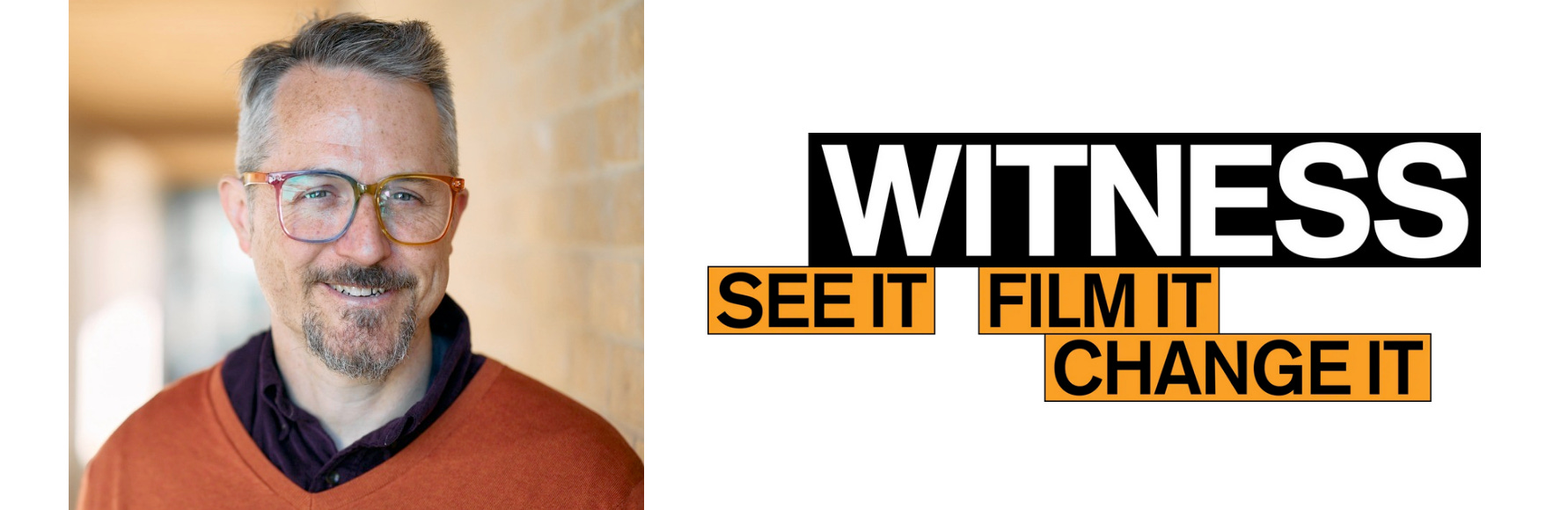
Sam Gregory is the Executive Director of WITNESS, the global human rights group using video and technology to defend rights. A human rights technologist and media authenticity expert, he has led innovation on deepfakes and generative AI, testified before US Congress, and received the Peabody Global Impact Award for WITNESS’s work.
I start all these conversations with the same question, which I borrowed from a friend of mine. She helps people tell their stories. And it’s a big, beautiful question, which is why I use it. But because it’s big and beautiful, I kind of over-explain it — the way that I’m doing right now. And so before I ask it, I want you to know that you’re in total control, and you can answer or not answer any way that you want to.
And the question is: Where do you come from? And again, you’re in total control.
That’s a great question. There’s so many ways you could answer that, I guess. I’ll give maybe two answers to it.
Where do I come from? So, I’m a transplant to the US who grew up in the UK, as part of a family that had also moved from somewhere else. So I’ve continued the evolution of my family moving from Europe to the UK to the US. So that’s one way of thinking about me — as someone who, at this point in my life, has spent exactly half my life outside the US and half my life in the US, as of this year — but still feels very much like someone from outside the US.
The second part of it — where do I come from — it’s interesting because I’ve also spent all of those 25 years, or pretty much most of those 25 years I’ve lived in the US, focused on the same sort of issues. So, like, when you talk about where I come from, it sort of comes out of, like, an endless kind of working around of what it means to trust what we see and hear — which has been what I’ve spent most of my working life thinking about. So, two answers to that question, I guess.
Yeah. Do you have a recollection — young Sam — what did you want to be when you grew up?
So, very young Sam wanted to be an archaeologist. I was fascinated by cave paintings and by medieval history. Subscribed to History Today magazine when I was a little kid, read Herodotus. So very young Sam was an archaeologist and a historian.
I think I wanted to be that till I was about 15. And then, around then, I discovered the two things that kind of have ended up linking together. One was kind of thinking about activism. So, young Sam, around the age of 15, I encountered the Tibet activist movement. The Dalai Lama spoke in an arena near where I lived, and I became part of the Tibet activist movement.
And then also, about the same time, I started thinking about kind of filmmaking, video making. And I think at the time, I wanted to become a documentary filmmaker — was how I saw the two combining. Like, documentary was the way you combine the two. So, archaeologist to historian, to activist and documentary filmmaker were probably the transitions.
That’s amazing. I mean, I can’t — we met many, many years ago, but I have in my mind this conception of Witness. And it seemed to me that Witness was doing a lot of work in far-flung places, right? I love the way you talk about small media. And I’ve been following your work, of course, but it seems like all that stuff is just — it’s now, it’s everywhere. The same questions are everywhere. Maybe I was being very, very naive at that time. Did Witness work? Is that an accurate representation of the evolution of these questions around media and trust? Or not?
You know, we’ve always worked globally, right? I’d always worked also in the US, right? So, you know, human rights happen everywhere. Human rights violations happen everywhere. I think there’s always been this central question of: how do you trust what you see and hear? Which is — I remember we first met around trying to build tools to really imbue trust into media, to prove its authenticity. And those concerns — you just see them playing out in very different ways over the years.
I think one of the things that we were probably — we’d already learned it by the time you and I first met, which I think was probably a little over a decade ago — was that you had to think at multiple levels about how you defend our ability to believe what we see and hear. One is, of course, how does a human rights defender in a favela in Rio film the evidence of a brutal police raid, right? In a way that is trustworthy, ethical, protects the victim, stands up as evidence. But if you don’t do that in a way, in a system that’s then going to make sure that gets seen and trusted — and a system that’s everything from how a platform is built to how AI systems enable us to know what is AI and what is human — then that human rights defender on the front lines is fundamentally disadvantaged.
So one of the things we’ve really wrestled with in our work is how to bridge between that very direct experience of audiovisual storytelling and evidence gathering that a human rights defender has, and these systems that are being built — that can either fundamentally put them at an advantage or fundamentally disadvantage those truth tellers.
And how do you describe Witness to people, for those who aren’t familiar with the organization?
So Witness exists to enable the frontline defenders of human rights and the journalists who document what goes wrong and what’s needed, to show the visual truth of what is happening. Primarily they use video, and increasingly they use AI-mediated tools to show what is happening and to show what’s needed to change that.
Now, how we do that — we also operate at multiple levels. We often describe it as our “thousands, millions, and billions” layers. So, at one layer, we very directly support specific communities who are using video, increasingly using these AI-mediated audiovisual tools, to document war crimes, state violence, land grabs. We do that with thousands of people each year.
Then we try and share the best practices, the good practices that come out of that. What do you need to do to document the police during an election in the age of AI, when everything is going to get undermined by people’s claims that everything can be falsified? We work out how to turn that into guidance and tools that are available to millions of people.
And then the third layer is this billions layer — which is this idea that if you don’t build the fundamental infrastructure of tech and policy in a way that enables us to trust what we see and hear, then we’re fundamentally disadvantaged. An example of that — and it’s an evolution of work we did together — is that a lot of our work over the last five years has been about: how do we build the trust layer in AI that enables us to know the recipe, the mix of ingredients that are AI and human in the videos we see in our timelines? In an age when it’s increasingly hard to discern what’s true and what is synthetic — or what is real and what is synthetic.
Yeah, I’m so curious. So much of the language around this — it just seems like it’s emerging, or not even — it’s not firm yet. But I heard you use the word “synthetic.” I heard you talk about the trust layer. Can you just tell me, what is the trust layer? Where are we in the process of developing a trust layer?
Yeah. So the way we thought about trust — and it really is an evolution of working on this for 15 years — and I can sort of take you back through that evolution of how we built our understanding. So largely, what we think of as the trust layer around our current information environment is — more and more AI content is entering. And it’s sometimes purely AI. Sometimes it’s a mix of synthetic and authentic — synthetic and something that was created by humans in the real world. And sometimes there is purely authentic human content, right? It’s just something that was filmed on a cell phone in a protest and it’s not materially changed by AI. Right? Like, broadly speaking.
And in order to have a trust layer, you’ve got to be able to understand that mix of ingredients in…