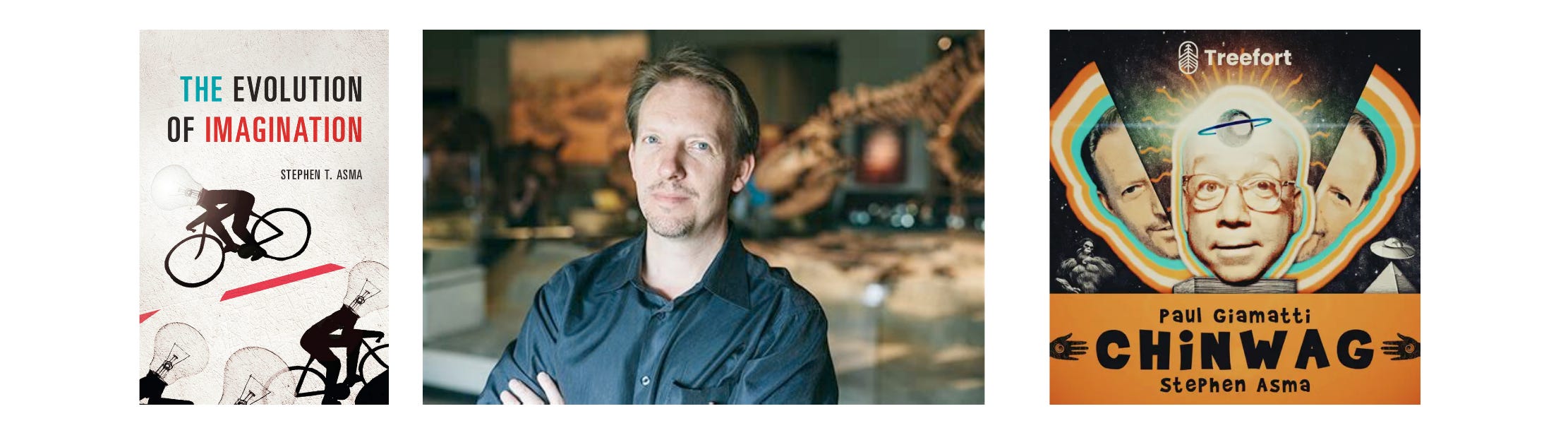
Stephen Asma is the author of ten books, including Why We Need Religion, The Emotional Mind: Affective Roots of Culture and Cognition (with Dr. Rami Gabriel), The Evolution of Imagination, On Monsters: an Unnatural History of Our Worst Fears and The Gods Drink Whiskey. He is the cofounder of the Research Group in Mind, Science and Culture at Columbia College Chicago. He was a professional musician in Chicago for many years, playing with such legends as Bo Diddley and Buddy Guy. Check out his YouTube channel, Monsterology.
His paper, “Adaptive Imagination: Toward a Mythopoetic Cognitive Science.” He makes the case for Imagination Studies in “Imaginology,” and for the primacy of imagery in thought in “Imagination is Ancient.” Find more of him here.
AI Summary. In this installment of Peter Spear's series of conversations with fascinating people, he sits down with Stephen Asma, a professor of philosophy at Columbia College Chicago and the author of many thought-provoking books, including The Evolution of Imagination.
Asma, who was mentored by Mark Johnson, the co-author of Metaphors We Live By, shares his journey from aspiring fine art painter to philosopher, discussing his blue-collar roots and his passion for exploring the middle ground between the sciences and the arts.
Throughout the conversation, Asma delves into the importance of imagination as the core operating system of the human mind, discussing the historical neglect of imagination in cognitive science and the need for a more balanced approach that incorporates both the rational and the mythopoetic aspects of cognition.
Asma also touches on his popular podcast, Chinwag, co-hosted with actor Paul Giamatti, where they explore a wide range of topics, from celebrity interviews to discussions on cryptids, UFOs, and the nature of historical narratives.
I start all these interviews with a question that I borrowed from an oral historian friend of mine. She helps people tell their story and uses this one question. Before I ask, you're in total control and can answer any way or not answer. The question is: where do you come from?
Oh, that's interesting. Where do I come from? I'm from a blue collar background originally. My father was a steel worker and my mother was a nurse. I grew up in that world of manual labor, which is how I decided I was going to get a Ph.D. because I really hated manual labor.
More interestingly, I suppose I'm from this middle territory between the sciences and the arts. I respect the sciences - I studied a lot of biology and my PhD was in the philosophy of biology. But I've always been a visual artist and a musician. This middle territory gets a lot of lip service but doesn't really get a lot of institutional validation that I wish it would. That's where I'm coming from.
Did you have an idea when you were a kid, a memory of what you wanted to be when you grew up? You mentioned the PhD, but what did you want to be?
I wanted to be a fine art painter. I knew that was not a good career move. I was one of these people who could draw at a really young age and people would say, "Oh, you can really draw." That created a feedback cycle where I would get the validation and then do it more, slowly getting better and better at it.
I thought I could maybe be an illustrator because they can make a living. Turns out it's just very hard to make a living as an illustrator, even back then. It's even worse now. I was on my way to be an illustrator and then I took philosophy classes as an undergraduate and fell in love with it.
I tried to read Kant's Critique of Reason and realized I would never understand this on my own. I needed a teacher. Therefore, to study this stuff, I'd need to switch my major. I thought I could keep drawing on my own, but I needed teachers to help me study philosophy. So I switched from the incredibly lucrative career of illustration to the even more lucrative career of philosophy. It was clear that I wasn't going to make any money, but that's how I shifted to philosophy.
Once you get in the flow of philosophy, you realize you have to go all the way for the PhD if you're going to work in the field. So that's what I did.
Where are you now and how do you - it seems like you've got so many different things going on. When people ask you what you do, what do you say?
I guess I say I'm a professor first, because I'm a full professor at an art school in Chicago called Columbia College and have been there for a long time. I feel like that's my main focus, but then I've written ten books, so I could just as easily say I'm an author. Although I identify with the thing that pays the bills, which shows my working class background.
So it's professor first, author, and now I'm saying podcaster because of this Chinwag podcast thing. (with Paul Giamatti)
It's amazing. So much fun. When did you discover that you could make a living doing this, being a professor? When did that sort of click in?
I was one of these people who played music to get through college. I was a pretty proficient guitar player. When I was at Northern Illinois University in DeKalb, about an hour from Chicago, I had a blues band and we would go into Chicago and play the blues clubs.
We built up a bit of a reputation because we were really young but playing all this classic stuff from the 50s and 60s. People were like, "Oh, it's the real thing." We got lucky one day waiting in line to see BB King play in DeKalb. The promoter, who knew who we were, came out and said BB King's bus broke down on the way and he needed like an hour to get here. He asked if we could go up and play a set of music. That was a pretty big moment for us.
We played for about 3000 people, got to hang out with BB King and got to know him. Then we became the house band at Buddy Guy's Legends in Chicago. I used to play with Bo Diddley all the time and Buddy Guy. I was really lucky - it was like being in the right place at the right time. I played with all these great blues giants, most of whom are dead now.
That was at the same time that I'd finished my PhD and was looking for jobs. Then I got a job as a professor in Chicago and had this terrible choice between continuing as a musician, which was super fun and really adrenaline-fueled, or continuing as a professor, because I couldn't do both due to the hours and travel. I chose being a professor.
What do you love about the work that you're doing now? What's the joy in it for you?
The professor job is super fun because the students always keep it fresh. Every couple of years, it feels like it's a very different kind of student with the development of being online all the time, with the changes from COVID. Really every five years or so, it feels like I'm teaching a totally different kind of person. That's exciting and fun, sometimes annoying.
A lot of the books that I wrote were mostly these kind of didactic books, like "I'm going to teach you what Buddhism really means." I enjoyed that, but now I'm tired of doing these teaching books and didactic projects. Ever since before I met Paul Giamatti, who I do the podcast with, but certainly since Paul and I have started this partnership, I'm enjoying more play in my work and more creative work, where I'm not trying to teach something or correct somebody's bad logic. I do that in my day job, but what I'm really enjoying is this creative, playful stuff that I can do now.
It just feels like walking the walk on imagination, doesn't it?
I think in a way I was always walking the walk in the sense that I've always continued drawing and playing music, but it's now becoming instead of a hobby in the background, it's coming to the foreground and it's really the thing I try to focus on the most.
My first experience of you, I think it was Monsterology. So on LinkedIn, is that possible that I would have run into Monsterology there?
Yeah, because I made this YouTube channel during COVID when everybody was just trapped. I might've put it on LinkedIn or something. I'll include a link to this YouTub…