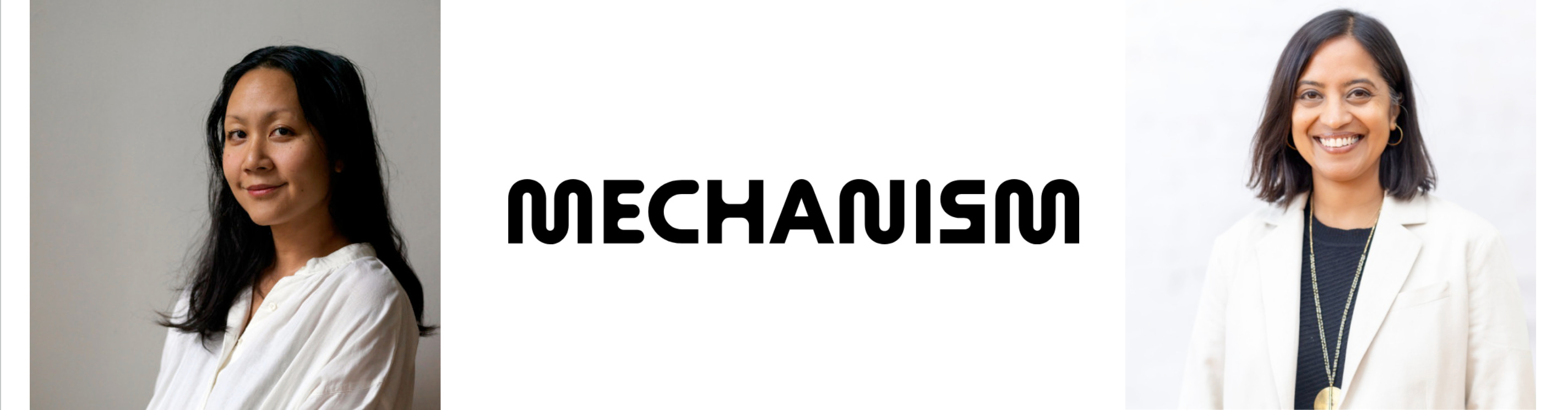
Nepal Asatthawasi is Director of Development at Mechanism. She leads fundraising and organizational systems that support Mechanism’s work with communities. Before joining Mechanism, she was Director of Development and Operations at the Pratt Center for Community Development.
Tanu Kumar is Director of Programs at Mechanism. She leads program strategy and partnerships to help communities design and deliver inclusive, community-led growth. Before Mechanism, she held senior roles at the NYS Office of Planning and Community Development and the Pratt Center for Community Development.
All right, Tanu and Nepal, thank you so much for accepting my invitation. I start all these conversations with the same question. Tanu, I think you’ve probably encountered this question before, but I stole it from a friend of mine who helps people tell their stories, and I start all these conversations with the same question.
So I’m going to ask each of you in turn. It’s a big, beautiful question, which is why I borrow it, but because it’s big, I over-explain it the way I am now. Before I ask it, I want you to know that you are in total control, and you can answer or not answer any way you want to. And the question is: Where do you come from? And I’ll let either of you choose who wants to go first.
Nepal AsatthawasiI can go first. You know, it’s the end of the year. I’m going home soon for a month. Home is Thailand. I’ve been in America for a long, long time, but home is always Thailand.
So I come from Thailand, specifically on the banks of the old capital, Thonburi — which is essentially Bangkok, but it was the former capital before it moved. And my people were farmers of durian for a very long time. As Thonburi got incorporated into Greater Bangkok, they became landlords.
And I have been trying to live with the knowledge of both those things my entire life. That is why I believe nuanced, community-based urbanism is extremely important — because it’s not just about form. It’s also about people and their histories.
Tanu KumarI come from a couple of places. I come from Chicago, from the Midwest, and grew up there for most of my life — suburban Chicago, in a largely immigrant community comprised mostly of people like my parents, who were first-generation immigrants from India. They were able to move to the U.S. because of the passage of a bill in the late 1960s that enabled certain classes of immigrants to enter the U.S. They had a window of about two years to apply for that and guarantee passage.
Another place that I come from is India, specifically northern India. My father is from Agra, now a pretty big city in Uttar Pradesh. My mother is from Indore, in the state of Madhya Pradesh. I spent a lot of my childhood going back and forth to India and lived there for longer periods at different points in my life.
So I very much feel like I’m from there and from the Midwest. I feel this expansiveness in terms of what my reality is, what cultures I inhabit. It’s a liminal space that I think a lot of first-gen immigrants experience and try to straddle, because there are a lot of different worlds coming together. That’s really part of my perspective in the work I do and in the way I choose to live my life now, as a resident of upstate New York in the Hudson Valley.
Do each of you have a recollection of what the younger you wanted to be when you grew up? Did young Nepal or young Tanu — what did you want to be when you grew up?
Tanu KumarThere are two things I really wanted to be. One was a dancer on Soul Train — did you all ever watch that? I’ve just dated myself. But I watched it every week and tried to mimic those moves, and that was a huge goal.
And the other was a writer. I have a very strong memory of being six or seven and feeling very certain that I was meant to be a writer — not fiction, but nonfiction. I wanted to be a nonfiction writer.
Awesome. Do you know who you were thinking of? What was the writer, what was a non-fiction writer to you at that point?
Tanu KumarI was thinking of… well, I watched a lot of PBS. So it was the kinds of people that wrote for, were able to create and produce documentaries on PBS, or the Jim Lehrer NewsHour, or any of these things. Those were very strong influences in my life. My father watched this every evening and we had family conversations about it.
So anything that was acceptable on PBS was something I wanted to write.
I like the Soul Train and the NewsHour together. Nepal, what did you want to be when you grew up, when you were a kid?
Nepal AsatthawasiI’m kind of getting stumped because I don’t remember. I feel like I had no strong inclination towards any profession, although with the kind of family that I was in — which was quite conservative and proper and very fixated on social standing and appearance — maybe being a doctor was acceptable. Or, conversely, not being very much at all, as long as you were able to move about in society in a respectable way.
So I do remember the through line has always been: I wanted to live life differently and to just be kind of free. Not necessarily bohemian, traveling in Bali with a guitar and a sarong type of free, but I just wanted to live a chill, interesting life doing interesting things. And yeah, still maybe an archaeologist.
I like how the archaeologist snuck in at the end there.
I mean, I definitely had a shelf of archaeology-related books. But when I was young, that’s the only thing I can remember with any great clarity. But I just wanted a different life.
How did you guys meet? We’re going to talk about the work that you’re doing at Mechanism, but when did you first encounter each other or meet each other?
Nepal AsatthawasiI feel like it predated us working together for many years before Mechanism. But I’m not certain of the circumstances.
Tanu KumarI remember. I was working at the Pratt Center for Community Development in Brooklyn, which Nepal later joined. And we worked together there for many years. But we were working on a project around entrepreneurship and supporting small businesses and thinking about space constraints and issues in New York City.
And Nepal was working at LaGuardia Community College’s incubator — I’m going to get the name wrong. But I remember this was back when you went to meet people in person anytime you met them for the first time. So I remember going over to Queens and meeting Nepal there in person.
Nepal AsatthawasiSo this was New York Designs, which was the first incubator that CUNY created with a makerspace in it. And it was housed at LaGuardia Community College. So actually, this is amazing because this is our shared — this is our kind of meet-cute. And it has everything to do with what we’re doing now.
Yes. In what way?
Nepal AsatthawasiIt was trying to create a production and entrepreneurship ecosystem that was connected to a public university system — specifically in one of its non-traditional colleges, its community college. So bringing that framework of small business, entrepreneurship, solopreneurship, innovation to a community of students who, because of their socioeconomic circumstances, didn’t have the luxury or the time to participate in those endeavors.
All right. Will you introduce Mechanism? At this point it’s usually, “Tell us a little bit about where you are and the work you’re doing now.” So I don’t know who wants to take the turn, but I want to also introduce Mechanism and the work you do together. Whoever wants to take the lead.
Tanu KumarSo Mechanism, which was formerly known as the Urban Manufacturing Alliance — and thanks to you, Peter, is not anymore — we are a nonprofit organization, and we work with communities and manufacturers and practitioners that support manufacturers across the country. We work to create production ecosystems that increase local resilience, well-being, and vitality.
We’ve come a long way from our days as UMA. We are still building on those foundations, but I think we are shifting away from “Urban Manufacturing Alliance” in a couple of impor…