Living Through the Polycrisis - This is part three. Part one is here, and part two is here.
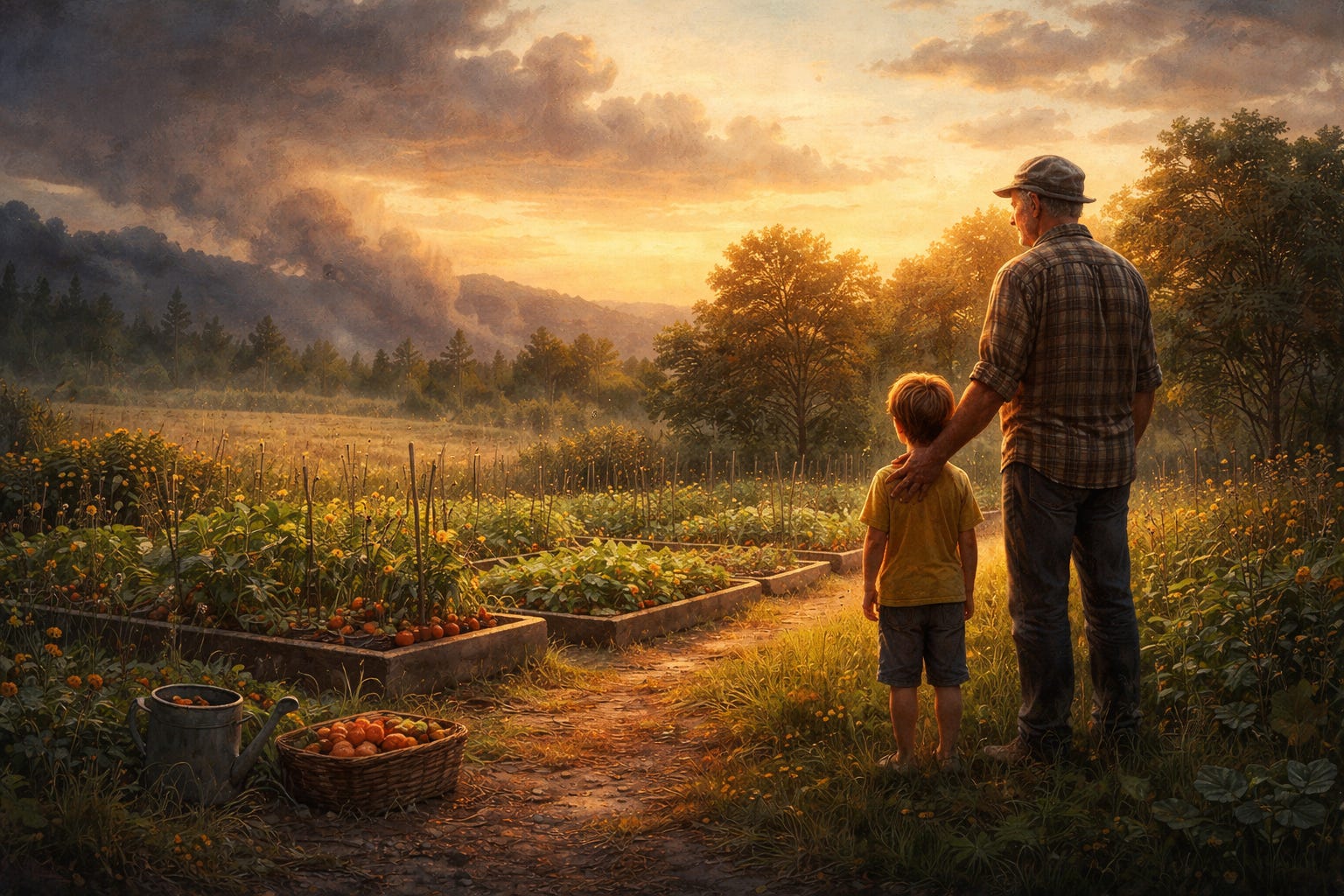
When I think about the future now, I don’t start with graphs or projections. I start with my grandkids, Logan and Piper. And just as importantly, I start with their parents—Amber and Justin—the generation standing in the narrow, demanding passage between what was and what’s coming.
The future stopped being theoretical the moment I held my grandchildren. It took on faces, laughter, scraped knees, curious questions, and a fierce tenderness that refuses abstraction. Whatever the polycrisis is asking of us, it’s no longer an intellectual exercise. It’s personal. It’s relational. It’s generational.
And that changes everything.
What if the polycrisis isn’t only a breakdown to survive, but a rite of passage for humanity itself?
Unleashed - W. Bradford Swift is a reader-supported publication. To receive new posts and support my work, consider becoming a free or paid subscriber.
Every culture that has understood maturation knows this pattern. There is a time of innocence, a time of testing, a time of confusion and fear, and—if the initiation is met rather than avoided—a time of responsibility and belonging. Adolescence is not optional. It arrives whether we’re ready or not. What is optional is whether we meet it consciously.
For most of human history, initiation rites marked the passage from childhood into adulthood. Today, no one is guiding us through that threshold. Instead, the planet itself is doing the initiating. Climate disruption. Ecological loss. Political instability. Technological acceleration. The collapse of old stories that once promised safety and control.
This is not happening because humanity is evil. It’s happening because we outgrew a worldview without growing up beyond it.
Children feel this moment intuitively. Long before they understand carbon cycles or geopolitics, they sense when the adults in the room are anxious, distracted, or pretending. They feel incoherence in their bodies. They notice when reassurance replaces truth, when busyness replaces presence. Logan and Piper don’t need us to explain the polycrisis—but they do need us to become adults they can trust.
And that brings us to the real work of this time.
Not prediction.Not perfection.But character, presence, courage, and care.
When systems fail, character remains. It’s what children learn when they watch how we treat the land, how we speak to neighbors, how we respond to fear, how we handle grief. Presence matters now because nervous systems learn from nervous systems. Calm isn’t something we explain—it’s something we embody. Courage matters because someone has to tell the truth without collapsing into despair. And care matters because care is the original human technology. Long before money, before markets, before machines, there was care.
This is the living heart of One Cause. The Four Great Truths are not abstract principles; they are embodied ways of being that children absorb simply by watching us live.
Collapse, seen through this lens, begins to look less like punishment and more like correction. A simplification. An undoing of excess. A quiet insistence that the experiment of domination has reached its limit. In that undoing, something ancient begins to surface again: community, rhythm, humility, interdependence, love.
Perhaps Earth is not failing us. Perhaps, in her formidable wisdom, she is calling us home.
The Four Great Truths, then, are not just remedies for crisis—they are ancestral gifts. Ways of orienting ourselves that we pass forward not as answers, but as inheritances. Interconnectedness. Sufficiency. Reciprocity. Stewardship. Especially stewardship—no longer as control, but as love across time.
We are the ancestors now.
What do I hope Logan and Piper will remember?
Not that their Grand-Dude wrote books or spoke about crises—but that he showed up. That he paid attention. That he loved fiercely. That he told the truth without bitterness. That he practiced unconditional love as best he could—the kind I see modeled so purely by Rascal and Luna, my canine teachers in unconditional love, presence, and loyalty. That Ann and I faced hard realities without surrendering joy. That we bent without breaking. That we practiced radical hope not as a feeling, but as a set of daily actions.
Ann and I don’t pretend to control anything. But we’ve learned something quieter and more powerful: we influence everything. Through shared meals. Through tending land. Through conversations with neighbors. Through choosing to live the Four Great Truths locally rather than panicking globally or retreating into the old untruths when fear rises.
The emotional journey of this time is not linear. It moves from grief—because grief is the price of love—into fierce love, into responsibility, and finally into a profound, grounded hope. Not the hope that everything will turn out fine, but the hope that how we show up matters, regardless of outcomes.
We may not get to choose the times we live in.But we do have the opportunity to choose how we meet them.
With fear—or with love strong enough to influential the future.
P.S.As I was recording this piece, I realized there was one more thread I wanted to name—because it’s a living expression of everything I’ve written about here.
Over the past few years, Ann and I have been quietly nurturing something called the Eco-Guardian Youth Project. It grew out of the same questions this series is asking: How do we help young people grow up connected to Earth, to community, and to their own sense of purpose—without fear, shame, or despair? And just as importantly: How do we model that way of being ourselves?
The Eco-Guardian Youth Project isn’t a program designed to “fix” kids or save the world. It’s an invitation—for families, grandparents, parents, teachers, and young people—to explore the Four Great Truths together through stories, conversations, creativity, and hands-on connection with the living world. It’s about planting seeds of stewardship, courage, and belonging that can grow across generations.
If this article resonated with you—especially if you’re thinking about children or young people you love—I invite you to take a gentle look.
And if these reflections feel meaningful to you, please consider sharing this piece with someone who might need it right now. That simple act—passing along a story that speaks truth with hope—is one of the quiet ways we influence the future together.
I’d also love to hear from you. Your comments, reflections, questions, or even your doubts matter more than you might think. They help shape this ongoing conversation and remind me (and others) that we’re not walking through this moment alone. Feel free to leave a comment below or join the chat if that feels right for you.
Thank you for being here—and for caring enough to read, reflect, and stay present in these times. 2026 - a banner year for choosing a new regenerative future.