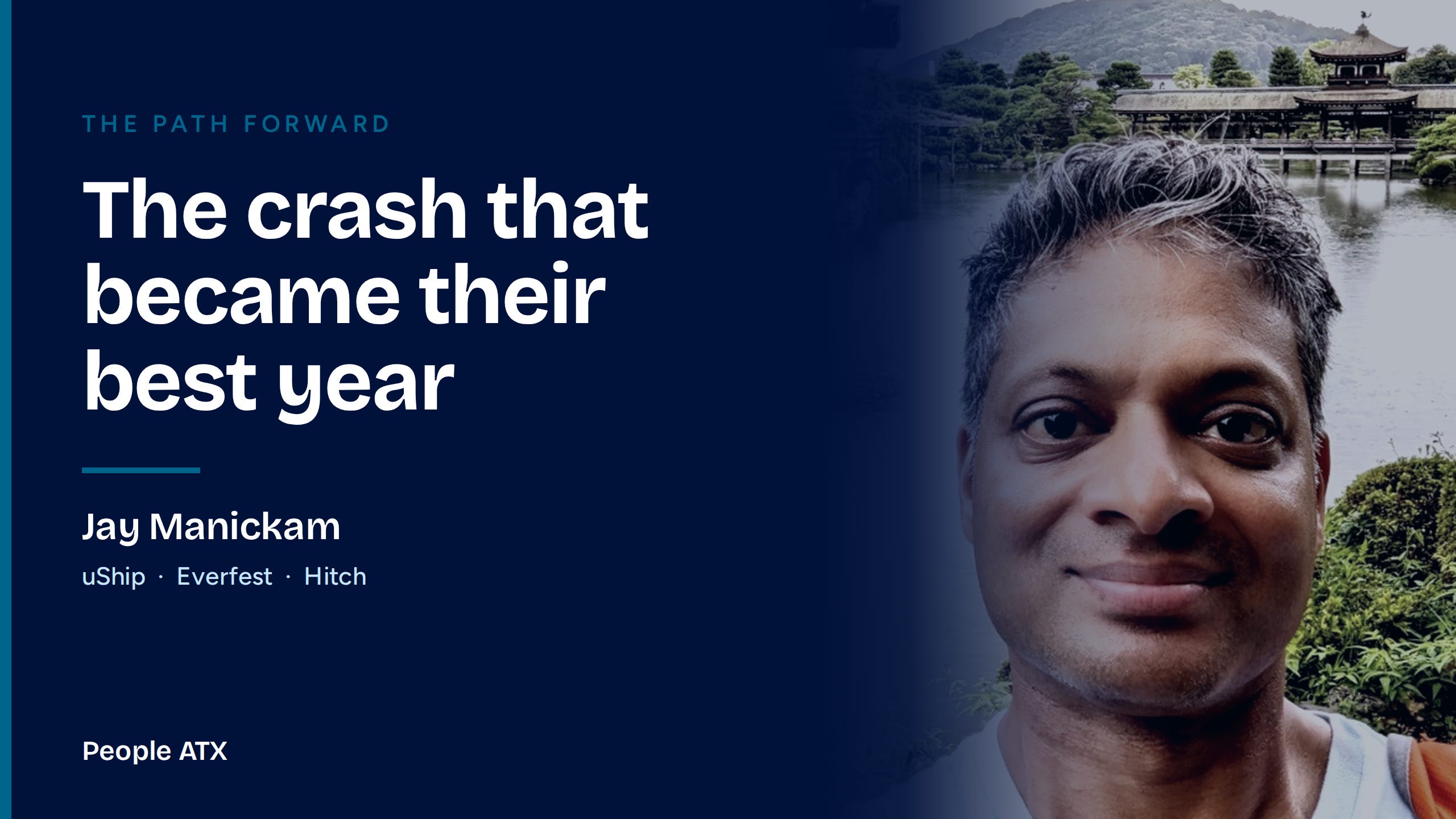
Jay Manickam launched uShip out of Austin in 2004. There was no Uber, no Airbnb, and nobody was saying gig economy yet. The only marketplace anyone could point to was eBay, and eBay sold objects, not a stranger driving your motorcycle a thousand miles. So he and his co founders built it without a map, and they got it wrong plenty of times before they got it right.
Austin has a handful of people who built the thing before the playbook existed. He is one of them. uShip, then Everfest and RoverPass at the same time, then Hitch. He is deep into AI now and he will tell you he wishes he had started a year earlier. But the hour we spent together kept landing on things that have nothing to do with tools. How you earn trust between ten thousand strangers who have never met. When to take money and when to leave it. What you look for in a person when you cannot afford to be wrong about them.
He also told me what he is afraid of, and it is not the economy.
Key topics
* Selling knives door to door at fourteen and what the fear taught him
* Pre med because his father was a pediatrician, philosophy because he loved it
* Arthur Andersen in 2001, watching a ninety year old firm come apart from the inside
* uShip as a class project with no model to copy
* Reputation as the first real problem in a service marketplace
* The 2008 crash, and the year it turned into
* Everfest, Chip Conley, and a good idea the market moved out from under
* When raising money is a necessary evil and when it is not necessary at all
* The first hires, and the three things he screens for
* The regret about being late to AI
* What he is afraid of, and what he means by purpose
What I learned in the full conversation
His first real job was knocking on strangers’ doors at fourteen. Thousand dollar knives, door to door, in the eighties, and he was not a natural. Probably still to this day one of the hardest and most nerve wracking things I’ve ever done. He did it to raise his floor, which is his phrase for what a shy kid with no self assurance needed at that age. He calls it a moderate success at best, and he is still glad he did it.
He was pre med because his father was a pediatrician, and nobody ever asked him about it. Chemistry major, family of doctors, an assumption he carried into college without examining. The second major was philosophy, and that is the one that stayed. Epistemology is still a hobby of his. What does it really mean to know something rather than assume it. Thirty years later he is running behavioral experiments on consumers, which is the same question with a bigger sample.
His first job out of school was watching a ninety year old firm come apart. Arthur Andersen, Atlanta, 2001. He was not on the Enron team, but he was close enough to watch it happen through what he calls self inflicted injuries and public relations fiascos. He says it was a fascinating thing to do as a first job, and what it taught him was how fragile even the most revered companies actually are.
uShip started as a class project, and the only benchmark was a company selling couches. McCombs, 2003, an entrepreneurship class that needed an idea. Connect people who need to ship large items with people going that way anyway. No Uber, no Airbnb, no language for any of it. Their benchmark was eBay, which moved goods rather than services, and never across distances where this much can go wrong.
The first problem was not matching people. It was reputation. Tens of thousands of independent owner operators, fragmented, with no real way to find work or prove they were any good at it. Before uShip could be a marketplace it had to invent feedback and ratings and some form of authority for ten thousand strangers who were all at different stages of their business. The consumer side turned out to be the easy half.
In 2008 the demand side turned into the supply side, and that year became their best. War rooms, layoff planning, real fear. Then something they had not modeled at all. People who six months earlier had factory jobs and banking jobs and retail jobs were signing up as owner operators, because they happened to own a truck. Maybe this is something I can do with my real world, real hands. Supply rose, prices came down, demand came back. Best year the company had ever had.
He had two ideas and could not choose, so he launched both and handed one away. Everfest and RoverPass, same moment. They knew they could not run both, so they took Everfest full time and found another young entrepreneur to run RoverPass while they stayed on the board. Most founders would have killed the second idea. He went and found an operator for it instead.
Everfest did not fail on the product. The market moved out from under it. Twenty five thousand festivals indexed, the largest directory in the world, a merger with Chip Conley’s Fest 300, funding from Live Nation. Then the mid market festivals started disappearing, bought by the two giants or going out of business, and the pandemic closed live events altogether. They found it a home and sold it. He tells that story without flinching or spinning it.
Money is a necessary evil for some companies and not necessary at all for others.
“Raising money is a necessary evil for a lot of businesses, but it’s not necessary for all businesses.”
He has raised institutional money for most of what he built, because marketplaces need infrastructure and national marketing and enough subsidy to reach price clearing volume. Today he would tell you something different. One or two people with AI can cover almost every function while bootstrapping, so get to a proof of concept and real revenue, and then ask what the money is actually buying you.
Hire as late as you can stand, because you need to know a job before you hand it to someone. Part of being a generalist, he says, is dabbling in enough areas to feel the moment you are over your skis, and that feeling is the signal. He is also clear about what the first people actually are.
“They’re not using a playbook. They’re creating the playbook.”
What they create becomes the institutional knowledge, and the institutional knowledge eventually becomes the company’s inertia.
Three things he screens for, and the last one is where he has made the most mistakes. Ambiguity first, and he does not bend on it, because people either love an unstructured environment or they do not and both are fine. Horsepower second, intellectual or work ethic, mostly innate and hard to teach past a certain point in a life. Then the one he calls a je ne sais quoi.
“Do I want to work with this person day in and day out?”
That is the hardest to read, because people hold their real motivation close, and it is where he says he has gotten it wrong most often. Earlier in the conversation he described the early hires as people you are in the trenches with rather than in meetings with. “You’re kind of dating these folks.”
He tests for ambiguity by making the job sound worse than it is. He gives candidates an exaggerated version of the role, more ambiguous than reality, less information than he actually has, and asks them to build a framework around it. If they can solve the harder version, they can solve the real one. “It’s almost down selling the opportunity.” He thinks entrepreneurship itself gets fictionalized in the opposite direction, and that setting expectations low and letting people be pleasantly surprised works on candidates the same way it works on customers.
The regret is a year, and it is about AI. He was not an early adopter. He is one now, and he says plainly that he wishes he had started a year sooner. Keeping your antennae up for a new technology gets harder the further into a career you are, and this one arrived faster than anyone expected it to.
What he is afraid of is not the economics. It is what happens to meaning. Americans have a relationship with work that defines us more than it probably should, he thinks, and he traces it back to people who had to make their way across a country. So he asks what that becomes under AI, for h…