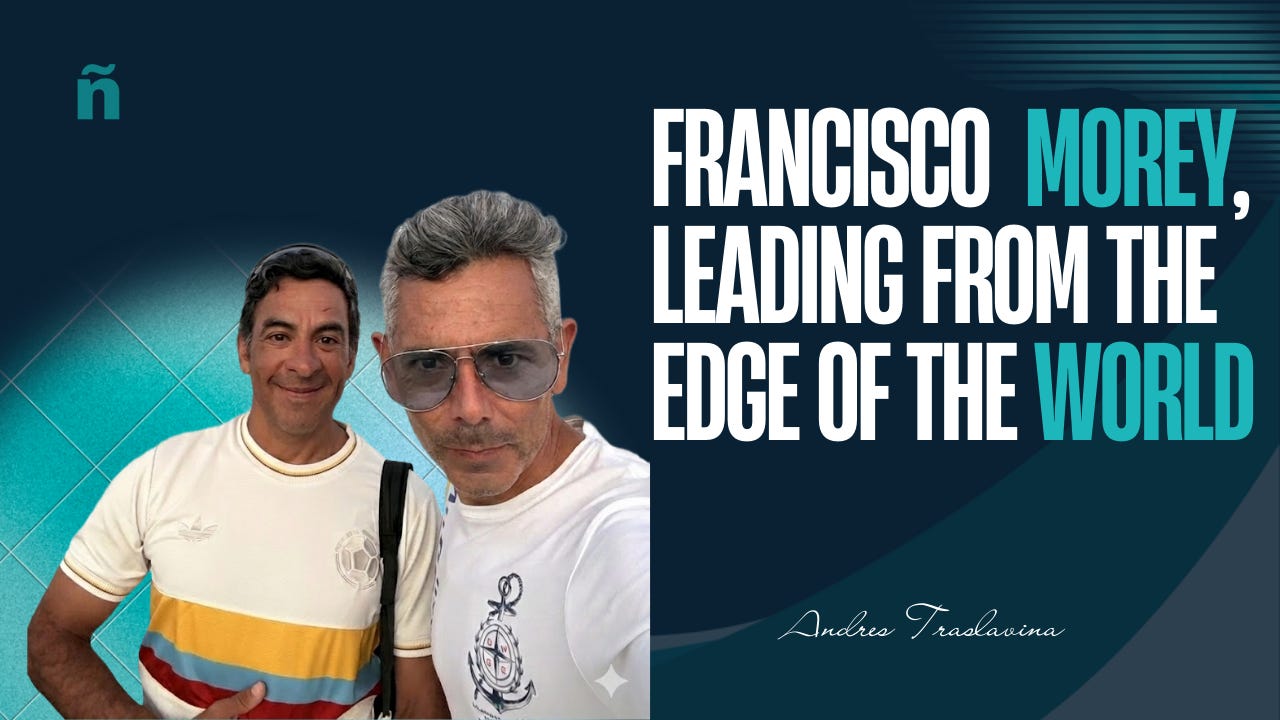
Executive leaders talk about scale, performance, and enterprise value. Few talk about humility, love, and endurance in the same sentence. Francisco does — not rhetorically, but operationally.
Born in Peru and forged through transition, reinvention, and disciplined self-examination, Francisco’s journey reflects what Jim Collins defines in Good to Great as Level 5 Leadership: a rare combination of personal humility and professional will.
This is not soft leadership. It is not charismatic leadership. It is not performative leadership. It is durable leadership.
And it is built on resilience, discipline, and an unusual comfort with letting people grow beyond you.
Level 5 in Practice: Humility Without Weakness
Collins’ research found that companies that moved from good to great were led not by celebrity executives, but by leaders who were “ambitious first and foremost for the cause, the organization, the work — not themselves.”
Francisco embodies that orientation. He does not frame leadership around personal visibility. He frames it around standards.
He leads with clarity:
* Clear ownership.
* Clear expectations.
* Clear consequences.
* Clear accountability.
When asked about retention, his response is not defensive. He states plainly:
“If someone leaves because they outgrew the role, that is success.”
That sentence reflects Level 5 thinking. Ego-driven leaders hoard talent.Level 5 leaders develop it — even if it costs them in the short term.
Humility here is not passivity. It is disciplined self-control. It is the ability to subordinate ego to institutional strength.
Resilience: The Endurance Athlete’s Advantage
Francisco approaches leadership the way endurance athletes approach ultra-distance racing.
In high-endurance sports, performance is rarely about explosive moments. It is about:
* Energy management.
* Consistency.
* Mental resilience.
* Long-term pacing.
* Recovery discipline.
The parallel is precise.
Sprint leaders burn out. Endurance leaders compound.
Francisco prioritizes rhythm over intensity. He invests in physical training, mental clarity, and reflective time. That is not lifestyle branding. It is capacity management.
In ultra-distance races, quitting rarely happens at mile one. It happens at mile seventy, when fatigue erodes judgment. Leadership fatigue works the same way. Poor decisions are often exhaustion decisions.
Resilience, in this context, is not toughness theater. It is sustainable discipline.
Discipline as an Act of Love
Executives often separate “care” from “performance.” Francisco does not.
He believes clarity is respect.
Avoiding difficult conversations is not kindness — it is avoidance. He addresses underperformance directly and early. Not to punish, but to preserve standards.
Love in leadership is not sentiment. It is commitment to someone’s growth, even when that growth requires friction.
In Good to Great, Collins describes the concept of “First Who, Then What.” The right people on the bus, in the right seats. Francisco operationalizes this through his “crew” model.
A crew implies:
* Defined roles.
* Mutual accountability.
* High interdependence.
* Shared mission.
In a high-performing crew, ambiguity is a liability.
Community as Leadership Laboratory
Francisco’s involvement in the community is not symbolic. It is relational and consistent.
At Islander Coffee, he is not merely a customer. The space represents something deeper: connection across founders, students, operators, and creatives. It is a physical ecosystem where ideas are exchanged and standards are observed in real time.
The coffee shop becomes a microcosm of Level 5 leadership:
* The barista owns the experience.
* The workflow is respected.
* The founder protects tone, not ego.
* Consistency outperforms flair.
The espresso tastes the same whether leadership is present or not. That is culture.
For executives, this matters. Culture is not what is written. It is what replicates.
The Power of Letting Go
Level 5 leaders are paradoxical. They combine fierce resolve with personal modesty. They build institutions that outlast them.
Francisco measures leadership not by retention rates alone, but by post-departure impact.
He asks:
* Did I stretch them?
* Did I give them ownership?
* Did they leave stronger?
In executive environments, exits are often treated as loss events. Francisco treats them as audits. If high performers repeatedly leave for similar reasons, the pattern is systemic, not personal.
That orientation requires humility. It also requires courage.
Resilience is not only about enduring pressure. It is about enduring feedback without defensiveness.
Passion Without Ego
Passion, in Francisco’s model, is not emotional volatility. It is sustained commitment to standards.
The endurance parallel returns here.
Elite endurance athletes do not chase adrenaline. They protect recovery. They monitor pace. They respect constraints. They train in obscurity.
Similarly, Level 5 leaders:
* Avoid theatrics.
* Protect long-term capacity.
* Build disciplined habits.
* Measure success in decades, not quarters.
Humility protects focus. Discipline protects performance. Passion protects mission.
What This Means for Executives
Francisco’s journey reinforces a research-backed reality:
Organizations that endure are led by leaders who subordinate ego to mission.
Resilience without humility becomes rigidity.Humility without discipline becomes weakness.Passion without structure becomes chaos.
Level 5 leadership integrates all three.
For executive leaders, the question is not whether you are ambitious. It is what you are ambitious for.
Personal legacy?Or institutional durability?
Francisco’s journey suggests a higher standard: build people so strong they no longer require you — and build systems so disciplined they continue without you.
That is endurance leadership.
And that is what lasts.