So I took the idea of archetypes from — I’m a Buddhist — from Tibetan Buddhism, where the entire practice is about embedding archetypes in our minds, and very scary images of the Lord of Death, Yama. And what I noticed in Jung’s work — he says he took the idea of archetypes from St. Augustine. So again, it’s the similar idea of trying to embed these tropes. I use the term — so for me, the fundamental metaphor and archetype is the fundamental unit of information. That’s another term I use: units of information, or meme. So those three for me are synonymous and I use them interchangeably. So I’m very happy to use the word meme — visual, audible. It’s an informational unit of any size. It could be a whole book or it could be just a flash of a colour in my conception.
And archetypal identities can be attached, in my philosophical anthropology, for want of a grand term — but we’re among anthropologists here. In my philosophical anthropology, the archetypes can be identified with these memes. And so for Jung, he didn’t have access to the same, for instance, archaeology or linguistics and ancient DNA that we have. So when Jung was writing about Tibetan Buddhism, he wrote the introduction to the second edition of *The Tibetan Book of the Dead*, which was found by Evans-Wentz, who wrote his PhD thesis at Oxford on fairy tales in W.B. Yeats’s work, and who was a follower of Madame Blavatsky, who’s from Dnipro in eastern Ukraine. And Madame Blavatsky created the religion of Theosophy, which fused ancient Egypt and ancient Tibet and made up a lot of stuff. But she would have picked up a lot of the stuff there from Ukraine.
But what we know, but that Carl Jung couldn’t know, is that what he considered to be universal and part of the collective unconscious of humanity — in this way which has received a lot of criticism — actually, all the examples he gives are from Indo-European languages and religions. He did not know this then. He didn’t really understand, and many people still don’t understand, Tibetan Buddhism, for instance, because it was transmitted from the Vedic into the Sanskrit, into the Tibetan, and now it’s coming back preserved in Tibetan, a non-Indo-European language. But basically its content is an Indo-European religion.
So in all of my work, I am only ever talking about archetypes that work on Indo-European-structured minds: the minds of those whose native tongue is an Indo-European language. So that’s the only claim I’m making. I’m not talking about collective unconsciousness of humanity. But what I can say from my own experience of watching and observing and experiencing propaganda from the first moments on that archetypal bridge in eastern Ukraine, where I spent three years in a forest, is that I perceive the world through archetypes. And that when I read information that contains what I call archetypal identities — characters — so Ukraine can be archetyped as a weak woman. Putin does this. He did this when he spoke four days before the full-scale invasion. He said, “Like it or not, take it, my beauty.”
So what he was saying to Ukraine — as international lawyers, I’m also a lawyer by training — they interpreted this. They didn’t use the word archetyping, but they intuitively understood it as archetyping. They said what Putin was doing was representing Ukraine as a corpse. And Putin got this particular phrase, which means a lot to Russians, because it features as song lyrics. So songs are very much part of the beginning of folklore, which led to the foundation of nation states — the first unified German state, the first modern Irish state, the first modern Greek state. These are all the products of purposeful campaigns based around mythology and folklore to establish a unified identity that helped create community that resisted occupation.
When Herder in 1777 launched the German folksong movement and inspired Goethe and the Brothers Grimm — who all of us will remember as children — to collect folktales, and inspired Wagner, and led to the first unified German state ninety years later, they set out purposefully to collect common culture in the form of stories. The same in Ireland. The Irish Cultural Revival — the first president of Ireland was a folklore collector. And he, among others, created this sense, which was true, empirically true, but Irish people didn’t understand it until this thirty-year campaign revived Celtic culture as a distinct culture from the Germanic-English occupier. So Germany under occupation in 1777 by the French — French generals actually living in Goethe’s house in Frankfurt, which I visited — a very different kind of occupation to the one we’re all aware of. Same thing in Greece against the Ottoman Empire.
And what they did was they collected these stories to create a sense of community. And this is what I realised the Russians were doing and what MAGA is doing. So it’s creating these archetypal in-jokes. If you’ve listened — and I’m sure you have, James and Wendy — you’ve listened to any of Donald’s campaign speeches where he’s talking about Hannibal Lecter, again, a fictional character, using an archetypal character in our modern culture that people of a certain age will understand. So people who are today between probably the ages of 50 and 70 will remember Hannibal Lecter as a film character.
And so what Donald is doing is he’s not linking into any archetypes that are embedded in all of humanity, in my humble opinion. He is ripping off the archetypes of which the cognition of a certain subset of Indo-Europeans at a certain moment in a certain culture are aware of — Hannibal Lecter in that case, Alphonse Capone for obvious reasons. The man who was found guilty of 34 felony counts, and of acts tantamount to — well, I won’t mention a horrible word — on E. Jean Carroll.
So Donald is counter-archetyping, which is what I try to do as well when I call him Duncy Putin or Druidy Don. But what I believe they’re trying to do, and successfully doing — and this ties in to my understanding of deep Indo-European religion — the Lord of Death is one of the primordial archetypes inside Indo-European cognition, whether it’s represented as Jesus Christ, or Yama in Hindu religion and Vedic before it and in Buddhism. Odin — Wednesday, Woden’s Day — Odin, Lord of Death. And these are all self-sacrificing first monarchs.
And basically, I think what they’re doing effectively is saying — and this resurrection of Stalin is saying — “I control your death.” This is what Donald is doing with whether it’s vaccines or anti-vaccines, all of these terrible policies that lead to people’s deaths. And the same thing with Putin and Stalin. They’re saying, “We control the time of your death.” And this is a very old, ancient, tried and tested formula for exerting psychological control over people. And I guess this is partly connected also to the drone safaris in Kherson. Obviously, we see this as a harbinger of what is to come. And they can do this through various means. There’s almost infinite stories that can be used to communicate these fears into people’s inner minds. And that’s what I believe they’re at.
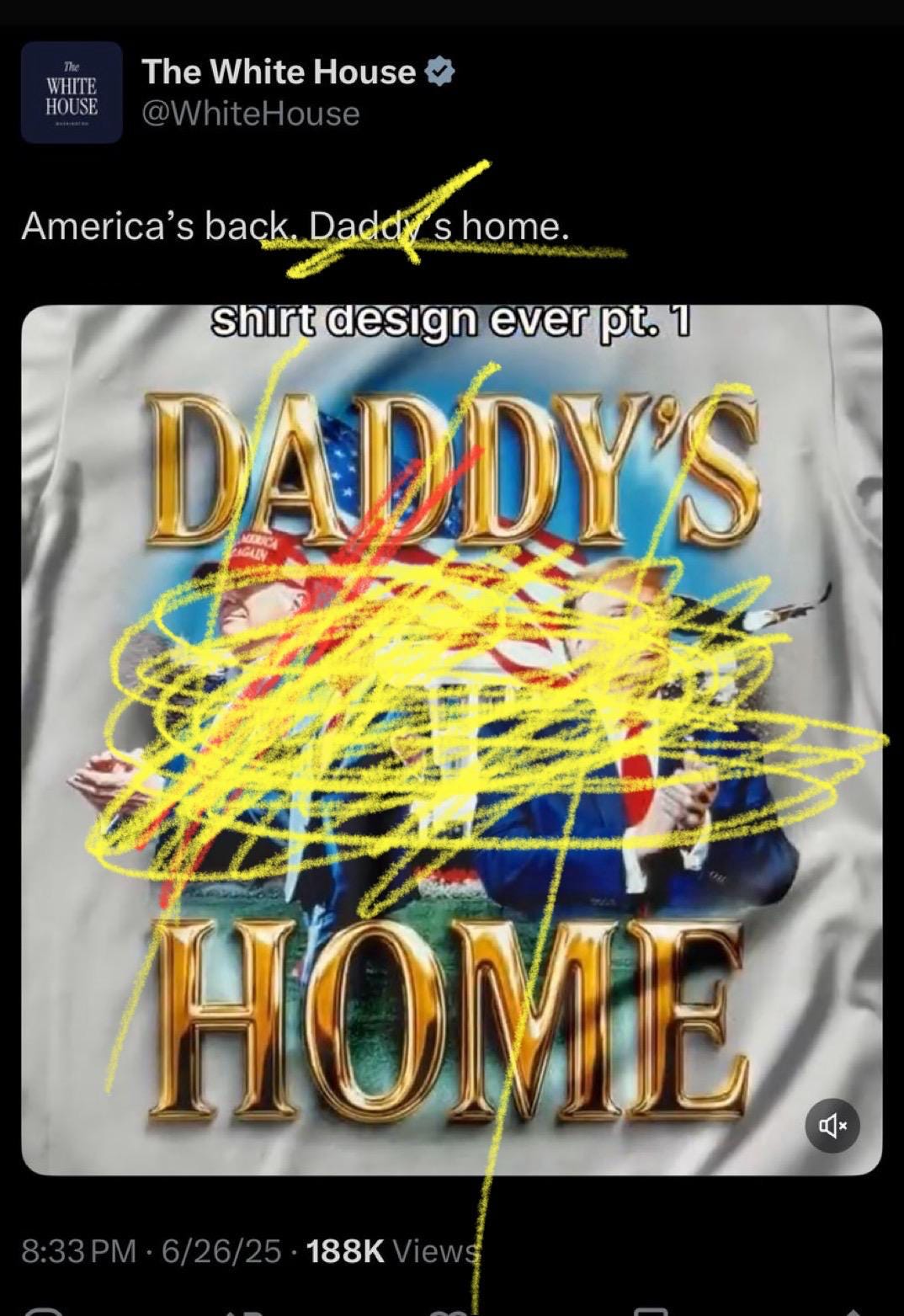
Yeah, framing. Archetyping, the way I use this new coinage — as one critic put it — is archetyping. It’s a form of framing. And the Russians are just brilliant at doing this. I try to do it in the memes. Like many of us will have seen when Donald — that meme of him as the Pope — and the people who are outraged by it share the meme. And it’s part of my mission to help — and obviously I fall for this stuff all the time as well — but when I see these patterns happening, I try to reframe it. But if I have to share these memes of Batman and Robin in the White House, one wearing black, and with the kid archetyping as a wise father, then I do it — I desecrate the meme, the image, to try and ensure that, like for instance, when I shared the image of Melania looming behind Donald while he signed, during his inauguration, his commitment to protecting the Constitution, I cross out using colours all of the image, because obviously we can’t unsee stuff.
But that framing is exactly what I mean by archetyping in one sense of the term. And that’s why I’d move — like the collective unconscious, I stay away from that, not only because the reasons why I think Jung settled on this universal element was just that he didn’t know what we now know about language and where it comes from, genetically and historically and factually. And so the best he could come up with was, okay, it’s universal.
And also, the great work which is used in Hollywood scriptwriting by Joseph Campbell, which attaches particular kinds of archetypes — the hero and that sort of thing — it’s useful work, but it’s not enough. If we’re going to solve this problem — and a lot of us do this naturally — so for me, the first tool I’m trying to teach is what I call archetypal Disinfolklore literacy. So there’s a little ṛta use there: archetypal Disinfolklore literacy. But it’s about seeing archetypes in memes, sensing them in stuff we interpret in milliseconds as it goes on our timeline, as a practice that we can then use in our daily lives when people are trying to manipulate us using archetypes unconsciously. They’re not aware that they’re doing this. This is what they’re doing. They’re trying to get us, in a manipulative way in a personal relationship, they may be trying to provoke us into doing something or acting in a certain way. And it’s the same mechanism being used there as it is when it’s working on a geopolitical level, trying to get us to frame ourselves as weak, or as a victim, or as a hero, or something like that.
So, yeah, good question. And framing is absolutely really important. And I think the Russians — this concept of information confrontation, where it’s not just the information, it’s not just the unit, it’s not just the meme, it’s the environment. And that’s what many of us don’t get in our normal Western way, if we haven’t studied this or studied linguistics, we don’t realise how the environment is being shaped. At a certain point, the scale of what MAGA is doing now, for instance, is not just inside the subculture that has twice won the US presidency. It’s now manifesting in people’s lives — if they’re on food stamps, if they work for the federal government, if they work for USAID, if they’re judges, if they’re lawyers. These memes from the internet fuse with the reality of whether your paycheck is going to come, whether your children are going to get food in schools, whether you can get a COVID vaccine. All of these. So it’s gone from a few tweets into the reality, into what I call the Disinfolklore Galaxy. And this is what I’m trying to help create awareness of — the mechanisms through which, A, this is happening.
The frame through which we perceive everything in our reality is being altered purposefully by a small group of people controlling MAGA, behind MAGA. And they’re trying to do it to humanity, not just to Americans — when they’re interfering in Romania, in Polish elections, they are trying to change the environment in which millions of Poles and Romanians operate. And so far they haven’t been successful in Moldova or Romania or in Poland or in Germany or in other countries. But as we’ve seen again and again, they never give up. They never give up, nor do the Russians.
And it’s the fusing together of this Russian Disinfolklore Galaxy, which is coming at us through Telegram and through the New York Times when they repeat trolls — it’s fusing together these two forces. We’ve never seen anything like this before, that obviously I wouldn’t have been able to access or see or perceive had I not been so focused on Ukraine or lived in Ukraine for seven years, and operated in Russia-occupied Ukraine for three years. Where that was, for me, the archetypal Disinfolklore Galaxy, where they changed the identities of Ukrainians inside the occupation through the information space, through the interaction of these memes that were constantly, relentlessly injected into their brains from the information space and then from the people you know best.
So it’s this interaction between the information space and your mother, your daughter, your child, your husband, your wife, your best friend, the person you trust, your politician, your hero, your shopkeeper, and everyone repeating the same Disinfolklore. And it takes on this pattern of reality and it becomes reality. And without you even realising, you’re inside this Disinfolklore Galaxy. We saw what happened with people we might know who went MAGA. And this is what I’m trying to help us perceive and escape from, basically, because I see it happening, not just in Ukraine, but elsewhere.
Raymond, yeah. Grace, thank you. I studied the transmission of ideas during the early German Reformation, 1517 to 1530, in quite great detail, where the Pope was archetyped as the Antichrist — rather than Donald Trump — and various ways of transmitting ideas. And so when I see a meme like this, I think of it in that light.
Of course, we now move, all of us individually, in our own small ways on Twitter. We’re participating in this and perhaps we don’t see it because we’re just living it. We’re creating memes all the time and sharing them so fast — the velocity of the memes — whereas with this kind of Dr. Seuss meme, which of course again does connect: what I like about it is it connects to our childhood and to folktales and where I believe we get our lenses from. So I don’t need to go into the collective unconscious and universal human experience. I focus on how we Indo-Europeans learn to perceive the world through the stories we encounter as children, if we’re lucky enough to have parents that read us Dr. Seuss or Grimm’s Fairy Tales, or we just caught bits of Disney on mobile phones. And now, of course, TikTok is part of the archetype — where people are getting these lenses of perception. So yeah, I like that a lot for that reason and the connection with Dr. Seuss.
And yeah, but of course, what we saw — and this is part of my intellectual development since the full-scale invasion — over the whole Wanger thing. And so one of our, I think it was Nile, one of our Finnish community members, who very early on said, “Look, I’m not going to call them Wagner, I’m going to call them Wanger.” And I adapted that to all my writing because, even before I had understood to the extent I do at the moment about archetyping, I realised something funny — something wrong, as the English might say — was going on when we heard Prigozhin, who was a character that we — firstly, Prigozhin wrote a book of fairy tales, published it in about 2002, which shows this connection. As we know, he controlled what I call the Disinfolklore Propagation Apparatus, which got Donald elected in 2016 and Brexit done.
And then he reappears as a character in our information space — or appears as a character in the mainstream — as the Sage of Bakhmut, quoted with his grainy iPhone footage, self-archetyping. Grainy iPhone footage which could have been made in St. Petersburg for all we know, rather than in Bakhmut, starts getting quoted in the New York Times and the Washington Post. This is from June 2022 onwards. And then this reaches this cacophony of archetyping Nazis as okay, as mainstream.
And so this goes, James, to the use of the swastika in that image. And this goes back to how archetyping yourself as pure evil, as a pantomime villain, has a really counter-intuitive impact on many people’s minds, and in a very worrying way. And so the connection there with the Wanger and the Wagnerians was they were basically normalising Nazism in our information space, preparing the way for the Unified Reich, which Donald is unveiling and implementing. And that’s their label, not my label. That is his campaign — what they called the Unified Reich, as we’ll remember from that archetyping of their project, Project 2025 or whatever it’s called, that’s gradually ruining — or has ruined — the First Republic.
So this — the power of these images. Us growing up with reading about the Holocaust and Auschwitz, and this predates the internet as well. So these people are trying to re-archetype the Holocaust — the assassins of memory, I think that great book from the eighties — where David Irving and these revisionist historians, the difference now is they’ve gone mainstream. So the power of the swastika only works to shock certain people; to other people it attracts them, as it did with the mainstreamisation of the Wagner. Which is very much connected to the origins of the first German nation state, and Wagner’s great work in bringing folklore into the minds of Germans and creating a sense of German identity — of the ten tribes, the ten mythological tribes that Herder spoke about in 1777 when he said, “Where is our Shakespeare? How will we unite the ten German peoples that Tacitus had written about fifty years into the Common Era? And we will do this by collecting folk songs.”
Donald does this by playing the January 6th anthem — folk songs. And Wagner, the composer, took this project up and brought these tales into the minds of humanity and into the German mind. And that led — along with Grimm’s work and Goethe’s work, the founder of *Faust* — led to the first unified German state in 1871. And then they pop up: they used this guy, and the Wagner military archetype themselves as a private military corps. And again, that would be repeated as if it was true in our media when, of course, they were always a Russian state — a Russian army unit with an image archetyped according to the aesthetics of the Nazi. Meanwhile, they’re trying to archetype Ukraine as full of Nazis. So this is the battle. This is an extraordinary battle.
So going back to that image, I think we’ve moved on from it. If you ask me how I think of this today, I think the black and white probably captures it, but we have to move much faster than this, and much more dynamic and powerful forces are at play in social media. Perhaps this is not enough. But as a historical document, it’s really interesting to me. And I will keep it now. Thank you for drawing my attention to it.