I would like to talk about character and characters in Disinfolklore. But maybe I will start quickly with just a brief précis of what I mean by Disinfolklore, because maybe not everyone here is aware of how I conceive of Disinfolklore.
So in 2016, I detected my first Disinfolklore Galaxy in Russia-occupied eastern Ukraine. Now I detect multiple Disinfolklore Galaxies. Make America Great Again, MAGA, Russian, Chinese Communist Party, and others are spreading through our biological and computational neural networks like translucent triffids rewilding the Garden of Eden. So here we have a perfect example of the narrative form that I try to capture with my moniker, Disinfolklore.
We have this idea of folkloric characters. In this case, triffids, which are a fictional plant — people of a certain generation who grew up on the island of Britain will remember *The Day of the Triffids*. I think it’s a book from the 1930s. The Garden of Eden itself is a folkloric reflex, obviously with a very deep and religious and important patina, but nevertheless it’s a folkloric story, the kind of story which if we read in folklore we would be quite accustomed to — but because any Christians who are listening here will be aware it’s inside the Bible, it has this very serious tinge to it.
And of course the idea of Disinfolklore Galaxies spreading through our biological neural networks is very important to the idea of Disinfolklore, which is also a theory of cognitive perception and how our emotions are used through stories to hack our rational thought systems. So there are biological neural networks. And the idea of the computational neural networks — of course, those of us here listening who are dealing with Twitter and X are constantly being trolled by computational neural networks. I have a great relationship with my For You feed — I hear a lot of people complaining about their For You feed, but I have no complaints about mine. It is a great algorithmically driven inspiration to me every day. It serves me up content that really inspires me and which doesn’t annoy me, and anything that does annoy me or people who annoy me, I just block and weed out. So I have quite a good relationship with my computational neural network. But of course many of the choices we make in today’s world are the product of computational neural networks — by that I mainly mean neural network algorithms which, as we encounter them, are offering us multiple different choices. But I’m quite Zen with them.
So this idea: the Disinfolklore Galaxies spreading through our biological and computational neural networks like translucent triffids rewilding the Garden of Eden. Triffids invaded the world in *The Day of the Triffids* — these massive plants basically take over the world. And this is what I fear and what I see.
I saw this word which is very common in American English but doesn’t exist in Irish or English or Scottish English, which is “trolling.” So I think probably “dragnet” is a play on this word, common in American English, where cops troll for criminals. When I was researching the moniker “trolling” and looking into its uses in contemporary culture, it comes up a lot in regional newspapers. I created a dragnet using the internet. At the beginning of my research in February 2020, I had access to the Factiva all-source, 33,000-source database for information. And I did a search for “trolls” and “trolling.” At that time, I got 65,000 results and I went through all of them, and a goodly portion of the results dealt with fishing or trolling in the context of looking for prey on the internet, but mainly it came from police. So I suspect “dragnet” is a play on “trolling,” which is not to be confused with trawling — as you describe it, trawling is using a net. So I think probably in American English, “dragnet” is the equivalent of “trawl,” as in T-R-A-W-L, which is different from “troll.”
Trolling, for those of us who don’t know — it comes into American English, as commonly used in the context of policing, from fishing discourse. And maybe a fisher is listening to this. But from my understanding of it, trolling is: you throw the bait onto the water on a line, and the bait wanders around the water. So you have this idea of movement and wandering. And it eventually ensnares its prey. And that, as I understand it, is trolling as in fishing. And then it went from there into police discourse. And then in the early days of the internet, what we call searching was called trolling, interestingly enough.
And we had this kind of competition for the meaning of “trolling” in the context of internet culture. For instance, way pre-Google, there was a Troll internet search engine, an early form of search engine. And obviously that came from fishing discourse. And I think this competition — so James may have misspent his youth reading Grimm’s Fairy Tales. Wendy, on the other hand, was probably interested in Nancy Drew and trolling for criminals. And I may have spent my misspent youth on various different chat boards in the early days of the internet, where trolls and goblins and this phenomenon from early computer culture — there was a factory in Southern California, in Oakland, where the copyright was owned for Troll Dolls. And this pops up in the literature constantly over the decades. It’s now resolved, but there was like a forty-year struggle between the copyright owner, the trademark owner for Troll Dolls, and various different franchises. And in the end, he won.
But I don’t think it’s a coincidence that trolls entered into early computer lore, computer culture, which was born basically within miles of Oakland, California, and this troll doll. And so the three of us have different origins for the word “trolling,” and we’re all using them slightly differently. And out of this competition becomes embedded an idea of a word, a moniker — “troll.” And at a certain point, the meaning of it becomes relatively stable. So no one really uses “trolling” now in the context of internet search, for instance. It’s still used for looking for criminals and in various other forms.
But I think the dominant use of the term “trolls” and “trolling” nowadays is in the context of what I call — my definition of trolling, having gone through this dataset — emotion-moving activity of body, speech, and mind. And so any time we’re moving emotion — this idea of movement is intrinsic to the TR sound, the TR sound in travel, transition, trans, transcend, and in oodles of other words. So movement is in there. And this idea of moving emotions, which is common — whether it’s an evangelical preacher driving the emotions of their audience, or on the internet, all of us are being trolled each day by the aforementioned neural network algorithm which is driving the For You feed. And equally we’re trolled a million times a day by our pets, by our lovers, by our children, by advertisers.
And so for me, this is common. This is the essence. I hoped I would find an essence for trolling that I could then use to characterise what’s happening. And this brings me to the pro-Palestinian organisation, which is a new character that has entered our information space since the bombing of Iran last week. And I predicted last week on this very show that the pushback, the blowback, would take the form of so-called pro-Palestinian protests. We have seen them in Times Square. We have seen two fighter jets in England be daubed with paint by so-called pro-Palestinian activists. We have seen an organisation called Palestine Action in the United Kingdom — it’s about to be proscribed. And today I’ve seen reported that a group of 150 so-called pro-Palestinian activists have broken into a warehouse of a company in Belgium, and the company makes matériel for Ukraine, for the Ukraine war.
So we understand the genetic link between October 7th and Hamas, between Hamas, Iran and Russia. And we understand this is not in any way controversial. These are very related organisations with related tactics, and October 7th conveniently provoked a divisive furore in most Western countries, completely out of character and out of proportion to the fuss over Ukraine.
And I don’t know, James, if you’re in North America somewhere and this graffiti was painted there, then there are two clues in it which make me feel that it’s inauthentic. The first is: no one cares about Ukraine, basically, apart from a few of us, really. But of course, in the information space, the idea that Ukraine has been cared about more than any other issue has taken hold, and so many low-information people will think, “Oh, we’re doing everything for Ukraine.” But the people who listen to this space understand how little we’ve done for Ukraine. So that assumption in there makes me very suspicious.
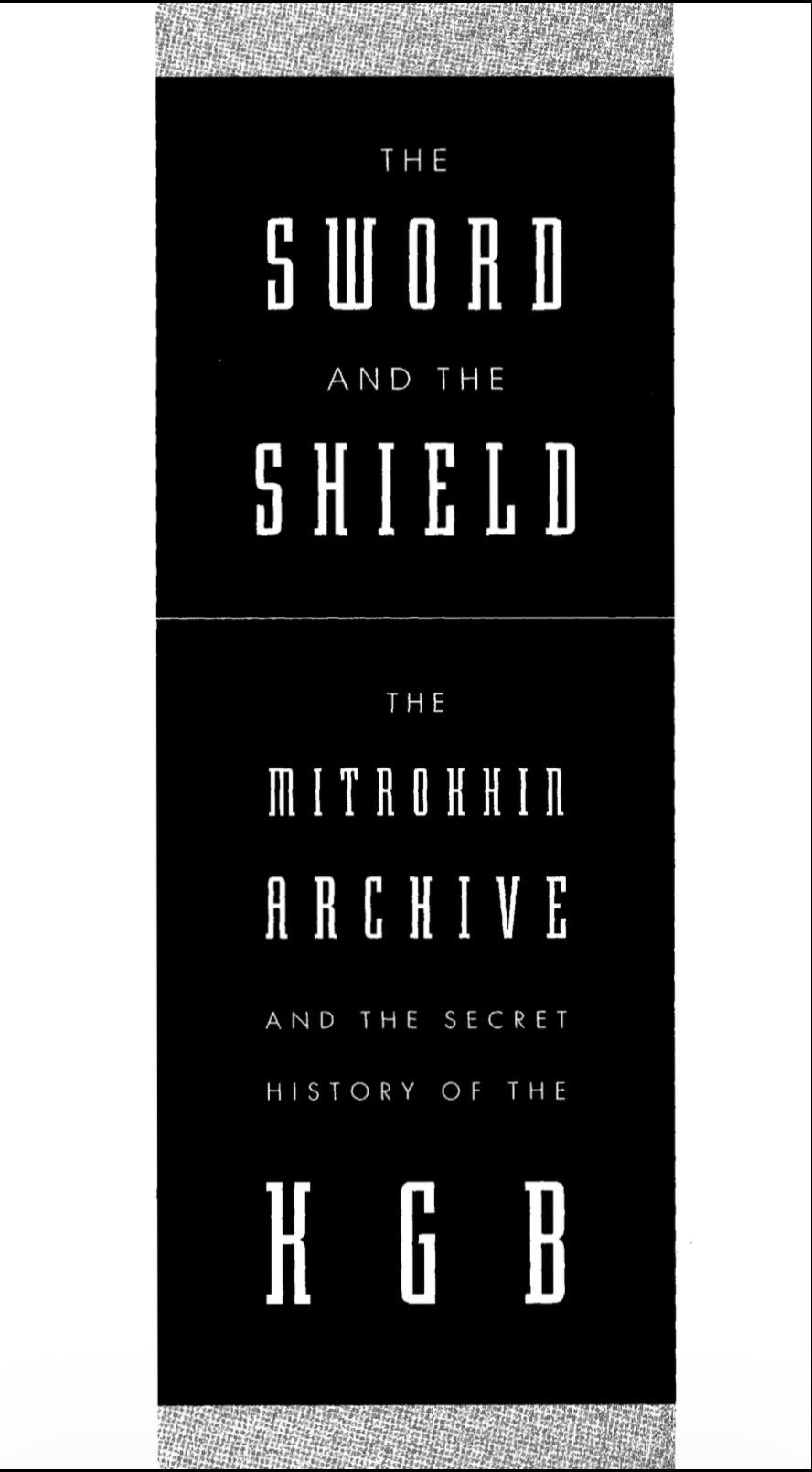
And then we know — we have lots of documentary evidence, including from the Mitrokhin Archive, which is an archive of documents that were smuggled out by one of the leading lights in the KGB and has been published under the editorship of Christopher Andrew from Clare College, Cambridge — the college next to the one that I attended — and is a fantastic source. If you suspect the Russians are up to some trick, then generally speaking you will find its origins referenced in the Mitrokhin Archive.
We know that Khrushchev explicitly authorised the use of anti-Black graffiti in New York City in the 1960s. We know that the “Dividing the Democrats” memorandum, which was written by Pat Buchanan, who is an adviser of Trump even today, emerged — I found it — in the archive related to Watergate. We understand the symbiotic connection between this use of racial division by the Russians and also by the far right connected to Donald Trump. And we also have some great reporting, some of which I contributed to, of the anti-Jewish, anti-Semitic graffiti in Ukraine, which was paid for by a Ukrainian oligarch — Jewish, by the way — but on behalf of Russia. That was in *Rolling Stone* towards the beginning of the war.
So we have this pattern, we have this technique of trying to stir racial division in order for Russia to gain. And those two elements in that particular form of graffiti, as well as the “y’all,” which seems like a very artificial way of trying to appeal to Black people, makes me suspicious about it, especially in the context of now — we have again this re-emergence of the so-called pro-Palestinian peace movement.
And the war — and I was going to talk about this in a bit because it’s very important — the war, we will see the blowback from, because we have an understanding of the Disinfolklore connected with the Ukraine war and October 7th, and also an understanding of what Russia’s party tricks are, from looking at documents like the Mitrokhin Archive, or simply listening to Mockers and reading the Telegram channels and Ukraine’s critique of them over the past three years. And then this Belgium case which came up today is just a perfect example. Why would a so-called pro-Palestinian group destroy matériel which is meant for Ukraine if it is not on behalf of Russia?
So this is almost so obvious — they’re trying to get caught and make it obvious. And we know the Russians do this. It’s not enough for them to manipulate. We have to know they are manipulating. It’s part of their strategy. And so what we will see over the coming time will be Chinese Communist Party, Russian and Iranian-driven proxies in our communities using TikTok and Telegram specifically. We will see titushky fake demonstrations. We will see stuff which will make the post-October 7th protests in Columbia and other universities — in my alma mater in Cambridge as well — look like children’s picnics.
So it’s interesting you raised that issue of that graffiti, James. And on the genetic link — I mean, that article is 23 years old, and I looked into it quite considerably because of what we talked about in the second show about the Indo-European roots. So as I understand it, what we now know from ancient genetics demonstrates this. Not that any of this matters today for people in Gaza, who deserve to be able to live in peace and not be hassled or killed or whatever. But the Palestinians emanate from the Aegean. At some point their language changed from an Indo-European language. They’re mentioned in the Bible and they got a really bad press in the Bible from the Jews. But they are an Indo-European-language-speaking people originally, genetically come from the Aegean, and their forebears had originally come from ancient Ukraine as Indo-Europeans. They came around 1000 BCE, around the time various different tribes were coalescing into what became the Jewish community. The Jewish community, by definition, are genetically distinct because they have interbred for, at this point, 3,000 years, basically. So the idea that there is no genetic difference between them and Palestinians is just not right. It’s not correct. And we know a lot more now. The whole genome — so that article is from 2001. As I remember, the whole genome was only sequenced around then, and it was like of a worm or something.
But let me talk about character, because one of the really powerful aspects of the Disinfolklore analytical method is that we can look at particular characters in memes, in stories, in our information space, and get an idea of what their typical behaviours are. And then when they behave differently from those archetypes that we form, we can pick up data and information from them. And obviously the opposite as well.
And so this week, for instance, the pro-Palestinian activist has suddenly become a character in Disinfolklore in a way that I hadn’t noticed so much before and hadn’t impacted on Ukraine. Another character which I detected through this — again, this recurring theme — is the anti-Andrii Yermak theme. So in Disinfolklore we look at our information space and whichever theme we’re interested in, say Ukraine, and we have thousands of different characters. And the characters can be individual humans or they can be places — they can be Bakhmut, or Mockers’ boom of the day. The idea of character isn’t tied to humans or even sentient beings.
And also, the Disinfolklorists can archetype — for instance, Ukraine as weak. And when Rubio talks about the character Russia, that it can’t be beaten on the battlefield today, what he is really doing is archetyping Ukraine as weak, and indeed the West as weak, but it’s not obvious in it. So these are all characters.
And the character which I believe is behind the recurrence of these anti-Andrii Yermak stories is tied to the “Dividing the Democrats” memo from the Nixon White House, but also to Ukraine, and is the character Paul Manafort. Who is — again — back inside the inner sanctum of Donald’s foreign policy. He, as many of us here will know, between 2004 and 2014, his job was to divide Ukraine between Russian-language speakers and Ukrainian-language speakers and to dominate the Russian-language-speaking Ukrainians. He did this through storytelling. He learned at the feet of Pat Buchanan and various characters who were around the beginning of MAGA.
And so if we’re looking out for characters in our story world, whether it’s specifically Ukraine or MAGA or American politics, then the dyed-black-haired Paul Manafort as a character is a really important character. And if you’re not aware of Paul Manafort and you are trying to discern a pattern in what’s happening today, then I humbly suggest that is a gap in one’s knowledge. Now, there are many characters I’m not aware of and I become aware of all the time, but Paul Manafort is particularly important and key to understanding what Donald is doing now, today, over the past few weeks, this whole two-weeks thing. These are all very cleverly exploited strategies by them. These are not done by accident, I believe.
And Paul Manafort, for instance, had Yulia Tymoshenko jailed — the princess in the high tower — for three years. And we’ve seen the invoices from the evidence when Paul Manafort was put into prison for acting as a foreign agent for Yanukovych and for tax evasion. We saw, and I was very privileged because I always wanted to see this stuff, and then when he was busted, in all the court documents we could see the presentations Paul Manafort used to make to leaders in Western countries justifying Yulia Tymoshenko’s imprisonment.
And one of the elements in there — and this goes back to the graffiti, James, that you mentioned — is one of the crazy strategies which Paul Manafort executed in order to destroy sympathy for Yulia Tymoshenko and to increase empathy for Yanukovych, his boss, who had campaigned on the grounds of moving Ukraine closer to Europe. So again, exactly similar to what Georgian Dream has done. So when you understand characters and you’re looking for characters and patterns — the characters of Russian Disinfolklore, the characters of their strategies, the people they act through — and then once you’re looking for them, you can identify them. And that really helps discern.
So the stories you read, the Disinfolklore you read on Telegram, aren’t just in existence independent of other stories. They actually have immanences in them. Their energy is similar to other stories. And so one of the bizarre things Paul Manafort did is — Yulia Tymoshenko had gone into power in a coalition with this party called Svoboda, which means “freedom” in Ukrainian. And they are a far-right nationalist party, but I have reason to believe they’re a Russian creation. And my reasoning for this is I was once brought to a meeting in Dnipro with Svoboda by a Russian diplomat who wanted me to meet them. And one of the first things I noticed in the room was a copy of *Mein Kampf* in English, in a bookshelf full of books in Russian and Ukrainian. And I was carefully placed in a seat beside this. And you’d have to be pretty dumb not to work out what they were trying to do.
And because of this, when I learned that Paul Manafort had, as part of his campaign, used the fact that Yulia Tymoshenko had been in coalition government with Svoboda as a reason why we shouldn’t have any sympathy for her — so this is again fitting this pattern. And the connection between Paul Manafort and Russia is several-fold. His work in Ukraine was paid for by four pro-Russia oligarchs, including Oleg Deripaska, who’s been in the news this week, and Dmitry Firtash. And again, we know this from the House Intelligence Committee reports which were done in the wake of the 2016 elections. He worked for Yanukovych and was paid, I think, something like about $35 million by Yanukovych, who, as we know, was the pro-Russia candidate — despite appearances, he was a wolf in sheep’s clothing. We know this because he then ran away to Russia. They rescued him, and they’re probably still fantasising about making him president in Ukraine.
And so if you’re aware of Paul Manafort as a character in this story, then it’s really key to understanding even what’s going on in our information space this week, when we see Newsweek writing an article about how American lawmakers on both sides are getting a bit sick of Andrii Yermak. And if you remember Victoria Spartz — towards the beginning of the war, she had been briefing against Andrii Yermak for a long time. She was briefing senior American lawmakers that he was, in fact, a Russian spy.
And when you see all of this popping up again, because you’re aware of characters and you’re looking for characters, it enables you to interpret the particular Disinfolklore this week. And then elements like the use of accusing Yulia Tymoshenko of, by association, being anti-Semitic — by association with this tiny Svoboda party which has no political support, which I have good reason to believe is itself a Russian proxy, a Russian organisation under the guise of Ukrainian nationalism — you get a sense for how complicated these concocted plans are. And if you try to explain this stuff to normal people who don’t spend their time thinking about Ukraine or thinking about Disinfolklore, you sound like a nutcase. But this is how they operate. And it’s well documented.
And I’ll send you the stuff with the *Times of Israel*. And so then, if you know all of this, and someone tells you that October 7th was a hijacking of the pro-Palestinian cause as well, and this could well have been planned by the Russians, then it all seems a lot more plausible. When you’re looking for characters and you understand characters — anyone can find these documents. I’ll send them to you in a message and you can post them, James, with the Paul Manafort material.
But that’s what I wanted to talk about: this idea of characters, and Paul Manafort specifically, because of this news about Andrii Yermak, which is like the perennial troll popping up again and again and again, and has been at least since 2019. He almost came to blows with Surkov, who was Russia’s curator for Ukraine at that time, at a meeting in Paris in 2019.
So: characters in Disinfolklore. I wanted to talk about that and the pro-Palestinian movement being a character, but also Paul Manafort-like characters — like in a film, they grow and you learn more about them. And as you learn more about them, then when they pop up and different symbols pop up associated with them, you understand them in the news, on Telegram.
I remember two days ago, if you’re online — the old ceasefire: there is a ceasefire, there isn’t a ceasefire. And this gave me very strong flashes of my time in eastern Ukraine, where it was my job to monitor ceasefires and ceasefires within ceasefires within ceasefires — hundreds. I think someone counted 180 different ceasefires at different times in the same geographical space. And so the idea of a ceasefire becomes decoupled from its meaning.
And so of course we all went through this a few weeks ago when it seems like Ukraine’s allies said to it, “Can you archetype yourself as wanting to have a ceasefire? Because Donald says that he thinks he can persuade Russia to take a ceasefire if Ukraine will.” So of course Ukraine archetypes itself as wanting a ceasefire. And nothing comes of it.
And then we have this bizarre day after the bombing in Iran, where Donald is tweeting on Truth Social, “I’ve just arranged a ceasefire.” And now the ceasefire has been breached. Everyone’s just going to fire their missiles and then there’s going to be a ceasefire. I mean, it just seems absolutely insane. No pattern to it. But it did remind me of what I experienced in eastern Ukraine.
And out of that experience, I got the idea of archetyping. And I think what Donald was trying to do is archetype himself as not at war with Iran, because in his mind or in the mind of his supporters, they can now pretend that America is not a protagonist in this war. And of course this is the mirror image of what Russia, to this day, is pretending — it’s not at war in Ukraine. It’s pretending it’s a special military operation.
And in the Iranian context, we’re hearing exactly the same stuff about how Iranians were going to rise up. And obviously I don’t know if they’re going to rise up or not. But what I can do is tell you it’s exactly the same pattern we don’t believe in in reference to Russia that we are now being asked to believe in in reference to Iran.
And the second thing which comes into this idea of character and characters: ceasefires can be a character. And suddenly ceasefires were very much inside Donald’s tweets and in his discourse. And it’s decoupled from reality. There isn’t an actual ceasefire on the ground. And the Russians in eastern Ukraine never cared about this, because the ceasefire is a character in stories, in the information space. It doesn’t correspond to actual actions on the ground.
And now this attempt by Donald to disown the fact that he unlawfully — from an international law perspective and from a United States Constitution perspective — bombed Iran. And now, obviously, the pièce de résistance is the reporting today which says that apparently it didn’t do anything and Iran’s just going to be set back a couple of weeks. So basically, America is at war by all meanings of the word war. It has bombed Iran. Today I heard MAGA Mike Johnson talking about how “we took out the entire leadership in Iran.” So there’s very little pretence that America is not, along with Israel, at war with Iran.
Yet in the tweets — which so many experts fell for throughout the day — “Oh, there’s going to be a ceasefire.” And these are the people upon whom we depend as experts to interpret. And they fell for the troll in a huge way all day long and probably are still falling for the troll.
And I think the idea that Donald is doing this by accident, or that the effect of it is not strategic, doesn’t hold water to me, because it’s exactly the same pattern I saw in eastern Ukraine. And it is also the same pattern that is in *1984* and all of these great texts. “Peace” — of course, “peace” is a character in Disinfolklore which doesn’t mean peace. For tankies it means war, basically. And in Russia it means war. And now for Donald and the people around him, they’re pretending there is a ceasefire when there’s no ceasefire. They’re pretending they’re not at war when they are at war.
And this is exactly the kind of Disinfolklore Galaxy, the Disinfolklore Universe, that I feared and forecast and wrote about and spoke about at the Pirate Party Security Conference in February. And the means of wrapping us up inside this are days like we experienced two days ago — I think it was Sunday. Well, it depends where you are. I can’t even remember what day it was. But anyway, while this is going on, if we can look at it and go, “This is a bit mad, but there’s also a rhyme and a pattern to it,” and the effect of it is to wrap us up inside what I call a Disinfolklore Galaxy, in which up is archetyped as down, peace is archetyped as war, war as peace, ceasefire — and all of these different words and meanings have a certain dynamism about them. And that is what Donald specialises in doing.
And we saw a perfect example of it in his past life when he’s talking about celebrity gossip or stuff like that. But it’s the expansion of these techniques and tactics from things which really don’t matter into kinetic geopolitical events and into the minds of everyone. We as a civilisation, and as a community in the pro-Ukraine community, we’ve been going through this up and down for three years. But now normal civilians who don’t pay much attention to things don’t know if America’s at war. In fact, I’m pretty convinced many think America isn’t at war. And when the blowback starts coming in earnest, no one will really know what hit them.
So I just wanted to throw that out there. Yeah, great. Out.