This is episode three, where I’m keeping a grip on where we are. This is episode three of a series I started four weeks ago. As some of us might remember, there were technical issues in the second week. I’m going through the piece which I delivered, the paper I delivered at the Pirate Party Security Conference at the time of the Munich conference in Munich last February. And the words from the United States Vice President at that conference are continuing to resonate with new policies being released all the time. Most recently, the attempt to sanction several senior European Union officials for so-called free speech crimes. So this is the Disinfolklore universe that I had an intimation we were moving towards, and it’s provoked into being by such actions as we have seen today.
I’m also aware of my promise to Iona about six weeks ago that we would deal with truth, and I’m moving towards that as well. It’ll be a few more episodes where I move towards that point.
But last week we saw the continued reference to the territorial integrity of Ukraine. Some of us might remember in the prehistoric past — which when I looked back on my writing over the past few months was actually only a month ago, believe it or not — five weeks ago, I got the first intimation that this new round of so-called capitulation or peace talks was beginning and the pressure was on. My first intimation of it, some of us will remember picking this data point up on our timelines, was when the United States had attempted to take the term “territorial integrity” out of the annual United Nations resolution in support of Ukraine’s war of independence and against Russia’s aggression.
At the time, that stood out to me like a sore thumb. The reference to sovereignty without the reference to territorial integrity. And the sound RT, RIT, is in both those terms — territorial and integrity. It’s also in sovereignty, but it’s disguised as the REIGN element — reign, reine in French — originating from this idea of straight, straightness, truth, and the rod which, for instance, President Zelensky held in his right hand when he was inaugurated as president in the Verkhovna Rada. And the current English king who is sovereign — there’s only one sovereign on the island of Britain, and that is the king — he also holds a rod, a straight rod in his right hand when he was inaugurated as monarch.
These are very old Indo-European rites and they are integrated into our language and the way we as Indo-European communities govern ourselves, going right back to Mykhailivka village in Zaporizhzhia, where the Yamna community — who spread Indo-European languages, religions, and forms of governance into the area between Ireland and India — lived between 4100 BCE and 3500 BCE.
So when I see today the President of the European Commission, the President of France, and Indo-European civilisation’s greatest leaders, particularly in Europe, referencing in almost identical terms the term sovereignty and digital sovereignty, it pleases me enormously. We’re moving forward towards the relationship between these concepts and trying to define what is rightful and what is truthful, which is what we try to do every day in real time on our timelines.
I am a great admirer of postmodern philosophy. I studied as a postgraduate at Georgetown. But I am also a little old-fashioned insofar as I do believe there is truth, and truth is not merely a mobile army of metaphors. It can be, but it’s not merely that. There is truth — when we sit on a chair, we’re sitting on the chair.
As we previously discussed about emptiness with Wendy — the idea of emptiness, that ultimately nothing does matter. However, in conventional reality, we have elaborated and established certain rules, certain regulations, and certain rights. And in that conventional reality that we’re living in, for me the preeminent rights are those established after World War II: the legal order, the international legal order for which 8 million Ukrainians died, including 1 million Ukrainian Jews. 8 million European Jews died, and however many tens of millions of others died. We established this set of rules and regulations after World War II, and for me that is the truth — the standard against which we measure any speech trying to incite hatred or division.
Sadly, we see the lack of respect for territorial integrity and sovereignty, which China for instance practised when it invaded and occupied Tibet, and which Russia has denigrated a billion times. And which, sadly, we are seeing now with the serious threats against Greenland — military threats against Greenland, part of the Kingdom of Denmark — and also against the European Union’s digital sovereignty. These concepts and ideas are more important than ever.
How I see all of this is part of the Disinfolklore universe, which the MAGA administration, as well as Russia, as well as the CCP, the Communist Party in China, are attempting to wrap us up inside. And thankfully, for the time being — and I see no clouds on the horizon on this front — the European Union is holding up what’s right, as indeed is Australia and Japan.
One of the main means we can use to determine who is upholding right — meaning the post-World War II legal and social order in today’s world — is how they are supporting Ukraine. Some of us might well have friends who don’t necessarily support Ukraine, or who have had their minds contaminated by Russian Disinfolklore so that they think they can challenge for the sake of debate or argument and argue Russian information warfare tropes, either knowingly or unknowingly — just to épater la bourgeoisie, to cause a bit of problems, to have an intellectual debate about it. That’s where it begins.
And then on the other end of the scale, it’s what the Trump administration is doing — withholding aid or not doing what it should be doing to defend Ukraine’s territorial integrity. It’s not enough to defend its sovereignty, because the three archetypes which are central to Indo-European communities since the time in Mykhailivka, Zaporizhzhia, between 4100 BCE and 3500 BCE, when the Yamna lived in one community before they spread out and established all the different Indo-European cultures — Celtic, Germanic, Indic including Iranian and Hindu, Slavic, and all the rest — they had these three archetypes in their community: sovereignty, security, and prosperity/fertility.
These three elements are represented today, for instance, in our memory of the Indian, the Hindi caste system, where you have priests, soldiers, and farmers. The priests are one aspect of sovereignty, the soldiers are an aspect of security, and the farmers are an aspect of prosperity or economy or fertility.
And again, the RIT sound is in those — security, fertility as prosperity, and sovereignty as well. So we have these archetypes very deeply embedded into our language, into the way we think, into how we govern and organise ourselves.
It really tickles me to have come across this whole literature, which is from this amazing French philosopher Georges Dumézil, who discovered these three archetypes — sovereignty, security, fertility/prosperity — immanent in all the Indo-European traditions in the 1930s. We’re going to move towards that point.
It really excites me to see how present and important, how primary and fundamental, these concepts are even today in these statements of resistance to this attempt to infringe on other countries’ sovereign rights to determine what is and what is not hate speech. Germany’s lead in all of these matters — I recognise it and I celebrate it, because obviously, because of their history, they are. And Merz is very much, as a self-declared rightist, very much part of the post-World War II generation which believes in never again.
I did this piece, some of you might remember, about six months ago, where I spoke about rescuing the right. I never myself identified on the political right. But when I look at how Meloni and Merz and President Zelensky are defending the identity of rightness — meaning truth, meaning our post-World War II legal order — with all of their utterances, with, as far as we’re aware, most if not all of their actual actions, putting their money where their mouth is. I saw Ursula von der Leyen, the president of the European Commission, this evening tweet that since the beginning of the war, the European Union has provided Ukraine with the equivalent of 193 billion euros worth of aid, and now this 90 billion euros worth of aid. This is the kind of reminder of actions matching words.
I find it particularly disappointing that people I know — I’m not even asking for a commitment from them. I’m just asking for them to recognise how many terrible things have happened in Ukraine. On the other hand, I celebrate so many other people, including family members, who not only because they realise it’s very important to me, but have this sense of rightness. And even though they don’t think about Ukraine all day long, like most of us do, and spend most of our time trying to come up with ways we can help Ukraine in whatever ways we can — the time and the energy we can spare, the money we can spare — just normal people, they make a rhetorical commitment to support Ukraine and to try to understand the conflict. They celebrate Ukraine’s victories and Russia’s losses. I celebrate those people just as much as I get a bit sad when other people don’t recognise what’s going on.
For many of you, you’ll know I spent time, from 2015 to 2018, in this particular part of eastern Ukraine, in Stanytsia Luhanska, which is the only official crossing point from Russia-occupied Ukraine into government-controlled Ukraine. I worked for the Organisation for Security and Cooperation in Europe, which was founded after the Berlin Wall fell but comes from the CSCE — the Conference on Security and Cooperation in Europe — from 1975, the Helsinki Final Act. I had cause to read it this week, and territorial integrity is in every clause.
Russia signed up to it and has violated sovereignty and territorial integrity. Because when you think about it, you can be a sovereign individual yourself, but you need an area — aria, which eventually finds its way into Aryan. You need an area, which is a modern English word but comes from the same root and the same idea. You need an area in which to exercise your sovereignty. For most of us as individuals, that’s our personal space, but it might also be our house, our apartment, our family, our community, our background, our intellectual hinterland, our education, our class if we think in those terms. Our identity as Ukraine supporters is part of our territorial integrity as individuals.
When people infringe on your territory, they’re also automatically infringing on your sovereignty and your security. So I see territorial integrity as sitting between these two fundamental Indo-European archetypes of sovereignty and security. And then the whole purpose of all of this is fertility — meaning making the community bigger and prosperous, prosperity. Once you have this secure area where certain rules are sovereign, probably with elite leaders and community, you can then get about to farming, or train your horses and make your wheels and farm your sheep — or indeed your digital identities.
This package of measures and concepts and manifestations of them is particularly fundamental to Indo-European communities. Other linguistic and cultural communities have different priorities. But for us, it is this package which, for good or for ill, has become embedded in international law, in the UN Charter, and in the Helsinki Final Act, which founded the OSCE.
While I was there in eastern Ukraine, in Stanytsia Luhanska, I encountered what I call the first Disinfolklore universe. For those who weren’t there, it’s akin to perhaps what you saw with MAGA affecting people that you knew. It goes from being a joke to actually being an identity-forming element for people who go MAGA. Some of us might have relatives or friends who have gone properly MAGA, and maybe some, like Marjorie Taylor Greene, have gone full MAGA and now seem to be emerging from that spell — and I celebrate that.
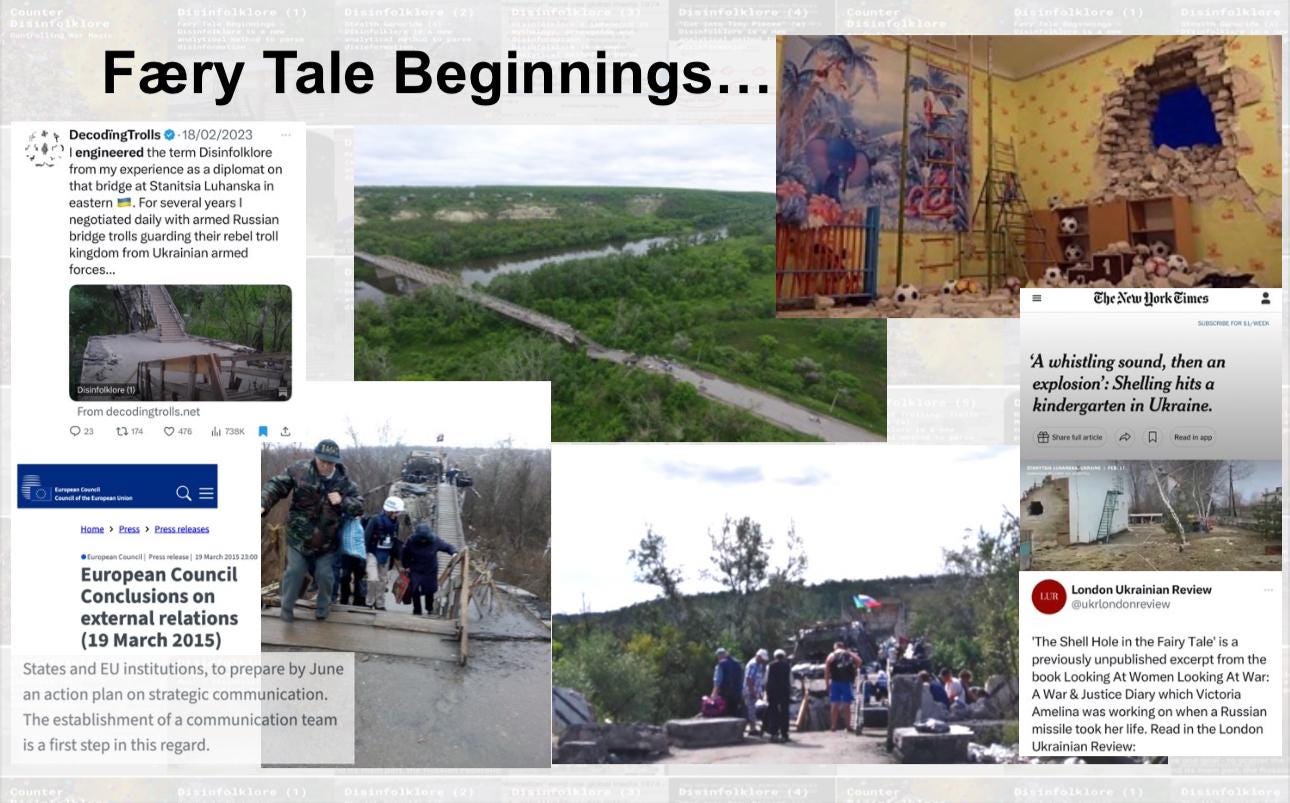
I engineered the term Disinfolklore from my experience as a diplomat on this bridge in Stanytsia Luhanska in eastern Ukraine. The scene itself was a biosphere reserve, forested. The Donets River, a very famous river since antiquity. The Donets is part of this series of DN-sounded rivers. In my work, there are three sounds which are really important and which are immanent in almost every sentence I speak. They’re on purpose now, but I notice them in other people’s speech.
Of these fundamental vocabularies, the most important is the MN sound. The second sound is the RT/RIT sound. The earliest attestations of that RIT sound we get in arta, meaning truth, in ancient Iranian, the Avestan language — arta — and in Vedic, which is the first attested Indic language, ṛta, from 1100 BCE. R-T-A. So you’ve got this right, RIT, meaning truth; arta meaning truth — A-R-T, RIT. That sound is still in the words we use for sovereignty — droit in French, law, or roi — and it’s also in territorial integrity.
The rivers — the third sound is the DN sound. We’ve got the Don River, which marked the border between the area protected by the goddess Europa and Asia. We have this map from Isidore of Seville from about the 6th century. Isidore of Seville was basically the Encyclopaedia Britannica of the pre-Middle Age world. And there’s this famous book — it’s called the Book of Druim Snechta in Irish Celtic. Unfortunately it’s lost. We only know about it through various references. The lore goes that the last copy of it was swapped for a copy of Isidore of Seville’s Etymologies, which I’m sure was very important to have in rural Ireland at the time. But we’ve got tons of copies of Isidore of Seville’s Etymologies and none left of the Book of Druim Snechta.
Isidore of Seville defines the area protected by the goddess Europa as being the area west of the Tanais — the Don, Tanais, Don. East of the Don River is Asia, and east of the Nile River is also Asia, according to Isidore of Seville.
Then you have the Donets River, which is the Little Don River. Then you have the Dnieper River, the Dnipro as we call it now in English transliteration from the Ukrainian — the Upper Don River. If you’re looking at that from Crimea, from the perspective of Crimea, it’s the upper one. Then you have the Dniester, the Dniester River. And then you have the Danube.
You have these great rivers of Europe, all with the DN sound in their moniker. In ancient times, actually, the Danube in Ukraine was called the Danistris as well. So those three sounds.
I was on the Donets. I didn’t know any of this while I was there, thankfully, because I probably would have bored to tears my fellow diplomats with all of this stuff had I discovered it there. But it made such an impact on me — this whole setting. Beautiful forests going either side of the river, willows hanging over, and this road, this bridge, this iron bridge, which is very important in folklore.
On one side of the bridge, about a kilometre north of the bridge, north of the river, was the Ukrainian Armed Forces position defending the bridge and defending Ukrainian government-controlled territory. On the south side of the bridge was where the Russian occupiers were. In May 2016 — I arrived there in February 2015, just after the bridge itself had been blown up, but you could still cross the river. It was a very difficult passage, like in a computer game or something.
A distance of maybe a kilometre and a half between the Ukrainian Armed Forces position on this road to the Russian occupier position, which was just on the other side of the Donets River, just on the south side. It was about 15 kilometres to Luhansk City, which was and is under occupation by the Rushists.
In this whole scene — it was a beautiful halcyon bucolic location. A lovely place with birdsong and trees and wild animals who often would set off landmines in the forestry. Before the war, before 2014, it was really sleepy. It had played a starring role in World War II. In the forests and the areas either side of the river, colleagues would show me shrapnel from the Second World War. There was an enormous amount of ordnance — so much so that there was rusty shrapnel all over the forestry.
While I was there, each night there were massive amounts of artillery strikes from one side to the other, usually trying to avoid people and soldiers. They were marking territory, saying “we’re here,” or maybe responding to imagined threats. Often soldiers would tell me, or people would say, “We get paid,” or “The other side gets paid to fire its artillery.” This is like an archetypal Disinfolklore fable. I never got to the bottom of it, but it’s plausible that that was why they were firing at each other. Some nights I catalogued thousands of ceasefire violations and filled very dutifully my Minsk form, which was then signed by my supervisor — and then who knows where it is.
Each morning I would go down to the bridge and go first to the Ukrainian Armed Forces position and speak to the commanding officer. After a while we got into a routine and they would tell me stories of what had happened the night before, which I would write down. Then I would pass by the sometimes thousands of ordinary civilians who were just waiting in queues on this borderline, this border territory.
A lot of folktales are about borders — between this world and another, between a liminal world, between truth and fiction, between fantasy and amusement. There was this liminal world. The Russians are fantastic at creating these borders wherever they go, and controlling people through starvation and famine and murder, but also through borders and queues.
Then I’d cross the bridge and go and speak to the occupiers. Often the stories they would tell me would be the exact opposite, the mirror opposite of what the Ukrainian soldiers were telling me.
At the same time, I was also doing an MBA at Oxford and travelling back there every six weeks. I was engaged in this other world there in Oxford where we were studying Silicon Valley and entrepreneurial finance and internet companies and various things. I made the conceptual link between trolling in computer culture and trolling as what the Ukrainian Armed Forces on one side of the bridge and the Russian occupiers on the other side were doing to me. They were trolling my emotions with these stories. I could never tell whether they were right or wrong.
I also noticed this phenomenon of how the internet and internet lore interacted with the reality on the ground. The Disinfolklore universe which I saw being created inside Russia-occupied Ukraine is my training set, as it were — like if you’re training an artificial intelligence neural network algorithm, you use masses of data to try and train the artificial neurons to process data. If you want to train it to identify cats, you put in lots of pictures of cats.
The training data set for me is these three years of going and hearing these stories and then watching how the stories that I was dealing with on the bridge interacted with the reality created inside the information space inside Russia-occupied Ukraine, which I went into every day. I spent periods of time — I spent six weeks in Luhansk City over the Christmas of 2016. At all times, including for the four years after I left there, I was very engaged in the information space of Russia-occupied Ukraine.
It was just such a strange phenomenon. It stimulated a lot of intellectual labour on my part to work out what they were doing.
An example: one day, a Russian colleague — because the OSCE, I was embedded with Russians, which added an extra level of complexity to my work there — a Russian colleague and I went to the bridge and there were several tons of sausages in white bags which had just been dumped at exactly the halfway point between the Ukrainian Armed Forces position and the Russian occupiers’ position.
The Ukrainian Armed Forces guys said, “We don’t know anything about this, they just appeared overnight.” Then the Russian occupier said, “When we first saw this appearing, we thought it was a new Ukrainian Armed Forces position. So we trained all our weapons on it. But we’d like you to try and arrange for this stuff to be removed. Otherwise, we’re just going to destroy it all.” And it turned out it was sausages.
Kharkiv sausages, which have a particular mythological significance in the minds of people who lived in the Soviet Union, where sausages were a great luxury. To me as a vegetarian, it’s pretty gross, basically, the whole thing.
I and my Russian colleague spent about an hour with the armed Russian occupiers inspecting the sausages. They were showing me the sausages and cutting them open. I have photographs of it all. And then there were drones around filming us.
For the next three weeks, me and my Russian colleague were appearing in Disinfolklore stories in the Russian occupation. The stories developed from: we were smuggling it. They had no compunction, no problem with dropping their own operative in this by saying the OSCE was basically smuggling sausages into Russia-occupied Ukraine to make a bit of money on the side.
Then various other iterations of this. The story featured every day for a few weeks, eventually becoming: this was the Ukrainians trying to poison us, so we’ve destroyed all the sausages — they’ve blown them all up.
This was a classic, archetypal experience for me, where I personally featured in a whole vector or instance, an observable — a whole system of trolls on one theme, on one temnik. I call it the luxury sausage troll saga because it went on. It’s the mundane interacting with the slightly annoying, because I did have to explain to my boss, “No, I had nothing — I wasn’t, I didn’t do any of this.” As a new story would come out, they’d ask, “Well, what are they saying?” Some people immediately dismissed it. Others began to believe it.
I had other instances like that. There would be an explosion and I would go to try and find out what had exploded — had someone fired something or not. I passed one particular occasion, I passed a Ukrainian soldier who was just polishing his RPG, his weapon which fired grenades. He was polishing it. I said, “Did you hear that explosion?” He said, “No, didn’t hear anything.”
Then I go on another 500 metres to the Russian occupiers and I say, “Did you hear that explosion?” The senior Russian officer — the most senior officer I had knowingly dealt with at that point — suddenly took me on this whirlwind tour of damage to the bridge, showing me clearings in the forest where the Ukrainians’ diversionary group had apparently fired at them. Then he shows me blood on the ground. But actually, it’s blackberry season and raspberry, and loads of tons of blackberries are being transported across this bridge from Ukraine into Russia-occupied Ukraine. So I wasn’t quite sure whether it was real blood or not.
The next day our team was there and they were shown injured people who were still around. And then others. And then stories were saying there were crisis actors. This whole new system of trolls again.
That’s my training set. When I’m reading about accusations in MAGA lore about crisis actors, or Pizzagate, or practically every day we’re reading about bizarre stuff on Twitter since the full-scale invasion — most of us have a good nose for it now — but this was the origins of my training set. That’s where I came up with the idea of Disinfolklore, which is this form of narrative akin to folklore, using the same, triggering the same emotional impacts as folklore, but which has real-world impacts on how you perceive reality.
All of this took place in an area which, for me, I associated with folklore the moment I arrived there because of the forest. These houses. I’ve spoken before about the Mother and Maiden in the Woods tale, which was another of these archetypal moments when I understood what was going on and the Russian use of archetypes in their Disinfolklore.
Our only reference point — we perceive reality through folklore much more than we’re consciously aware of. I’m aware of it because I’ve spent the last eight years of my life trying to make sense of my experience there during the three years.
Victoria Amelina had written about the Executed Renaissance, which is this phenomenon of the 1920s in Ukraine. I’m sure this has been in other segments. The Russians decided they were going to have to brainwash the Ukrainians, but they couldn’t do it through Russian because they only spoke Ukrainian. So let’s pretend we’ll support their culture, but we’ll give them 10 years of Ukrainianisation.
Putler constantly bangs on about this — he’s on record many times saying he wants to correct Lenin’s mistake. By that he means Ukrainianisation. You had this great flowering of Ukrainian culture during the 1920s. And then, naturally, the Rushists executed all of them — hundreds, thousands of Ukrainian writers in different ways. In this forest in Finland, but also in Kharkiv.
Victoria Amelina — I learned about it from her writing. Then, of course, she was going around Ukraine collecting stories about the violence for the war crimes tribunals. She published her diaries before she was murdered. Again, murdered. The Russians are really thorough about how they try to destroy Ukrainian culture. And they will be thorough about trying to destroy our cultures if we give them the chance. Just look what they are doing to American political culture at the moment, and America’s reputation, just by dint of this bizarre spectacle of Witkoff and co.
This is what the Russians do. They pollute and contaminate everything.
One of Victoria Amelina’s short stories was “A Shell Hole in a Fairy Tale.” The fairy tale kindergarten I knew well in Stanytsia Luhanska. In one of the first salvos in the war, it was the Wagner group — who I encountered in Stanytsia Luhanska in 2015 — they were first given the job of invading the rest of Ukraine from there on the 24th of February 2022, and they fired a shell into the fairy tale kindergarten in Stanytsia Luhanska.
I have this great photo, because it was on the front page of the New York Times: “A whistling sound, then an explosion — shelling hits a kindergarten in Ukraine.” You can tell, you don’t really need to be an expert in understanding how missiles work, to know that the entry point is from the southern end into this kindergarten. I think that was around the 22nd of February — before everyone recognised the full-scale invasion.
When I saw that, and when I saw them also bombing the Shastia power plant, I knew the whole war was imminent in those two actions. Destroy the kindergarten and try to kill children. No one was killed in that. And the otherworldliness of the photograph — the kindergarten is really important, even more so than in Ireland where I grew up or in Western countries. I would postulate that it was very much part of the culture in the Soviet space. Brainwashing began in the kindergarten, I suppose.
But what Ukrainians did after 2014, in each of their villages with this decentralisation, they invested huge efforts into bringing their kindergartens and these institutions — which they had inherited from the Russian occupation — up to European standards. Going around, particularly in the years from 2018 to 2022, when I was based in Dnipro and mainly ranging around Dnipropetrovsk and Zaporizhzhia oblasts, particularly the area of southern Zaporizhzhia oblast around Huliaipole. They had European-standard schools, with massive amazing sports facilities that had all been built using money coming from USAID, from the European Union, and from Kyiv.
The desecration of these symbols of Ukraine’s post-2014 emergence from its Soviet cloud — which the Russians of course still have never achieved. There’s probably a few elite places in Leningrad or Moscow where you have top-class European-standard schools, but the rest is just rubbish everywhere. But Ukraine had these. Firing a shell into the fairy tale kindergarten.
Everywhere I look are these folkloric references. You have this fusion, this melding — the sausage troll saga, this bizarre situation which could have caused a war, could have been the war if the Russians had destroyed these two tons of sausages in these white bags that Saturday afternoon. I never got to the truth of what had happened. I presumed it was some sort of smuggling operation, even though I was there.
Out of that, the Russians create all of this Disinfolklore — all of these stories to help implement in the brains of Ukrainians living inside the occupation the idea that they were under threat. The international community was trying to poison them with poisonous sausages. We were just these hypocrites here trying to monitor the peace, yet all we were interested in was smuggling sausages.
The symbolic significance of sausages — to a Westerner like me, I learned. But sausages, especially Kharkiv sausages, luxury sausages, in the minds of people of a certain age in Russia-occupied Luhansk, were still this great luxury. It has this resonance, this symbolic resonance, which may be invisible to us.
All the elements of what I now understand to be Disinfolklore — this fusion of reality with fiction, with folklore, which has a really strong emotional connection — it’s more than merely watching a film or reading a good book which has no strategic intent behind it. It’s a method of changing how we actually perceive reality. It has the effect of brainwashing people, whether they’re in MAGA or in Russia-occupied Ukraine.
Maybe now we’re seeing the high point of MAGA. I hope so. And I hope the relentlessness of these tens of millions of Epstein documents, which explode the foundation — the main foundation myth in MAGA — that perhaps this will have the power to wake everyone up from their spell. But we can’t be sure.
The sound “right” or “writ” is in both those terms: territorial and integrity. It is also in sovereignty, but it is disguised as the “reign” element—reine in French—originating from this idea of straightness, truth, and the rod. For instance, President Zelenskyy held a rod in his right hand when he was inaugurated as president in the Verkhovna Rada. The current English King, who is sovereign—there is only one sovereign on the island of Britain, and that is the King—also held a straight rod in his right hand when he was inaugurated as monarch.