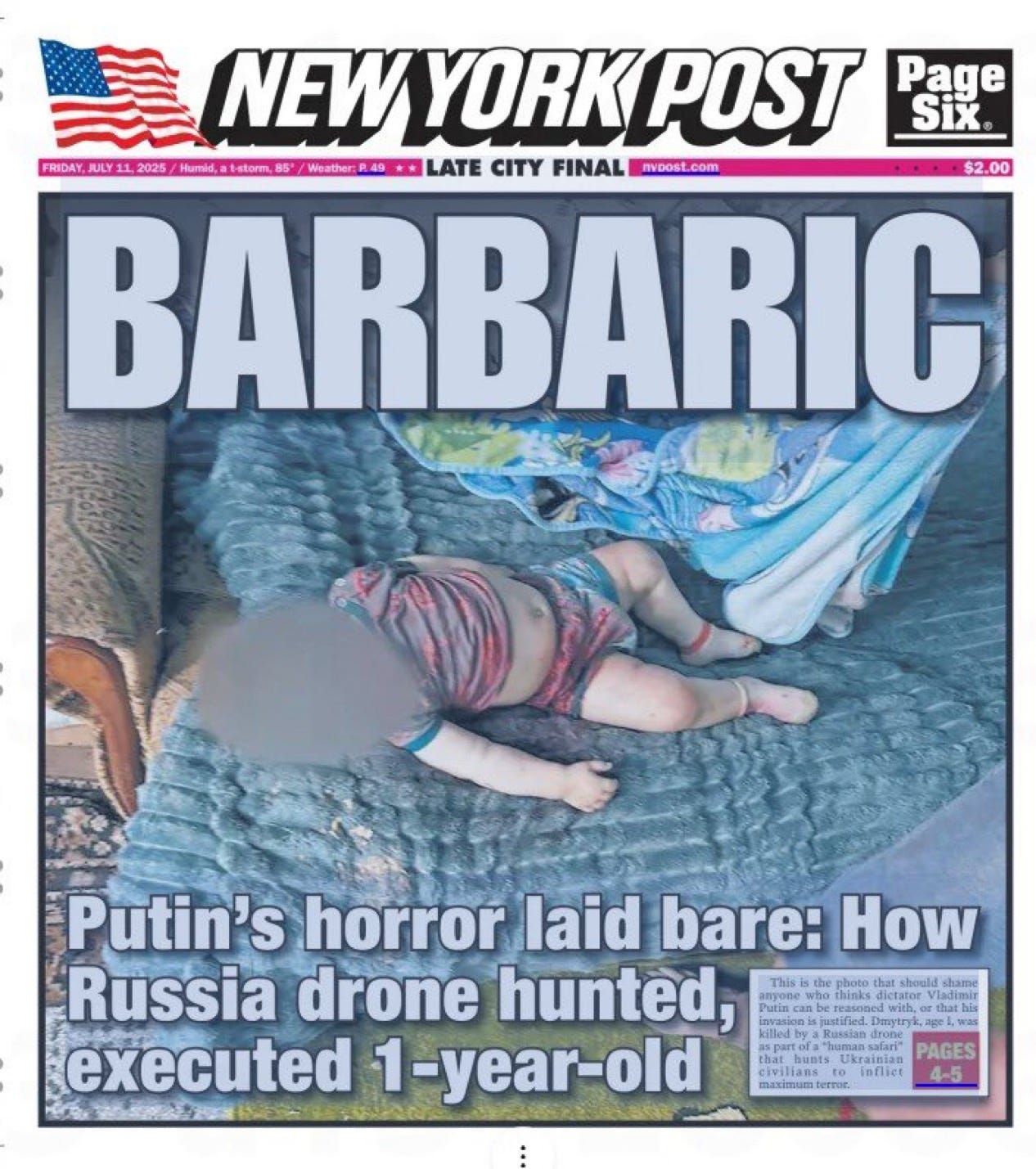
Disinfolklore is Russia using First Person View Drones on human prey to train its drone pilots.
Then the Russian state publishes the footage of these murders, from the perspective of the First Person view drone pilots as they close in on their human prey.
This is archetypal Disinfolklore: create the event (in this case murder), then publicise it using different memes and means of storytelling. Russia’s only in Ukraine to create social media content, which it uses to troll its own population and America’s leaders into perpetuating Ukraine’s annihilation. Disinfolklore always has a purpose. Infolklore (such as this podcast), by contrast, has an opposite purpose.
After detailed investigations into 200 of the 2,800 murders of civilians by Russia using First Person View drones in Kherson, the UN Commission of Inquiry has determined these are Crimes Against Humanity.
The UN Commission of Inquiry based in Vienna has issued a report on the human safaris in Kherson that all of us are aware of, which have been going on since July 2024. It has established that these are crimes against humanity.
Part of the indictment of Russia and those participating in the prosecution of these crimes against humanity — interesting to use the word “prosecution” there — is that Russia, the Russian state, is sharing these videos of their human safaris, of the 140 people they’ve murdered using first-person-view drones. The Commission of Inquiry determines that because they are first-person-view drones, the operators are hunting individuals, chasing them, watching as they murder them, and then sharing these on what I call the Disinfolklore apparatus: Telegram, X, Facebook, Instagram, and now sadly the White House press room.
These videos themselves are a perfect example of Disinfolklore. They breach all ethical guidelines — which is the second of the six criteria I use to determine whether a story constitutes Disinfolklore. The second criterion is “right” or ethical discipline. Obviously it’s morally wrong to engage in human safaris. There’s no law anywhere, moral or otherwise, which allows this.
Now we have a determination by a UN commission specifically established by 184 UN member states to inquire into Russia’s war crimes in Ukraine. It determines that these are crimes against humanity — there is no greater crime in the human family. Therefore, the breach of the second element in the Code of Positive Trolls, which I use to distinguish between a unit of Disinfolklore and a unit of folklore or any other kind of story or narrative form — now we have this determination. That’s a perfect example of Disinfolklore.
Much of what is on Telegram — and of course Telegram features in Russian combat propaganda, in Russian military strategy, where you have this concept of “information confrontation” in which informational units and the environment are engaged in a confrontation — here we have Telegram, specifically leveraged by the Russian state, to communicate Disinfolklore into the inner minds of humanity. Very successfully. It is acting in concert with the military apparatus in Kherson.
It’s not just killing these people. It is spreading the stories, spreading the images of these people being murdered, as part of its plan to dominate the inner minds of humanity and create terror — not just in the minds of the people of Kherson (and this is not me, this is the inquiry), but inside the minds of humanity as people gradually become aware of what’s going on.
That’s a good example of what Disinfolklore is in practice.
What helped me see this pattern — this is what I really do, I hunt for patterns in data. I assimilate, as many of us do who participate in X, because X, as we now know from the third report on Foreign Information Manipulation and Interference by the European Union, released a couple of weeks ago — I highly recommend reading it along with the first two reports — X is where, on a dataset of I think over 40,000 FIMI instances collected by the European Union, X was involved in 86% of them.
This is where we all are. I know many of us have ethical dilemmas about whether we should be here. Most of us are also on Bluesky and other places. But the fight is here. The examples are here.
I saw Margarita Simonyan tweeting again in her folksy Disinfolklore way — she does this a lot, telling these stories, as indeed does Donald. They tell stories of frankly horrifying things. This goes to your question, James.
For instance, the way Donald communicated — I think it was March 2024 — that if the head of a major NATO country said to him, “We can’t pay for our NATO membership, would you protect us?” he said, “I’d say, you know, do whatever the hell they want with you.” This unit of information was then reported by CNN as a fact — that Donald had told this head of state that America wouldn’t protect him. But we’re not clear whether this ever happened. It was reported as a fact by CNN. And so you see these folksy stories get taken up.
Simonyan tonight — she’s talking about how “people in the offices in Moscow” are saying that if Germany gives weapons to Ukraine, Ukraine won’t be able to do anything with them without Germany’s help, therefore Germany is complicit, and so they’ll have to strike Berlin. This is a classic piece of Disinfolklore.
There’s a distancing device in the narrative form. It’s presented as a folksy story: “people in the offices of Moscow” — as if she’s just heard this gossip. She’s said this before, when she spoke at the St Petersburg International Economic Forum in June 2022. Many of us will remember this. She said: “People in Moscow are saying that all our hope is in the famine.” And then she interprets what these folksy people are supposedly saying.
She’s sitting beside the head of state. She’s sitting beside Putin himself on the dais at the St Petersburg Economic Forum, dressed in green — which is why I call her Maid Marian Simonyan, like a reverse Robin Hood. This is an aspect of the Disinfolklore analytical method: we can use these folklore archetypes to interpret those who are themselves using folksy archetypes, and to combat them.
She said: “All our hope — the people in Moscow are saying — all our hope is in the famine. And what they mean by that is” — this is her interpreting what the ordinary folk in Moscow are supposedly saying — “there will be famine in Africa and the migrants will come to Europe, and then the European Union will release the sanctions because it’s impossible for us not to be friends.”
This is the folksy banter of the schoolyard. This is your seven-year-old child speaking to their best friend after an argument: “It’s impossible not to be friends.” But this isn’t a micro chat in a schoolyard. It’s a conversation sitting beside the head of state of a country at war, which is planning to starve millions of people in Africa in a madcap attempt that you’d only see in literature — in Don Quixote or in some folktale.
The madcap plan to win in Ukraine is to starve millions of Africans. That will provoke the Europeans into lifting the sanctions. Then Russia will become friends with Europe and Ukraine will be abandoned. The way she tells the story, it’s solid Russian strategy, but told in a folksy way. It’s absolutely horrifying when you analyse what it’s saying. But it passes most people by. It enters their inner minds.
As indeed does this stuff archetyping the former president of Russia as drunk. Many sensible people were tweeting today the content of Medvedev’s tweet, once again threatening World War III if something happens — I think related to the Germans. These are folktale archetypes, folksy stories which communicate really horrifying things when you parse the data. It’s a pattern they use. And it’s really effective, because people like us share these because they provoke something in our emotions. Even if we think we’re harming the former president by archetyping him as drunk, we’re still repeating the meme. The horrifyingness is slyly communicated, the energy continues, and it pings around the world.
Thankfully, today, as many of us know because we’re tuned in, we see great advances in our political leadership over what we’ve experienced since February 2022.
But this method of communication has had impact. President Biden’s policy — “don’t poke the bear” — is the Disinfolklore meme, probably the most successful one ever, that actually impacted foreign policy. It stopped America properly helping Ukraine.
International relations itself, the entire discourse, is full of these metaphors and Disinfolklore — “don’t poke the bear” being one — Disinfolklore memes that are represented as a means of communicating foreign policy and strategy affecting the lives and deaths of millions of people. Whereas in fact, these strategies are only communicated by means of these memes, and through these memes.
What I have spotted, which as far as I’m aware no other writers have really noticed, is this continuity across multiple narrative forms and discourses. It’s obvious in anthropology, folklore studies, or Jungian psychology, when they’re referencing myths and archetypes and storytelling. But the same dynamic is at play inside international relations discourse, inside the speeches — until recently — of many of our leading politicians. And obviously everything Donald says: he speaks Disinfolklore fluently.
It’s these folksy stories: from the January 6th anthem of the January 6th insurrectionists, organised by the current head of the FBI, to the songs used at his rallies, to the folksy way of speaking about Al Capone, to the archetyping of Melania as Al Capone’s wife — wearing haute couture clothes made by Ukrainian fashion designers in LA, DressX, who supply haute couture interpretations of comic-book aesthetics for people like Elon Musk and Melania Trump, who want to archetype themselves as characters in our information space by referencing through their clothes superheroes or characters from folklore, from our contemporary folktale.
That’s a sample of the scale of what I believe I’ve identified with Disinfolklore as a narrative form.
To answer your question, it’s basic. I took the idea of archetypes from — I’m a Buddhist — from Tibetan Buddhism, where the entire practice is about embedding archetypes in our minds: very scary images of the Lord of Death, Yama. What I noticed in Jung’s work: he says he took the idea of archetypes from St Augustine. Again, it’s the similar idea of trying to embed these tropes.
I use the term — so for me, the fundamental metaphor is “troll,” the fundamental unit of information. That’s another term I use: “units of information” or “meme.” Those three are synonymous for me and I use them interchangeably. I’m very happy to use the word “meme” — visual, audible, it’s an informational unit of any size. It could be a whole book or it could be just a flash of colour. In my conception, archetypal identities can be attached to these memes.
In my philosophical anthropology, for want of a grand term — but we’re among anthropologists here — the archetypes can be identified with these memes.
For Jung, he didn’t have access to the same archaeology, linguistics and ancient DNA that we have. When Jung was writing about Tibetan Buddhism, he wrote the introduction to the second edition of the Tibetan Book of the Dead, which was found by Evans-Wentz, who wrote his PhD thesis at Oxford on fairy tales in Yeats’s work, and who was a follower of Madame Blavatsky — who’s from Dnipro in eastern Ukraine. Blavatsky created the religion of Theosophy, which fused ancient Egypt and ancient Tibetan and made up a lot of stuff. But she would have picked up a lot of it from Ukraine.
What we know now, but Carl Jung couldn’t know, is that what he considered universal and part of the collective unconscious of humanity — actually, all the examples he gives are from Indo-European languages and religions. He didn’t know this then. He didn’t really understand, and many people still don’t understand, Tibetan Buddhism, for instance, because it was transmitted from the Vedic into the Sanskrit into the Tibetan. Now it’s coming back, preserved in Tibetan, a non-Indo-European language. But basically its content is Indo-European.
In all of my work, I am only ever talking about archetypes that work on Indo-European-structured minds — the minds of those whose native tongue is an Indo-European language. That’s the only claim I’m making. I’m not talking about the collective unconscious of humanity.
But what I can say from my own experience of watching, observing and experiencing propaganda from the first moments on that archetypal bridge in eastern Ukraine, where I spent three years in a forest, is that I perceive the world through archetypes. When I read information that contains what I call archetypal identities — characters — so Ukraine can be archetyped as a weak woman. Putin does this. He did this four days before the full-scale invasion, when he said: “Like it or not, take it, my beauty.”
International lawyers noticed — I’m also a lawyer by training — they didn’t use the word “archetyping,” but they intuitively understood it. They said what Putin was doing was representing Ukraine as a corpse.
Putin got this particular phrase, which means a lot to Russians, because it featured as a song lyric. Songs are very much part of the beginning of folklore, which led to the foundation of nation-states. The first unified German state, the first modern Irish state, the first modern Greek state — these are all the products of purposeful campaigns based around mythology and folklore to establish a unified identity that helped create community and resist occupation.
When Herder in 1777 launched the German folk-song movement and inspired Goethe, and the Brothers Grimm — who all of us will remember as children — to collect folktales, and inspired Wagner, leading to the first unified German state 90 years later, they set out purposefully to collect common culture in the form of stories.
The same in Ireland. The Irish Cultural Revival — the first president of Ireland was a folklore collector. He, among others, created this sense which was empirically true, but Irish people didn’t understand until a 30-year campaign revived Celtic culture as a distinct culture from the Germanic-English occupier.
Germany under occupation in 1777 by the French — French generals actually living in Goethe’s house in Frankfurt, which I visited — a very different kind of occupation to the one we’re all aware of. Same thing in Greece against the Ottoman Empire. They collected these stories to create a sense of community.
This is what I realised the Russians were doing, and what MAGA is doing. Creating these archetypal in-jokes. If you’ve listened to any of Donald’s campaign speeches — and I’m sure you have, James and Wendy — where he’s talking about Hannibal Lecter, a fictional character, using an archetypal character in our modern culture that people of a certain age will understand. People today between probably the ages of 50 and 70 will remember Hannibal Lecter as a film character.
What Donald is doing is not linking into archetypes embedded in all of humanity, in my humble opinion. He is ripping off the archetypes of which the cognition of a certain subset of Indo-Europeans, at a certain moment in a certain culture, are aware. Hannibal Lecter in that case. Al Capone for obvious reasons — the man who was found guilty of 34 felony counts, and of acts tantamount to, I won’t mention a horrible word, against E. Jean Carroll.
Donald is counter-archetyping, which is what I try to do as well when I call him Duncy Putler or Druidy Don. But what I believe they’re trying to do, and successfully doing — and this ties into my understanding of deep Indo-European religion — the Lord of Death is one of the primary, primal, primordial archetypes inside Indo-European cognition. Whether represented as Jesus Christ, or Yama in Hindu religion and Vedic before it and in Buddhism, or Odin — Woden’s Day, Wednesday — these are all self-sacrificing first monarchs.
Basically, I think what they’re effectively doing is saying — and this resurrection of Stalin is saying — “I control your death.” This is what Donald is doing, whether it’s vaccines or anti-vaccines or all of these terrible policies that lead to people’s deaths. The same with Putin and Stalin. They’re saying: “We control the time of your death.” This is a very old, ancient, tried-and-tested formula for exerting psychological control over people.
I guess this is partly connected to the drone safaris. What the Kherson situation is — we see this as a harbinger of what is to come. They can do this through various means. There are almost infinite stories that can be used to communicate these fears into people’s inner minds. And that’s what I believe they’re doing.
Watch this great documentary by Zarina Zabrisky:
https://khersonhumansafari.com/#card-6ewvucrvz5dt2uy