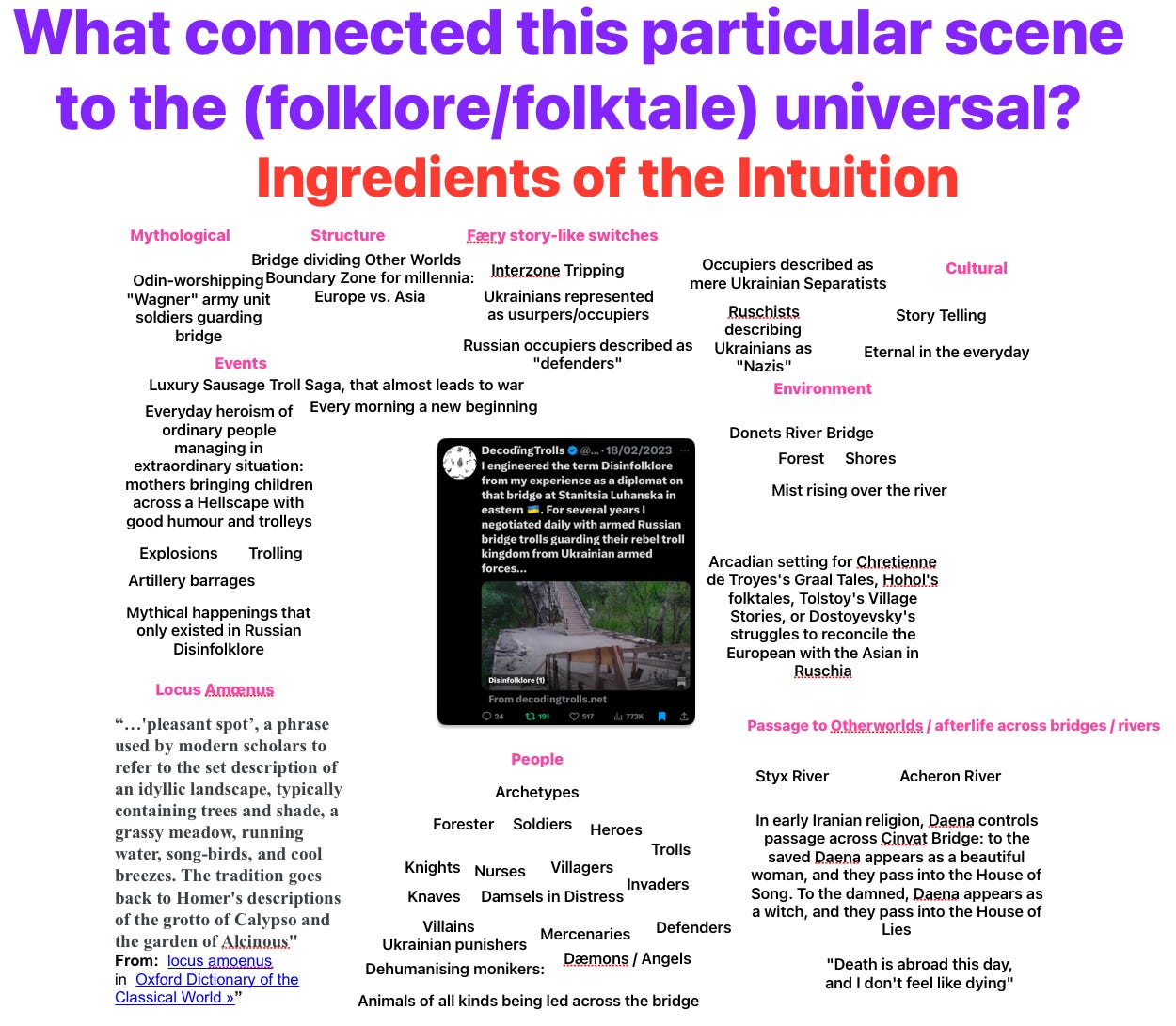
Last week I was right back at the bridge at Stanytsia Luhanska and I went through the luxury sausage troll saga and the complicity between the activities which the Russians, and indeed the Ukrainians, create on the ground, but then the complicity between these actual activities and how the Russian Disinfolklore apparatus, the propaganda apparatus, then spins these actual events.
What I wanted to talk about today was the folkloric dimension of the bridge, because that’s obviously quite fundamental to Disinfolklore. I’m aware that most of us haven’t thought too much about folklore since we were children. I wanted to bring us through how I had this intuition — unwrapping that intuition that there was something folkloric about that situation — into what has now become the Disinfolklore analytical method.
The saga of me and my Russian colleague featured in a whole array of Disinfolklore stories spun by the Russians. But there’s another aspect of the bridge and that situation I was in that struck me almost the first moment I was there.
One thing I’ve noticed, by listening to Chuck Pfarrer since the Maria days, and Alan as well — I’ve actually learned quite a lot of how he thinks, how a Navy SEAL thinks and computes data. Every now and again, someone in my real life who doesn’t pay that much attention to Ukraine but is interested in what’s going on, I find myself speaking about what’s going on — like, for instance, about Pokrovsk in November — being able to channel what I was learning from Chuck Pfarrer and how he was looking at the battlefield. He didn’t think it would fall that easily. I realised I’ve actually learned quite a lot. A certain part of my mental architecture, the way I compute data, especially battlefield stuff, has really developed and evolved a great deal as a result of listening for three or four years to Chuck Pfarrer.
By analogy, that’s what I’m trying to do with the Disinfolklore analytical method. I’m grateful for these opportunities, these shows, which is just to give an idea of how I think about this kind of data and how I control it going into my mind.
But I didn’t start out that way. I forged the word Disinfolklore out of disinformation and folklore in February 2023. I established a folder on my computer in February 2020 called “Folklore.” That folder is where I was putting all these texts that I was reading to try and understand what trolls and trolling was about. Out of that initial attempt to look at how those terms were being used in the media, tracing them back — that led me on this massive journey, which I’m still on, into the origins of Indo-European languages, but also particularly through this data set I got from Factiva of tens of thousands of references to trolls and trolling.
I had that folder on my computer called Folklore, and then disinformation, obviously, was one of the words. It could be misinformation or disinformation. In February 2023, I was trying to think of a way of how I can archetype everything I have learned since being on the bridge. That was February 2023, a year into the war as well, where I realised — because of my experience on this bridge from February 2015 onwards, seeing and looking at patterns and data — that I had a particular way of perceiving the daily diet of information we were receiving through X and through Telegram. At the time I was on Telegram and looking at it for the full-scale invasion.
I spent the first month of the full-scale invasion collecting information for the OSCE’s Moscow Mechanism mission, which then in April 2022 produced the first report. It was charged by 44 countries, nation states, to inquire into Russia’s conduct of the war in Ukraine for the first month. That report was then cited in the definitive, historic, comprehensive 600-page judgment delivered by the European Court of Human Rights about three months ago on Russia’s violations of the European Convention on Human Rights.
I was collecting this data initially to help these four jurists who were producing this report. But I found that I had a particular perspective on it that was worth sharing. I was looking for a means of naming it, naming what I was doing. I consciously sat down one day and wrote down “disinformation” and then “folklore.” Disinfolklore was then pretty obvious because of the F in disinformation overlapping with folklore. That’s where the moniker, the branding, was born.
Instead of including the word folklore, I could have chosen song, or folk song, propaganda, stories, narratives, or a heap of other words to describe the new phenomenon I’ve identified. Folklore, however, captures best the way of seeing — in the sense of that brilliant book by Berger, Ways of Seeing, ways of looking at art. I think it’s from the early 70s. That title, that idea from Nietzsche as well — all knowledge is perspective. This idea of ways of seeing is as valid today, to see what I describe as Disinfolklore, as folklore was in Jacob Grimm or Herder’s times.
I mentioned Herder’s call last week, in 1777, where he said: we’re under occupation by the French and we need to unite the 10 Germanic tribes. In order to do this, we need our Shakespeare. Where is our Shakespeare? We have no Shakespeare. He launched the folklore collection movement in Germany, which recruited the Grimm brothers later and Goethe.
It’s quite amusing in a very nerdy way that one of the origin stories of the folklore movement is in Macpherson’s Ossian tales, which turned out to be faked. From the 18th century, they brought into the consciousness of all of Europe — Europe was basically convulsed by these stories of peasant wisdom and the found document, which is a trope across Indo-European culture, including in Tibetan Buddhism, of these documents which are suddenly found somewhere under a rock.
Macpherson is the archetypal Disinfolklorist because he did communicate something very authentic — they’re mainly based on Irish folklore — but he did it in a deceptive manner. But who can blame him, because it was that work which then inspired Herder to realise: we can create a sense of national self-identity by collecting stories and finding the archetypal stories of the German people.
For three years I had been researching Indo-European mythology and folklore — the three years before 2023, a year into the full-scale invasion. For three years I had been researching Indo-European mythology and folklore as a means of seeing how Russia and MAGA were using stories to create community. I was looking for that moniker, and then Disinfolklore just suddenly came to me — a bit like all those famous Eureka moments.
When I arrived, the reason I had this folder called Folklore on my computer was, yes, I was trying to look at trolling and trolls. But from almost the very first moment I arrived at the bridge in Stanytsia Luhanska — which is on the Donets River, in a biosphere reserve area, beautiful forestry either side of the river, weeping willows whose leaves are falling into the river and whose boughs are bowed towards the river, and a bridge across it — on either side of the bridge were the Russian occupiers on one side and the Ukrainian defenders on the other, separated by a kilometre and a half. There were all these old houses, beautiful old wooden houses. Typically the architecture around that part of Ukraine is brick-built first storey, and then they have wooden tops.
This didn’t fit my archetype of Russia or the Soviet Union, where I thought everyone lived in these horrible apartment blocks. That’s from the perspective of a bourgeois Westerner, where these apartment blocks generally seem like the equivalent that Americans see as projects. But now, having travelled a lot around central and eastern Europe, I realise that that archetypal meaning of these places is not consistent with the data — you have lovely, well-looked-after apartment blocks. To the untrained eye, they just look like a council estate in South London or something. But when you get close to them, you see a whole community of people looking after them, with people from all parts of society living in them.
At the time, it was quite surprising to me that people in the former Soviet Union would live in these kinds of houses — I’d learned about collectivisation and getting rid of the kulaks. But eastern Ukraine, as we’ve probably all seen in these images, is a beautiful, amazingly beautiful place. There’s something folkloric about it, and I saw that the moment I arrived there, because my only reference point when I arrived was folklore and stories I had read in Ladybird books, or Hansel and Gretel, or from Disney films. A lot of the scenes I saw there — my only archetype in my consciousness was folklore. I had that intuition.
I’m not going to say the first time I went to the bridge at Stanytsia Luhanska — we gradually moved there, closer there. The first day I arrived in Severodonetsk in this hotel called the Mir Hotel, which is now no longer with us, like so many buildings I know in Ukraine that have been destroyed and looted. I was only there for seven years. I often reflect on this: if so many places dear to me — including hotels I stayed in and my own house in Severodonetsk, which was destroyed, and my next-door neighbour was torn to pieces by Russian artillery, and then his friend went to rescue him and he was torn to pieces too — if I have had this experience, even though I only lived there for seven years, then what it must be like for Ukrainians to have whole cities and towns disappear from them. It often gives me an idea of the scale of the destruction.
Sitting in the Mir Hotel in Severodonetsk, where I lived for my first year there, we gradually moved closer to Stanytsia Luhanska from Severodonetsk. It’s about 180 kilometres, and there were terrible roads. We would drive there each day, there and back. About a month after I arrived, we finally got to the bridge for the first time.
Pretty early on, I intuited there was something folkloric about the situation. I had an intuition that folklore was connected to it. There’s this idea of a bridge — in folkloric tales, something mediating between worlds and other worlds. The bridge was both a metaphor and an actual fact.
On the Russian-occupied side of the bridge, they were Wagner soldiers guarding it. Not only had they — by that time, this was before the mythology of the Wagner Group had really entered the mainstream. It’s probably a bit hard for us to remember this, but the Wagner Group really didn’t — most normal people didn’t know anything about Wagner Private Military Company until about 2022, 2023. People paying attention to Russia and Syria would have known about them. But in 2015, this was very close to their beginnings.
From my earliest times there, I was coming across mythical stories about these guys, these amazing mercenaries. But what I was seeing in actuality was scrawny, scruffy mercenaries in really bad, unkempt uniforms. I was aware that something cynical was going on to create out of them this mythology about elite forces.
While I was there, as all of us know, the initial resistance — and the hint that Ukraine would defeat Russia — was already visible in the period from April 2014 to September 2014. It was a ragtag group, mainly a couple of groups — Azov and Pravyi Sektor — composed out of football supporters’ clubs, mainly based in Kyiv, who became magnets for resistance to the Russians. With the help of some oligarch cash — in the case of the Dnipro 1 and Dnipro 2 battalions, which were paid for by Kolomoyskyi and Dnipro’s Jewish community who armed them and got them up — the storied second army in the world was already on the back foot by September 2014 by this ragtag group of people who became soldiers and now obviously are part of the Ukrainian military.
A mirroring process went on in Russia-occupied Luhansk, where you had a lot of community groups of people just protecting their local community. Either they had believed the Disinfolklore about the Ukrainians coming to kill them, or they saw the rapacious mafia-run militias and wanted to protect their neighbourhoods. The Wagner Group were given the job of eliminating these groups of armed resisters and people who just wanted to protect their neighbourhood in Russia-occupied Luhansk. I was there while that was going on.
Then, as I realised, they took their mythology from this guy who was supposedly killed in the aeroplane that supposedly killed the Chef. Again, another moniker from folklore, another archetypal moniker — Prigozhin, the Chef. He’s just Putin’s chef. He’s a restaurateur. He’s in catering. And yet he financed the operation which got Donald elected and got Brexit done.
They took this ideology of Wagner — the German composer, who was part of Herder’s project. He was much later and Herder was well dead by then. But he continued, he was responding to Herder’s 1777 plea: where is our Shakespeare? We have to create songs. They weren’t even talking about stories like the Grimm brothers were collecting. Herder was talking about songs. Wagner helped create that sense of German identity with his songs and operas and shows, which were based on mythology that really only existed because the Roman historian Tacitus had collected these stories and published them in Latin in about 80 CE.
A lot of what we know about the origins of the Germanic people — that Mannus had three sons — and a lot of the material I deal with in my Finding Manuland project comes from this Roman historian, recorded in Latin. Wagner the composer went back to this and created this sense of pride and unity in the German people.
But the guy, Utkin, who supposedly formed the Wagner Group — he was fond of the aesthetics of the Nazis. Again, that’s the Russian account from 2016, which I preserved: “Who are the Wagner militaries?” And it’s like: “He’s not really a Nazi, he just likes the aesthetics of the Nazis.” But of course, the aesthetics of the Nazis — the uniforms and such — were very much part of how they brainwashed people and created their sense of identity. You can’t separate the aesthetics of the Nazis from what they do.
They deliberately take this German composer, this high-art composer, which again trolls people into pronouncing it “Wagner.” You’ll notice I haven’t pronounced it “Wagner” because I don’t want to give it any positive connotations and I don’t want to communicate that I appreciate Wagner’s operas. Of course Wagner is a great composer. He can’t be blamed for Hitler. I’m not interested in that. What I am interested in is how, from the very early beginnings, the Russians were using this mythology about the Wagner Group — this elite force whose name came from someone whose entire intellectual project was to weave, out of mythology, out of archetypal Germanic mythology, a sense of collective identity — and how these operatives became characters inside Russia-occupied Ukraine and executed enormous numbers of people.
In February 2022, they were given the job. It was the Wagner Group. I think it was Nile once who persuaded us on Volya, or on Maria at the time, that we should be subverting this and calling them “Wanger.” I’m happy to hear Mokrushyna has stuck with that, and I’ve stuck with it as well. Every now and again someone points out, “No, it’s not Wanger, it’s Wagner.”
They create this mythology about a private military company. There’s something folkloric about that. There’s something folkloric about the whole structure of the position — the bridge, as I mentioned, dividing other worlds. One world from another: Russia-occupied Ukraine from government-controlled Ukraine, paradise from hell.
In daily life on that bridge, most days I would speak to dozens of people and hear dozens of stories. Through my interpreter, through my amazing translators, I’d ask them: “Tell me about your journey today. How was it?” Luhansk City is about 14 kilometres away, but it might take them seven hours to travel that 14 kilometres. Russia specialises in creating these border zones. One of their unique skills is just to create hell on earth.
The bridge was dividing other symbolic worlds — in folklore and in folktales — but also in actuality. The tales people spoke of, travelling from Russia-occupied Ukraine into there. That particular spot has been a boundary zone for millennia. The Donets, the Don River, is the dividing line according to Isidore of Seville, who was the Wikipedia of the 6th century. Your monastery was nothing if you didn’t have a copy — or it was everything if you had a copy — of Isidore of Seville’s Etymologies.
The Don River, according to Isidore of Seville, is the dividing line with Asia. Everywhere east of the Don, the Tanais as Isidore calls it, is Asia. The Donets River itself, as the Little Don River, has been a boundary zone for millennia. And here it was a boundary zone again from 2015 onwards.
In the Second World War — this always really blew my mind — it was also a boundary zone. The Nazis and the Soviets fought right there. In the forestry all around it was rusty old shrapnel from that time. Here it was again. It was paradise between 1945 and 2014. No one in 2013 would have predicted this was going to become a boundary zone again.
Then there were the events, like I talked about last time — the luxury sausage troll saga — that almost led to war. These are folklore-like events.
Recently I visited this amazing place in Turkey, Göbekli Tepe, which is often described as the first monumental site — basically three stone circles with lots of orthostats and designs from 12,000 years ago. It was discovered a decade or two ago. On these orthostats, on these stones, there are carved animals. The thing which affected me most was seeing birds — vultures with their wings spread. This same motif was in Babylon, the Hittites, and now many countries, including Russia, have the double-headed bird. I’ve seen the double-headed bird in Hittite art from about 1400 BCE on orthostats. Poland and loads of countries, America, have the eagle. To see that this was important enough in human culture 12,000 years ago totally blew my mind.
They also had these boars — wild boars carved on the stones. This amazing wild boar which clearly had significant religious significance to these people living 12,000 years ago. And this really intricately designed boar’s head, with still the red paint on it, that was buried in this place, discovered maybe a bit by chance.
That also added to my understanding of the luxury sausage troll saga, because you have this connection with pigs and boars going right back through folklore. Three little piggies going to market. We heard Putler describing Western politicians as piggies, basically lambs to the slaughter, using folkloric tropes. The luxury sausage troll saga itself had folkloric resonances, even though at the time I didn’t know about Göbekli Tepe. I was aware of the significance of pigs in Three Little Piggies and in folklore. That struck me at the time, and then obviously the weaving of this event — all of this archetypal Disinfolklore in Russian occupying media — was used to brainwash Ukrainians in Russia-occupied Ukraine into thinking that I, as a representative, as a diplomat from the international community sent there by 57 member states of the OSCE to help establish the facts in relation to particular incidents and to try and de-escalate the conflict — that they created Disinfolklore out of my presence there.
Then there was the everyday heroism of ordinary people managing an extraordinary situation. It was mainly women, children, and older people of pension age who crossed this bridge every day — 10,000 civilians at the height going each way. At various stages over my three years there, we went through lots of different phases. Sometimes people would have to wait seven or eight hours, or overnight, on one side of the bridge.
The main motivating factor for people from Russia-occupied Luhansk was that they came over the bridge to collect their pensions from the Ukrainian state in Stanytsia Luhanska and then return. In April 2014, about a million and a half people saw the writing on the wall and left Russia-occupied Ukraine and Crimea immediately. I met and got to know many who made that choice — they just left their apartments and never went back because they understood what was going to happen.
But a lot of people didn’t leave. They may have had older parents, or they didn’t have the foresight. Maybe culturally they were closer to Moscow than to Kyiv. They might have just had a comfortable life there. Or maybe they were just stubborn, obstinate — who could have foreseen what was going to happen? So they decided to stay. Pensioners then had access to their pensions in Ukraine still. They crossed the bridge to physically collect them and go back.
In my naivety at the time, I thought they’d come over to the other side of the bridge and see that Ukrainians aren’t devils. Therefore the Disinfolklore they were being subjected to, the brainwashing Disinfolklore, wouldn’t brainwash them as deeply in Russia-occupied Ukraine, because they were coming over to Ukraine, seeing normal people, and collecting their pension.
But now I realise the power of Disinfolklore — and we see this with MAGA as well — it’s so powerful that it becomes the filter through which you perceive the entire world. People are willing to sacrifice their children or their family or their longest relationships. We see with anti-vax stuff: they’re willing to subject themselves to death because they believe RFK Jr.’s ideas — that eating raw meat, having a raw deer every day, eating dogs with brain worms inside them, is actually going to make you a lot stronger.
Ideas are so strong — and this is the power of Disinfolklore. It’s a more common idea today for me to say this. It’s less controversial than it would have been before COVID or 10 years ago, because I would have always had this romantic notion that the will to survive would overcome ideas. But now I think we’ve seen enough of how people can be brainwashed to not need to be convinced that Disinfolklore can ruin lives, ruin families, and ruin Russia and Ukraine as well.
The everyday heroism of ordinary people managing an extraordinary situation — mothers bringing children across the hellscape. That really struck me. Speaking to people about their experiences there every day and collecting those stories, which I wrote up faithfully in my reports — not that many people read them, even in my own organisation. But I did the best job I could to record their stories. Maybe one day I’ll publish them all.
It was just very ordinary people, but the heroism of the mother, the young mother pretending to the child that this was completely normal, trying to coax the child across this one-and-a-half-kilometre stretch of land with the detritus of bullets and old artillery shells — just really grim stuff.
I’m going to post now in the Purple Pill just some photos. I had to be careful about which photos I took there. But one Christmas, Christmas 2016, I systematically recorded the entire situation. You’ll see the apocalyptic scene I was dealing with and some of the heroic scenes — mothers with their children. There’s this picture I’ve just posted: a man looking at me very suspiciously as I took the photograph of him, pushing his mother in a wheelchair across this terrible space. You see the stone — “be careful of the mines.” This is common in folklore, where you just have ordinary people, archetypal normal people, in extraordinary situations.
I never ceased to be amazed, especially because you didn’t have men of military age — generally speaking, they didn’t want to be in that space. You had a lot of smuggling going on, porters carrying things who were often young guys. There was a whole sub-economy there. But it was mainly older people who couldn’t be press-ganged or tortured or captured.
I always used to think of my mother: imagine if she had to go across there.
Then there was the idea of trolling of emotions — emotion-moving. Over the course of being there for three years, you become attached. I felt I owned the place in many respects, because no one else was witnessing it in the same way that I was. My team was, and when I left, it was time to leave because I would get emotional.
The Russian occupiers were also looking at our internet profiles. By that time I had deleted my internet profiles. I didn’t appear on the internet again until I established a Medium account in the autumn of 2019, and then I started using Twitter in June 2021 after I had created Decoding Trolls and had an idea of the Code of Positive Trolls — so that I wasn’t just randomly tweeting stuff, but that it all adhered to this communications technique.
The Russian occupiers — we had to cross and speak at multiple checkpoints. They were always trolling us, playing hardball, being mean, spinning wheeling tales. They were also looking at our internet profiles. Some of my colleagues hadn’t deleted theirs — I was told to delete my Facebook and everything when I started that job, and I dutifully did that. But most of my other colleagues didn’t. In some respects they paid a price, because it helped the Russians run operations against individuals.
Then the link with artillery barrages as well, where I realised they’re about trolling people’s emotions. This whole discussion of the Oreshnik in Lviv the other day — I’m quite happy that now those who’ve paid attention to it, on the Times broadcast or the Telegraph podcast, are looking at it in the sense that this is an information attack, not a military strategy. I’m really happy about that level of awareness, because that was one of my main foundational intuitions in eastern Ukraine: sometimes these days of thousands of ceasefire violations by the Russians had exactly the same emotional impact on me as trolling by the Russian occupiers or online — where someone attacks you online and you feel this sense of “someone’s attacking me, I’m in danger.”
That’s quite a sophisticated idea. We shouldn’t forget that Russia only said the purpose of this Oreshnik is to add weight to the mythical, mythological, disavowable attack on Putler’s residence. Note the posh term they use. And in response to that, “we fire the Oreshnik,” and then we’re supposed to go, “Oh, that adds credibility to the Disinfolklore.”
I’m quite satisfied now that this idea — that Russia’s attacks on civilian infrastructure in Ukraine should mainly be understood on the level of Disinfolklore — is gaining traction. Going back to why I’m careful about sharing stuff: if that is their intention, they want to create horror, and somehow out of that horror — we saw ISIS doing this as well — that horror attracts people, like my Turkish colleague or my Kazakh colleague, into watching these horrible things. They’re keeping the trolls’ energy alive. Trolls, as far as I conceive of them now, die if no one keeps them alive. I try to be careful about perpetuating them.
Then there was the other aspect: mythical happenings that only existed in Russian Disinfolklore. The Russian occupying media would talk about attacks which the Ukrainians had carried out. Often I was there when these mythological attacks appeared in their media, and they’d talk about them for weeks afterwards. I’d get a call from Kyiv or our operations team saying, “Tell me about this attack.” And it’s like: it didn’t happen. Because I was there. I know, or my colleague was there, and we know it didn’t happen.
I realised that these things can be real even if they’re just in the information space. That’s the folkloric element — something feels so real and so vivid that you’re not quite sure whether it happened or not. Like a child getting really scared by a story, so scared they can’t sleep. Then they begin to think — even though they saw it in a film, a Disney film, a horror film, or on TikTok — you can’t really remember: is that real or not? Did it happen? It melds into our consciousness.
Russia riffs off this — implanting artificial memories of what the USSR was like. Noticing that you can create prosthetic memories in people’s minds. We’ve talked about that before.
The other folkloric aspect was this concept in art, especially in classical stories, called in quite posh Latin, locus amoenus. The definition of a locus amoenus is a pleasant spot — a phrase used by modern scholars to refer to a set description of an idyllic landscape, typically containing trees and shade, a grassy meadow, running water, songbirds, and cool breezes. The tradition goes back to Homer’s descriptions of the Grotto of Calypso and the Garden of Alcinous.
This folkloric aspect: even though it was hell on earth a lot of the time, I never lost sight of the beauty of that place. I longed to return there after the de-occupation because it was a pleasant spot. It had the birds, the grassy meadows, the running water, the cool breezes, the trees, the shade. I had that intimation the first time I was there.
Another dimension of that situation was the people who themselves were archetypes. The leader of the Russian occupiers, until he went missing — someone said, “Oh, he’s probably gone on leave,” and it’s like, no, you don’t go on leave — you get eliminated. He used to spin these tales. Every morning I would go down there and say, “So what happened last night?” and he’d always have a story for me, knowing I would then put it word for word in my report. He described himself as “a simple forester.” That’s a classic archetype from folklore.
Soldiers, knights, nurses, villagers, knaves, damsels in distress, invaders, trolls, villains, mercenaries, defenders, and animals of all kinds being led across the bridge — it was like a living folktale. Like Mokrushyna’s front room when she’s doing her show and the cats are having all these adventures. Great stories are being created all the time.
There were these archetypes there. That’s a narrow meaning of archetype by comparison to how I now use the idea of archetyping — where Russia uses archetypes of national identity. For instance, it knows a certain proportion of the population will be antisemitic, so it stirs them up and gets everyone fighting. That’s the wider view of archetyping which I use.
Then there were very story-like switches, always there every day — interzone tripping. Russian occupiers describing themselves as defenders, Ukrainians represented as usurpers, as occupiers. We see that all the time in these Telegram stories. The Russians are still at it. They’re trying to re-archetype reality — saying they’re trying to liberate Kupiansk from the occupiers. But international law is the standard against which we decide what is liberating and what is not.
These fairy-story-like switches, reversals, are quite confusing for many of us until we get our eye into them. Even the idea of “peace” — “We’re just looking for peace” — but actually peace means war.
Mists, often rising above the river especially in the morning — in Welsh mythology, and particularly in Irish mythology, mists are a portal into another world.
The passage to other worlds — and I’ll finish here — the afterlife is across bridges and rivers. The Styx River, the Acheron in Greek mythology. Odysseus passes into the underworld through the Kerch Strait, believe it or not, interestingly enough.
In early Iranian religion — and hopefully, if they can get rid of the mullahs, we’ll get a bit of Zoroastrianism back — Daena, again D-N, same as in Don, river, meaning river. Daena controls passage across Chinvat Bridge. To the saved, Daena appears as a beautiful woman, and you will pass into the House of Song. But to the damned, Daena appears as a witch, and you will pass into the House of Lies.
This goes back to Luhansk. Russia-occupied Luhansk was a House of Lies. Archetyping it as a House of Lies is substantiated by the Disinfolklore apparatus and how they used Disinfolklore to brainwash people. But this goes right back to the common heritage — whether it’s Donald using Truth Social and trying to re-archetype lies as truth, going back to the federal January 6th indictment, where it is the usurper Donald telling lies about the election being stolen to generate a rationale for the January 6th insurrection.
That goes all the way back to the inscriptions of Behistun — which I will be the first to visit if Iran is liberated from the mullahs — where we have Darius the Great, who founded the Achaemenid Empire, which ruled most of Anatolia and Mesopotamia and all the way to Greece for roughly 400 years until Alexander the Great came on the scene. The inscriptions of Behistun, where he talks about all the usurpers he has overcome who promoted the Lie. They promoted the Lie that they were the rightful monarchs of their areas. These inscriptions are in three languages and enabled the decryption of cuneiform — basically the key to cuneiform.
Going back to what I promised I would get to, the point we’re moving towards: this idea of truth and the Lie. Going right back to the Zoroastrian religion — whether you call him Zarathustra or Zoroaster, either works — he lived around 1400 BCE. As far back as then, this idea of a House of Lies is hell, basically. That was the other side of the bridge, where the Disinfolklore apparatus was going on. And the House of Song was the Ukraine part of the bridge.
Those are all the different dimensions — folkloric dimensions, if you like — of that scene. Next week we’ll move along, move away from the bridge. But I wanted to give you that deep dive, both parts: the luxury sausage troll saga, but also this aspect, because I know folklore is quite hard for us perhaps to relate to outside of the nursery and outside of our experience of it, either as parents or as children ourselves.
This was me exploring my intuition — that just occurred to me — that there was something folkloric about the situation. Today I’ve described all the actual dimensions of the folkloric aspects of it, which led me to Disinfolklore. I’ll leave it at that for today.
**Wendy:** This has struck me on so many different levels. First, I certainly appreciate the Disinfolklore term because it really helps understand that this is about going back to the archaic — things that we think of as the first things we know about as kids, as societies. And the “dis” in front of it really means that somebody’s rewriting those for us, and they’re quite often successful in doing that.
I appreciate how you chose that word. I think it’s a very good word. It’s disarming as well — to use a word like folklore, because it sounds kind of weak. It’s not a history textbook, right? It’s folklore. But it catches on sometimes more easily.
You talked about your recognition of the danger of Disinfolklore, and so I wanted to borrow from another source to add to this discussion.
**James:** John C. Lilly wrote a book called Programming and Metaprogramming in the Human Biocomputer, and he had two postulates or theorems. The first involves individuals. He says: “In the province of the mind, what one believes to be true is true or becomes true within certain limits to be found experimentally and experientially. These limits are further beliefs to be transcended. In the mind, there are no limits.”
The other postulate is about society — a corollary of the first: “In the province of connected minds, what the network believes to be true either is true or becomes true within certain limits to be found experientially and experimentally. These limits are further beliefs to be transcended. In the network’s mind, there are no limits.”
I found that helpful to compare to what you’re talking about. I think it really does represent well the risk to us — that these things become true once we believe them. When I was a child, my first dream that I remembered was a two-foot-long ant in the backyard. I didn’t know what a dream was, so I was convinced I had seen a two-foot-long ant. I didn’t know the difference between the two worlds.
**Wendy:** I remember dreaming about stepping on tomato worms. It was gross. But thankfully that never happened in real life as a child.
I wanted to point out — and Decoding does a great job of this — from an anthropological viewpoint, we’re programmed to respond to folklore, to respond to people’s stories, to respond to these kinds of tropes. That’s part of our heritage as social animals. We tend to want to believe our close associates more than somebody who’s far away. Social media has in many ways short-circuited this way of being that we’ve evolved as human social animals. It’s something we’re really struggling to catch up with. That’s a lot of why we do these segments — to learn ways to cope with these rapidly changing challenges to our ways of thinking.
**Stephen:** Thank you for both those things. I’ll re-listen — hopefully this will go up on Spotify and then I can re-listen to those quotes from James, because I love that use of the term “network” as well. Ukrainians, I noticed when you auto-translate stuff — certainly the work I was doing on Telegram for the first months of the war — they often use the term “network” in a way we don’t really use in English. They would say “such-and-such has appeared on the network.” That’s quite a colloquialism for them that we don’t really have among normal people in our world. The way James was using that term, network, reminded me a lot of studying hypermodernism and the idea of the network and network activities.
And Wendy, on that point about learning — I think this is the value of the work I did looking at the impact of trolls and trolling as keywords in the Dow Jones Factiva database, getting these thirty-three-thousand responses and then going through them. From the early 70s onwards, and then just suddenly this eruption in 2007, 2008 on social media. You have a lot of early computer culture and alternative stuff from the 80s onward in Oakland and other places. That comes through a little bit in this data set. But there is just this step change that happens with Facebook and Twitter.
For most of us, it feels quite recent. I remember when we all discovered Facebook — whenever it was, probably 2007 — and within two weeks everyone you knew was on it. It produced this big change. And we see now this battle that’s in the national security strategy of the United States, which is basically: “We don’t want to deal with European governments and the European Union. In fact, we’ll go to war with Europe over our provincial, recent idea of free speech” — which, by the way, benefits them because “I own Truth Social” or “I own X.” They use these mechanisms to brainwash and create, using Disinfolklore, their adherents, their cult followers. They mobilise them to get more power and abolish democracy.
But thankfully, because of the Macron judgment and these new rules in Australia and the European Union’s work on the Digital Services Act, it’s still a contested space and the battle is not over yet. I try to never lose sight of that.
What you’re talking about, Wendy — the stakes, and how children have been taught to do things or not do things through storytelling. Being afraid to go to the forest, being afraid to go into town because of the child snatcher. Social media is the modern form of it.
Modern folklore theory, as I learned in that course I did, does encompass social media, although there is a conservative bias towards what we might easily recognise as folklore — Hansel and Gretel type stuff — but also towards songs, working men’s songs, and the appellations. But definitely, for me, war lore and what we’re subjected to by these so-called milbloggers — who are really highly cultured, highly trained, brilliant, academically trained people in the most part. People like Zarina Zabriskie, who as part of her linguistics degree in St Petersburg was taught a module on combat propaganda.
All of these people — they’re not just some guy with a phone, which you kind of imagine. It’s quite disarming to be called milbloggers or whatever. They’re actually very clever, for the most part, propagandists who are merely voicing very complex, manipulative ideas that take advantage of folklore and how it works on our brains.
The fight is on. Thank you, Wendy, for hosting the space with James, and for helping us surface these ideas. We deal with these stories all the time anyway — with M.ockers and all the different shows on Volya, Will’s Absurdistan. It’s good to have a bit of theory underneath them.
Continued from:
First in series: