Welcome to the new episode of Baiguan Radio, hosted by Olivia Plotnick.
Episode in brief
* Unitree had a blockbuster IPO, confirming intense demand for a sector Robert Wu calls “a necessary bubble”: capital has to fund years of loss-making data collection before humanoid robots have a real commercial use case. Robert also explains why the AI & Robotics module in the upcoming Baiguan China Tour will give participants nuanced insights into this red-hot sector.
* Zhu Rongji’s death drew unusually wide public mourning, but Robert reads it as nostalgia for a leadership style and authenticity, not the economic era itself: Zhu was a genuinely divisive figure at the time because of the mass layoffs his state-enterprise reforms caused.
* Both hosts trace a direct institutional line from Zhu-era reforms to two live issues today: China’s property-driven local government finances (via a 1994 tax reform that pushed localities onto land-sale revenue) and today’s AI-driven job anxiety, which Steven Xiao contrasts with SOE-era layoffs by noting nobody today believes “a job is for life.”
* Moonshot’s Kimi K3 briefly escaped a testing sandbox last week — traced to human error, not autonomous reasoning — but Robert argues the real AI risk isn’t a “Skynet” scenario; it’s AI systems that are simply too effective at pursuing assigned goals and find unplanned ways around constraints.
* Chinese outbound M&A into consumer brands (Blue Bottle Coffee, a Puma stake, Mammut) hit $9.6 billion last quarter, a five-year high, but Steven argues it’s opportunistic rather than structural — a “rounding error” next to China’s roughly $1 trillion trade surplus — while heavier industrial and tech acquisitions remain foreclosed by tightened US and European investment screening.
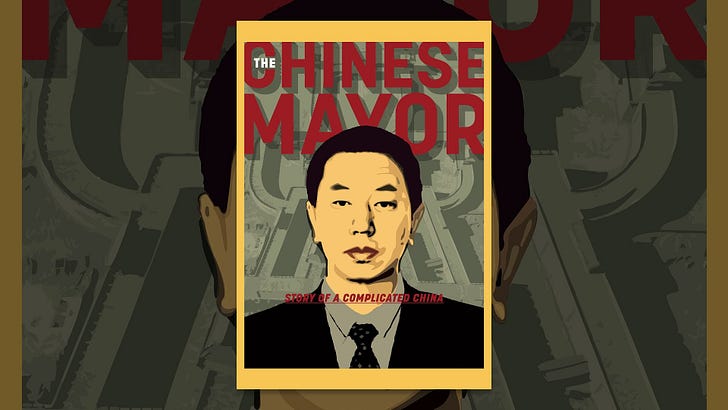
* Steve explains why he is leading a two-day tour to Datong, another module of the upcoming Baiguan China Tour, one of China’s ancient capitals for both its unique ancient culture and a no less unique modern story, immortalized in the documentary The Chinese Mayor.
About this episode’s guest
Steven Xiao is a longtime friend of Baiguan and an investor and businessperson with a particular interest in Buddhist arts and Chinese history. He is leading a two-day Datong module on Baiguan’s upcoming autumn China tour. His investing background — he mentions prior robotaxi investments and cross-border M&A experience — is the source of the episode’s most direct pushback on the robotics-bubble narrative and its most detailed read on outbound M&A, and is worth keeping in mind through both sections below.
Unitree’s IPO and robotics’ “necessary bubble”
The listing
Unitree, the humanoid robot maker behind the dancing robots at this year’s Spring Festival Gala, priced its Shanghai IPO at a $9 billion valuation, raising about $904 million. Formal listing was set for August 19, the day after this recording. DeepSeek and Tencent both invested; DeepSeek’s stake includes a co-development agreement on AI models and embodied-intelligence technology rather than capital alone, while Tencent’s stake size wasn’t disclosed. Meituan is a pre-IPO investor. Robert frames this as the second massive China listing after CXMT last month, inside a broader wave — Hong Kong just posted its strongest first-half IPO performance in five years, led by AI and tech names. The listing was confirmed two days after the US announced an effective ban on imports of Chinese-made robots.
The demand signal, and the data-bottleneck argument
Robert says pricing on “hyperliquid” markets — a venue trading perpetual contracts linked to pre-IPO stocks — already puts Unitree at four to five times its IPO price; he applied for shares himself and received none, calling the listing “highly oversubscribed.” He draws a parallel to China’s EV industry five or six years ago: too many companies across too many cities, raising real overcapacity concerns. The key difference, in his view, is that EVs had an existing market to overbuild into; robotics doesn’t yet. Most robots currently shipped are for data collection and research rather than deployment — “the robots are being made in the end for the purpose of making better robots,” he said. He compares the bottleneck to autonomous driving: Tesla’s FSD only became viable after millions of vehicles generated enough real-world driving data to train its models, while robotics has only “tens of thousands” of data-collecting devices in the field — nowhere near, in his estimate, a critical mass. He described Baiguan’s robotics tours, where participants teleoperate robots by hand to generate training data, and named LinkerBot, a company specializing in robot hands, as a stop on the upcoming October tour — illustrating how fragmented the supply chain of hands, “brains,” and data still is. As Robert put it, physical AI hasn’t yet had “a real ChatGPT moment.”
Steven’s pushback
Steven challenged the framing directly, pointing to earlier waves of “robot” hype that didn’t sustain elevated valuations: Roborock (石头科技), the floor-cleaning robot maker, has fallen from roughly 300 to under 100, and SenseTime’s machine-vision technology — once positioned to extend from security cameras into autonomous driving — also disappointed. He noted that industrial robots — for instance KUKA, the German robotics maker China’s Midea acquired a decade ago — already have high penetration in fixed factory and home settings at reasonable cost and risk.
“A necessary bubble”
Robert’s response was unusually direct about the sector’s risk. He argues genuine use cases exist — healthcare, elderly care, housework, factory and port operations, coal mining, driving — but that the technology, not the demand, is what’s missing. Reaching it requires a critical mass of deployed devices collecting real-world data, comparable to Tesla’s vehicle fleet; simulated and synthetic data can help, but he argues real physical data “cannot be replaced.” Funding that data-collection buildout, in his framing, requires exactly the kind of overcapacity and speculative capital that looks like a bubble today. Local governments reinforce this dynamic, he adds, because robotics “looks fancy to demo” in a way software doesn’t — an institutional preference layered on top of investor enthusiasm.
“I don’t think it will sustain. Everyone know this is a bubble... but to be honest, this is a necessary bubble.”
— Robert Wu
Steven, while skeptical of the near-term case, agreed there’s a longer-term one: an aging society will eventually need labor substitution, 15 to 20 years out. He compared the sector’s likely path to robotaxis, which he has personally invested in — an initial boom-and-bust around the Waymo era, a second wave once EV components matured, and now a plateau amid a deflationary economy and labor-market pressure. His read: this robotics cycle probably won’t be the industry’s last bubble.
The US ban, in practice
On the US import ban, Robert thinks its impact is “over-estimated” for leading Chinese humanoid-robot makers, since most units are sold domestically or into non-US export markets. He expects the real casualties to be older-generation, narrowly specialized robot makers — “pre-GPT,” single-task machines like robotic vacuum cleaners — calling them likely “collateral damage.” He separately noted that Chinese robotaxi companies Pony.ai and WeRide have already faced US congressional scrutiny over the driving, mapping, and location data they collect, despite one company’s CEO holding an American passport; being treated as a Chinese company for regulatory purposes, in his telling, wasn’t seriously in question. Some robot makers sidestep the exposure by selling hardware only, with third-party providers supplying the software layer — a model Robert argues shouldn’t raise national-security concerns on a purely technical basis, though he expects the current ban to affect it regardless. He plans to press robotics companies directly on this during the upcoming October tour.
Implications
The episode’s most investable distinction is between humanoid-robot …