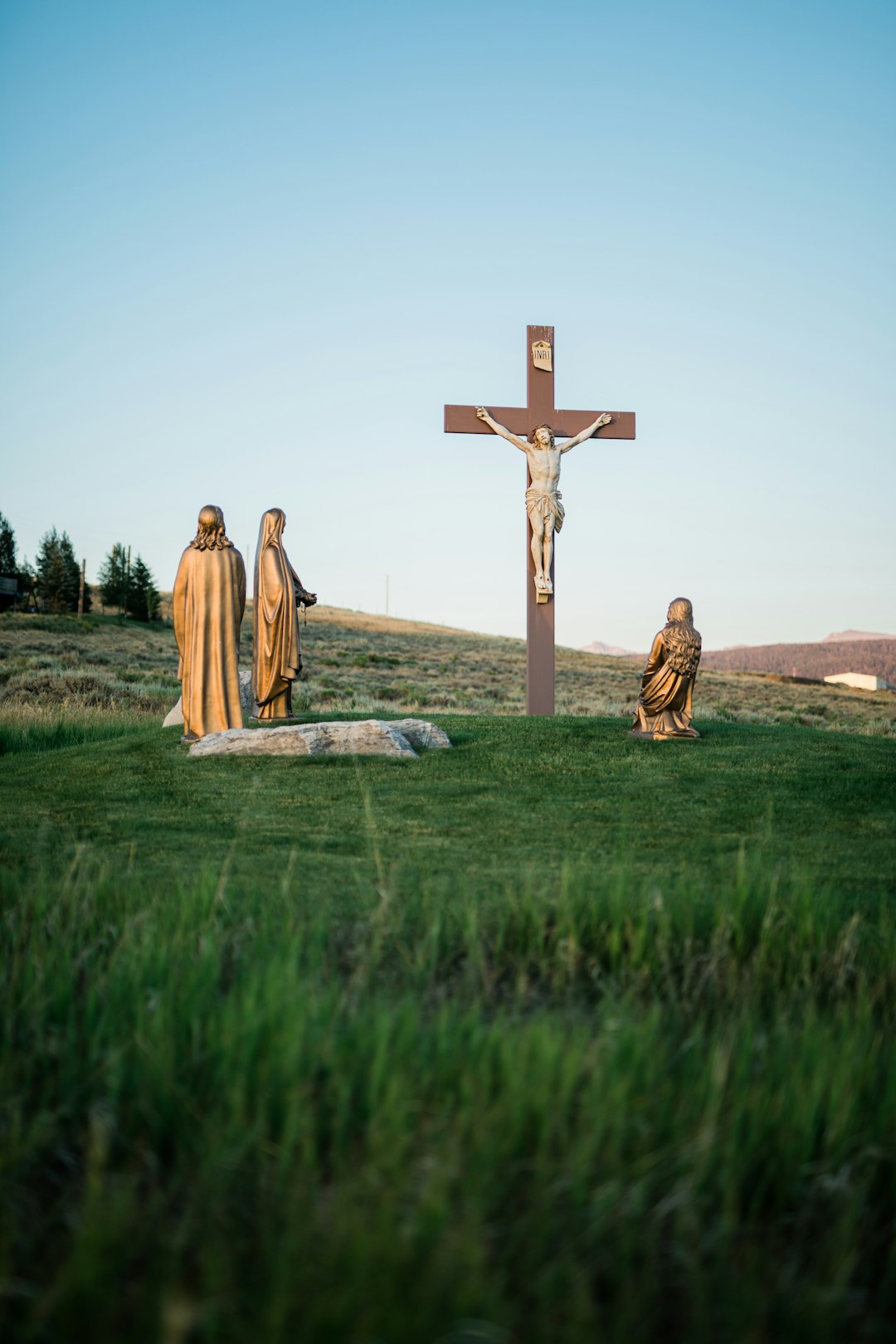
Woman, Behold Your Son
7 Words, John 19:16-27, Remsen Bible Fellowship, 3/30/25
In John 1:5 we read that, “the light shines in the darkness, and the darkness has not overcome it.” Unless of course you’re reading a translation which says, “the darkness has not understood it.” Why is there discrepancy? The Greek word which John uses can mean either to understand/comprehend, or to lay hold of/conquer/overcome. And as you read John’s gospel, it seems he chose an intentionally flexible word because both possible meanings are true. The Word became flesh, the Son took on humanity as Jesus of Nazareth, and the Light of Life himself shone into the darkness of our sin-sick world. And that world could neither comprehend Jesus, or overcome his light.
One of the most difficult aspects of Jesus to understand is how Jesus exercised his unconquerableness. By dying on the cross. Jesus reigns over all the universe. And that rule and reign are not only predicated upon his cross work, but were exercised while he hung on the tree.
After the mock trials of Jesus in John 18 and 19, beginning in John 19:16b we read the following:
So they took Jesus, 17 and he went out, bearing his own cross, to the place called The Place of a Skull, which in Aramaic is called Golgotha. 18 There they crucified him, and with him two others, one on either side, and Jesus between them. 19 Pilate also wrote an inscription and put it on the cross. It read, “Jesus of Nazareth, the King of the Jews.” 20 Many of the Jews read this inscription, for the place where Jesus was crucified was near the city, and it was written in Aramaic, in Latin, and in Greek. 21 So the chief priests of the Jews said to Pilate, “Do not write, ‘The King of the Jews,’ but rather, ‘This man said, I am King of the Jews.’ ” 22 Pilate answered, “What I have written I have written.”
Pilate turned Jesus over, and the soldiers took him out. But note how John phrases this: he went out. John doesn’t mention the soldiers leading him; it just says he went. Note also the emphasis that John makes in regard to the cross: bearing his own cross. We know from the other accounts that somewhere along this journey, likely at the city gate, Jesus’ body gave way under the cross. So Simon of Cyrene is enlisted to carry it the rest of the way. But all during this meandering walk of shame through the city, Jesus is carrying the cross-bar on which he will be hung.
They took Jesus out to Golgotha, the Place of a Skull, and there crucified him. This would have consisted of laying him down on the cross-piece, nailing his hands down, lifting him up to just above eye-level, and then nailing his feet in.
“As Moses lifted up the serpent in the wilderness, so must the Son of Man be lifted up, that whoever believes in him may have eternal life” (John 3:14-15).
What was Jesus’ transgression, according to Pilate? Why was he crucified? The crimes of crucified criminals were listed above their heads, and the sign over Jesus read: Jesus of Nazareth, the King of the Jews. He was crucified for being the King.
Verse 20 says that this sign was read by many. This is because the place of crucifixion was near the city, right beside the road. Further, as Jesus was led to the cross, one of the soldiers leading him would have carried this sign. It would have been read by all, because in large black or red letters, the sign was written in three languages: Aramaic, the language of the region; Latin, the language of the soldiers and official language of the empire; and Greek, the lingua franca, the universal trade language.
This signage offended the leaders, who cried out, “Pilate, change the words! Say this is what he claimed, not who he is!”
But Pilate refused. What I have written I have written. This statement of Pilate is most likely one of spite. He’s annoyed by the Sanhedrin who have put him in this precarious position. The sign is clearly meant to be a burr under their saddle. But what is God saying with this sign? What Pilate has written is absolutely true—and it renders judgment over all who look to the cross and fail to see that this is the King of the Jews. God uses even the spiteful actions of sinful men to communicate his message.
In verses 23-24, the camera pans, as it were, from the big and “important” people (Pilate, chief priests, etc) toward the soldiers.
23 When the soldiers had crucified Jesus, they took his garments and divided them into four parts, one part for each soldier; also his tunic. But the tunic was seamless, woven in one piece from top to bottom, 24 so they said to one another, “Let us not tear it, but cast lots for it to see whose it shall be.” This was to fulfill the Scripture which says,
“They divided my garments among them,
and for my clothing they cast lots.”
The soldiers, four of them, sat beneath Jesus' body and gambled for his clothes. It was typical for the executing officers to split up the prisoner’s belongings at a crucifixion. While John doesn’t spell out what they’d already divided up, it was probably his sandals, belt, headpiece, and outer robe. The logical thing to do with the last and most valuable piece, this chiton worn next to the skin, would have been to split it down the seams—but Jesus’ chiton had no seams. So they say, let us not tear it but cast lots for it to see whose it shall be.
While this scene at first seems to be a simple human story of dividing things up in the most equitable way possible, mundane as can be, John wants us to see something greater at work. This was to fulfill the Scripture which says, in Psalm 22:18,
18 they divide my garments among them,
and for my clothing they cast lots.
It’s as if John is saying, look at this tiny detail! Something so mundane, so part of every crucifixion, and yet in Jesus’ case it fulfills a greater purpose: filling up, completing those things which are predicted of Christ in the Old Testament.
In Psalm 22 David was telling of his own struggles with persecution and feeling abandoned by God. But as David’s greater Son, Jesus is more righteous. Therefore his suffering is even more unjust. And his suffering is greater, to the point where the language that David uses metaphorically for his suffering becomes literally true of Jesus. Jesus fulfills - fills up - what David wrote.
The camera now shifts slightly from the soldiers to the witnesses standing next to the cross.
So the soldiers did these things, 25 but standing by the cross of Jesus were his mother and his mother’s sister, Mary the wife of Clopas, and Mary Magdalene.
Four women are mentioned here. Mary the mother of Jesus, and her sister. They are not named, but they are identified. Also mentioned are Mary the wife of Clopas, and Mary Magdalene. Matthew mentions a crowd of women (27:55) looking on from a distance—it seems likely that this group of four listed by John were among that larger crowd, but that at some point they drew close to be near Jesus.
Jesus’ mother Mary is left unnamed, as she is all throughout this gospel. And I think it is important to note that while Mary is an important figure in the gospel narratives - she gave birth to the Savior! - she is not some superhuman saint-like figure. She is certainly a model of faith. But it’s a faith that is a model for us because it is like unto us. There’s a real sense in which we must say that Mary is not special. She’s not sinless, she’s not perfect in her understanding, and she is just as confused and broken at the crucifixion as all the rest of Jesus’ followers.
Here, at the foot of the cross, we don’t see Mary the mediatrix, standing between God and the church. Some Catholic commentators interpret the verses which follow by spiritualizing Jesus’ statement of care for his mother—they flip it around, saying that John, representing the church, is cared for by Mary. But this is not taught anywhere in the New Testament - Mary doesn’t take care of the church - and is in fact the opposite of what Jesus is about to say.
Mary is an important figure in this narrat…