We have here in the north and south walls of the nave of the Stations of the Cross. There are fourteen in all. Through each one we follow Christ in His Passion. We accompany Him through the sacramental action of the prayer sequence, one station at a time. As we pray, we participate in the experience of the inward and spiritual grace of Our Lord’s Passion: His holy walk of voluntary sacrifice, all the way to the Cross, through His death on the Cross, and being laid in the Tomb.
Our Liturgy in Holy Week and Easter proceed in the same way. We proceed by Stations. We started at the death of Lazarus and his resurrection. We continued to the Station of our Lord’s entrance into Jerusalem upon the back of a donkey. Then to Maundy Thursday and our Lord’s institution of the Sacraments of the Eucharist and Holy Orders. The next station was the Garden of Gethsemane in watching with Our Lord at the Altar of Repose and His arrest. Then on Good Friday, we were with our Lord as He was on the Cross, His dying on the Cross – these were during the Three Hours service. Then to His entombment, in our Tenebrae service. Finally to the Station of His resurrection through the Easter Vigil, which represents the finding of the tomb empty by the Holy Myrrh-bearing Women still in the dark of night, and this carries forth into Easter Day and the wider celebration of His resurrection by the apostles and disciples. Through it all, we were truly with Jesus and with His disciples, by means of the New Testament accounts, the Scriptural accounts, the Liturgy, the hymns and Sacraments.
Today we continue to the next station. That next station is our Lord meeting the disciples in the Upper Room. He came to them on the evening of that day, the first day of the week, the doors being locked where the disciples were for fear of the Jews. And so let us put ourselves again into the story–or, rather, allow the Holy Ghost to lead us deeper into Christ’s mystery. We are in the Upper Room. We share the fear of what the chief priests might do next. We are confused, disoriented, and uncertain what even to do. And yet, we are in truly holy space, holy space like this nave, with this sanctuary. We have been here before: at the Last Supper and the teachings of Christ’s farewell discourse. This is Christ’s house; this is His Father’s house; this is a house of prayer. But … what to do? How to pray?
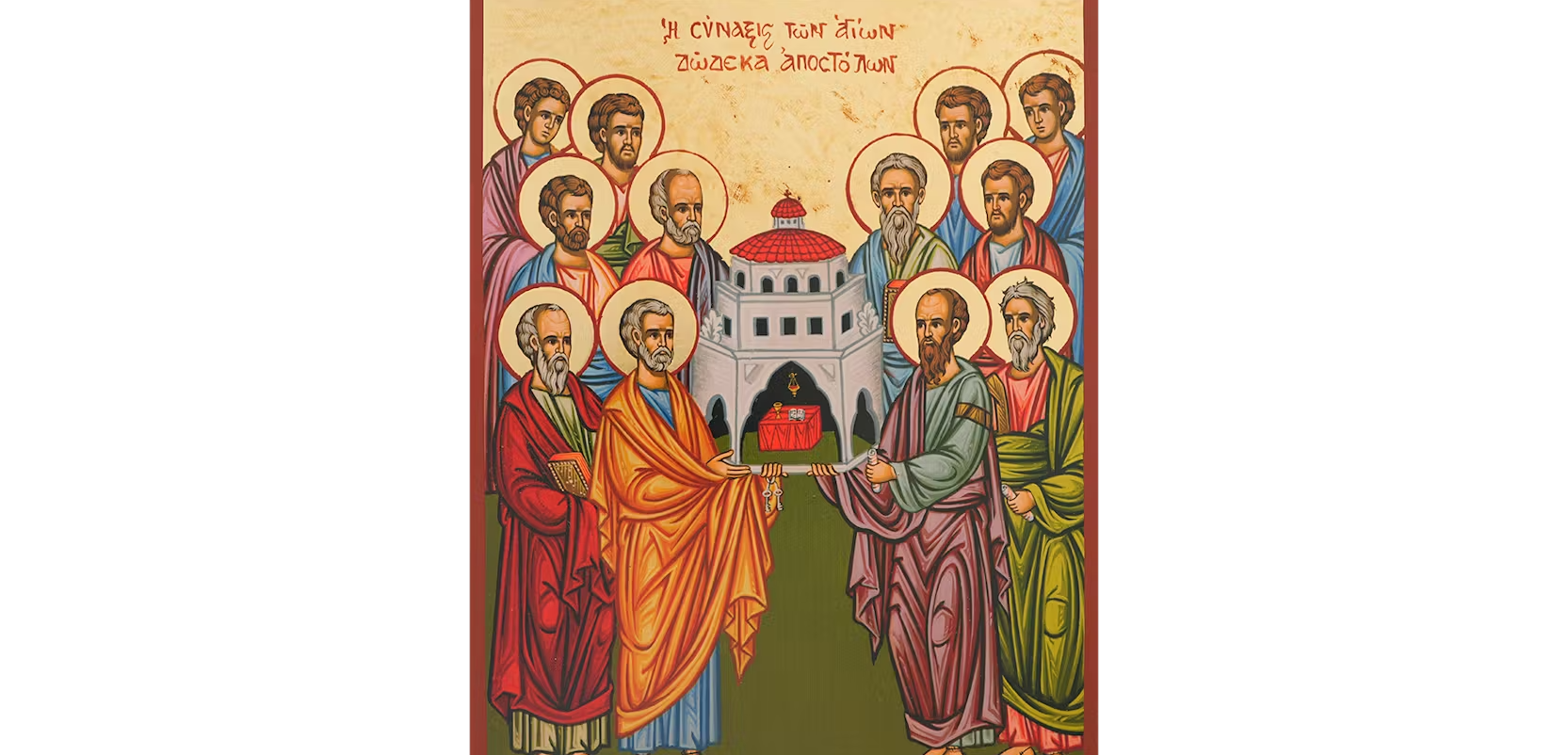
Jesus enters. He came and stood among them and said to them, “Peace be with you.” Our Lord’s first words to them after His mighty resurrection were “Peace be with you.” This was the exchange of peace; the very same we exchange in Mass. He bestowed upon the Church His peace. This peace of heaven; this peace which passes all understanding; this peace spoken by Christ in His resurrected and glorious Body, a Body in which His hands and His side bore the wounds of His Crucifixion. And He said “Peace be with you” a second time. And He said, “As the Father has sent me, even so am I sending you.” To be sent is to become an apostle. The Greek word for apostles is ἀπόστολος, and it means a messenger, one sent forth. This moment, this Station, is beholding Our Lord and Savior commissioning the Apostles.
Thus it is fitting for Jesus, in commissioning the Apostles, breathes on them and says to them, “Receive the Holy Spirit.” They are to be bearers of the Holy Spirit. They are made full of the Holy Spirit so that they can proclaim the Gospel to the world: to the Jews and to the Gentiles; their inspired voices to go forth into all the earth, and their words to the ends of the world. They are made full of the Holy Spirit as Blessed Mary the Virgin Mother was full of the Holy Spirit, as Saint Elizabeth and Saint John the Baptist were full of the Holy Spirit, as Simeon and Anna were full of the Holy Spirit. They were truly born not of the flesh nor of the will of man, but born of God, and thus sharers in Christ’s victory over death and the Devil. Christ Himself was alive and resurrected in the Apostles, thus were they able to proclaim the Gospel: forgiveness of sins, and the Gospel about eternal life in Jesus Christ, the Son of God.
It was because they were full of the power of the Holy Spirit that Saint Peter’s preaching on Pentecost, which our first reading picks up just after Peter finished, was able to draw three thousand souls to be baptized on the day of Pentecost. The power of the Holy Spirit is to draw people to Christ, to life abundant in Him. And the power of the Holy Spirit drew the three thousand not only to Baptism but to life in Christ’s Body the Church: hence, the three thousand souls joined in with the liturgical prayer life of 120 Upper Room disciples. Saint Luke captures this when he writes, “They devoted themselves to the apostles’ teaching and fellowship, to the breaking of bread, and to the prayers”–to those three modes of prayer: of life in community sharing the revelation proclaimed by the Apostles, of the Eucharist, and of the daily liturgy (that is, “the Prayers”). By this threefold pattern, called in Anglican tradition the threefold regula, we participate in the peace Christ bestows on His Church; we receive the peace that keeps our heart and mind nourished by the knowledge and love of God, of His Son Jesus Christ; by this pattern, this model, this rule or regula, the Holy Spirit is kept among us, that He, with the Father and Son, always remains with us, and in us, and we in Them.
This is life in Christ, this threefold pattern of prayer: life in Him Who died for our sins, and rose again for our justification. He rose again, that is, so that we could be capable of partaking in the divine nature, in the words of Saint Peter. Because of Christ’s Passion and Resurrection, the dry land of our sinful and unholy life can become the green earth of the life of new spiritual creation in Christ. By this life in Christ, we put away the leaven of malice and wickedness, and serve Christ in pureness of living and truth. Thanks be to God for the witness of the Apostles, their courage, their fortitude, and their generosity in showing us what life of prayer in Christ looks like, that we can ever join them and the angel in their prayer and in their holy song; that through the threefold life of liturgical and sacramental prayer and fellowship, we can do all such good works as Christ has prepared for us to walk in; to be in Him, and He in us: Christ Jesus our Lord and Saviour, who lives and reigns with the Father in the unity of the Holy Ghost, ever one God, world without end. Amen.