Welcome Back.
Three meetings shaped the last two weeks.
Each one looks like a different story. Each one is actually the same story.
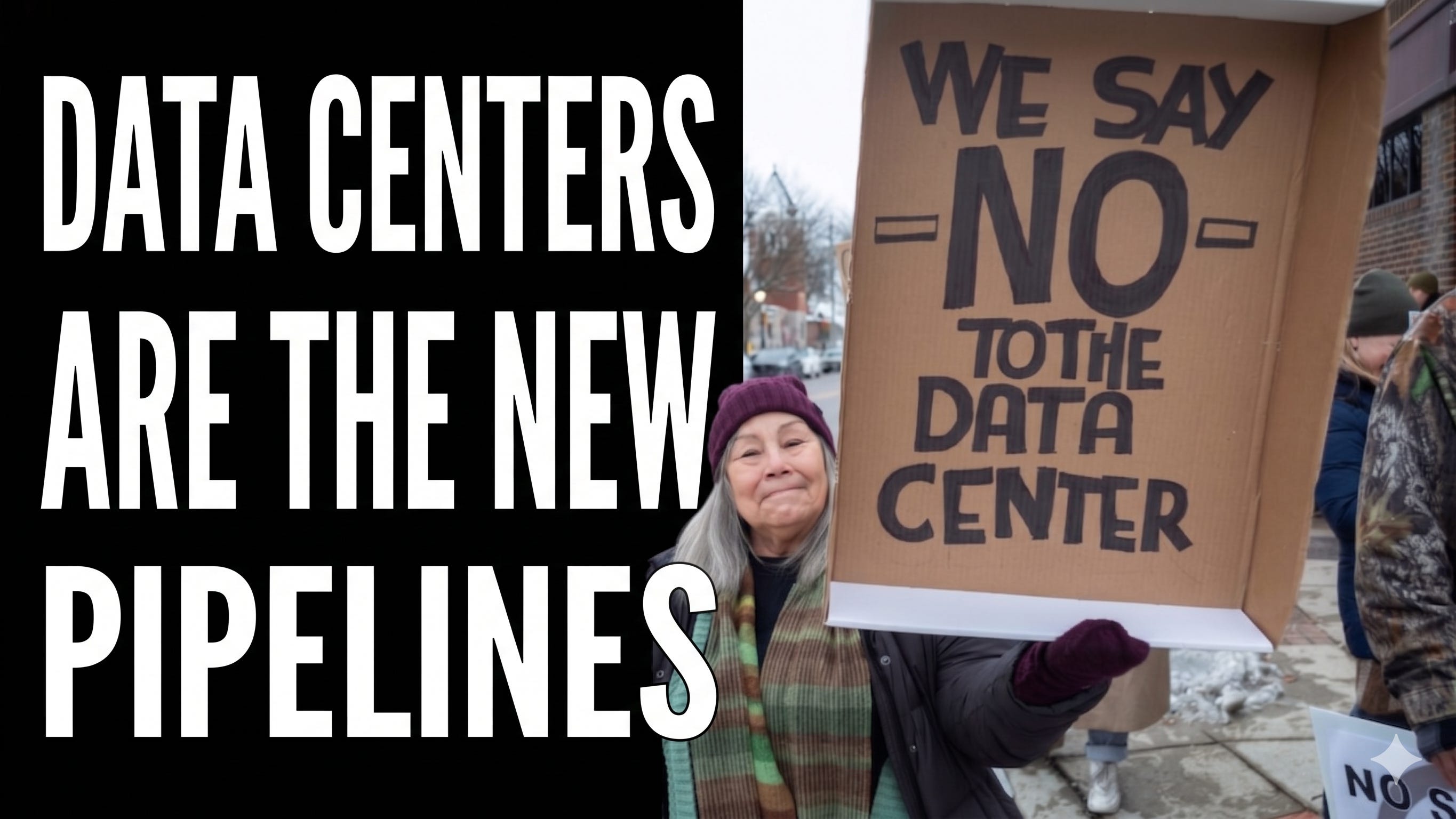
The first was Donald Trump inside the Zhongnanhai - the inner compound of the Chinese leadership. Only three other sitting U.S. presidents have ever been invited in. The second was Mark Carney and Danielle Smith shaking hands on the West Coast pipeline framework, with an October 1 target to designate it a project of national significance and a stated goal of 8 million barrels a day of export capacity by 2030. The third didn’t happen in any one room - it happened in courthouses across Texas, Florida, Oklahoma, Ohio, and Alberta, where county after county is now ruling against the build-out of AI data centers.
That third story is the one most people are missing.
Data centers are unquestionably the most politically cancerous infrastructure that has ever been positioned in the history of North America.
73% of voters — left and right, U.S. and Canada — do not want them in their backyard. The AI capex cycle has become, almost overnight, the most hated topic in domestic politics. And that creates a problem the hyperscalers do not know how to solve.
It also creates an opportunity for the one jurisdiction on this continent that has spent forty years figuring out how to build hated-but-necessary infrastructure: Alberta.
I’m not calling a market top. I want to be clear about that. This is not a 2000 or 2007 setup. But the character of the market is changing. Long rates are breaking out in the U.S. and in Canada, Powell is out and the new Fed chair was sworn in last week, energy is leading, AI names are ripping (Micron just touched a trillion in market cap), and we are about to absorb four of the largest IPOs in human history. Cerebras already priced at $150B. The stock traded to $350 before selling off to the $270s. SpaceX is filing at $1.75T-$2.0T. That single IPO is roughly 75–80% of the entire market cap of the TSX.
When that much private money gets vacuumed into a few mega-listings, it pulls capital out of every other corner of the market to find price.
Expect volatility through the summer.
Where Mel Sharpened It
Mel pushed back on a few of my reads in ways that mattered.
On the Trump–Xi summit: my instinct was to read Trump’s deferential posture as a tactical concession. Mel reframed it through a Foreign Affairs lens - what she called the new G2 world. It is not a Cold War redux of mutually-assured destruction. It is a mutual recognition that neither the U.S. nor China is going to displace the other, and that the two powers are now finding ways to use each other inside defined domains rather than trying to win.
That distinction matters for Canadian foreign policy. If the U.S. is comfortable with a working G2, the question of how Carney’s posture on China (EVs, canola, capital flows) will be received in Washington is suddenly more open than it looked six months ago.
She also pushed me on a question I underweight: where is the line between Trump the person and Trump the president? With most leaders that distinction is invisible. With this one it is unusually visible — and getting that read right is what separates analysts who take him literally but not seriously from analysts who do the opposite.
The most useful frame Mel offered was on the data-center backlash itself. She introduced Maslow’s hierarchy as the right lens. We make the mistake of treating policy choices as binary… yes/no on the ballot, when they are actually continuums of trade-offs. Canadians have had the luxury of not having to make those trade-offs ourselves, which has produced a generation of luxury beliefs about energy that don’t survive contact with the actual physics of running a modern economy.
Caring more about the environment than economics is a position you can only afford when someone else is producing the energy you’re using.
The Macro Read: AI’s New Constraint Is Permission, Not Compute
For two years the binding constraint on the AI cycle has been compute and power. That is changing fast.
Gavin Baker had the cleanest line on it: TSMC could produce $2 trillion in chips this year if they didn’t care about the longevity of their business. There is that much demand. Instead they will produce about 20% of that — roughly $400B — because they are pacing themselves. The chip side of the constraint is being managed by one disciplined Taiwanese foundry.
The newer constraint is permission. Data centers need cool climate, cheap power, abundant land, and a community that will actually let them build. The hyperscalers spent two decades building wherever they wanted because latency didn’t matter much and the physical footprint was small.
That world is gone.
Latency now matters. Bandwidth now matters. Megawatts per square foot has gone vertical. So the build-out is colliding with NIMBY politics in every county in North America right as the cycle needs to accelerate.
We would have a bubble if we could actually get the infrastructure built. We can’t. We have a governor on this runaway wagon, and it is the most healthy thing that could possibly happen to this cycle.
The CEOs running the leading AI labs are not equipped for this fight. Dario Amodei keeps telling everyone the world is going to end and that only he can save it. Sam Altman is, charitably, not lovable. Elon Musk is the most polarizing human being on earth outside of Trump. Alex Karp can’t sit still in a chair. These are not people who win school-board fights in Lubbock or Strathcona County.
The AI CEOs of the leading labs have all failed at the political game. It’s over. Game over. They need to find a new path forward.
That path forward is going to be checks in mailboxes. A municipality is not going to be moved by a one-time $50M payment to a county budget. It will be moved by a $10,000 annual check to 14,000 households for 20 years. That is the math the hyperscalers are about to learn.
Which brings us to Alberta.
The Policy Read: Alberta Is the Most Investable Place on the Continent
Alberta is uniquely positioned for this opportunity for reasons that compound on each other. Northern, cool climate. Cheap energy. Stranded molecules that can be moved behind-the-meter into power generation rather than flared. The only deregulated electricity market in Canada, which means private generators can build and sign power purchase agreements directly with data-center operators - something you cannot do in a system where the government owns the generation. We have engineering talent that knows how to build large, complex, hated infrastructure on time and on budget. We have been doing this for forty years.
The data-center boom is the same political problem as the pipeline - and we are the only province that has spent a generation getting good at solving it.
On the MOU itself, Mel did the heavy lifting again:
* The Carney–Smith agreement on the industrial carbon price gave industry clarity but not competitiveness. Those are two different things. Clarity is necessary. It is not sufficient.
* Brownfield projects will be fine. The economics of greenfield investment - new pipelines, new facilities, the marginal barrel - are still not competitive with comparable jurisdictions elsewhere in the world.
* The pipeline is contingent on Pathways. Pathways is contingent on the pipeline. Someone has to move first.
* Alberta will submit its proposal to the Major Projects Office on July 1. Designation as a project of national significance is targeted for October 1. Separation referendum is October 19.
If you’re the federal government, and you are about to designate a project of national significance two and a half weeks before a separation referendum, you are going to ensure that project is still inside our nation when the dust settles.
Mel was unambiguous on the referendum. She is a federalist. She is voting to stay. And her argument — which I agree with — is that separation does not solve the infrastructure problem. It almost certainly makes it worse. If your primary reason for wanting to separate is that you can’t get a pipeline built, leaving Canada does not get the pipeline built. The path forward is to use the leverage we have inside the federation.
Her closing line was the cleanest framing of the whole episode, and it’s the one I keep coming back to:
Alberta is not in a parent–child relationship with Ottawa. If we stomp our feet and don’t get what we want, we become the actors the rest of the country accuses us of being. This is good for Alberta. This is good for Canada. It should be done on merit. - Mel
What I’m Watching
* The IPO calendar. SpaceX filing at $1.75T is the largest IPO in history. Expect a capital vacuum that pulls money out of mid-caps and small-caps across the index. Use the volatility to add, don’t chase.
* Long rates. The 30-year is breaking out in both the U.S. and Canada. New Fed chair just sworn in. The bond market is the variable that resolves the next regime.
* Alberta data-center build. Watch for the first behind-the-meter announcement from a hyperscaler in Grande Prairie, Edmonton, or Calgary. That is the leading indicator of the regional capex cycle turning on.
* MOU sequencing. July 1 (Alberta submits to MPO) → October 1 (designation target) → October 19 (separation referendum). These three dates compress an enormous amount of political capital into a 16-week window.
* AI infrastructure earnings. Stay long the picks-and-shovels - memory, power semis, optical/photonics, transformers. Sell-side estimates still drag the real demand curve.
Podcast & YouTube Recommendations🎙
* Dan Loeb - ILTB
* Meb Faber and Tom Lee Talk Macro
* A Beautiful Tribecca Apartment