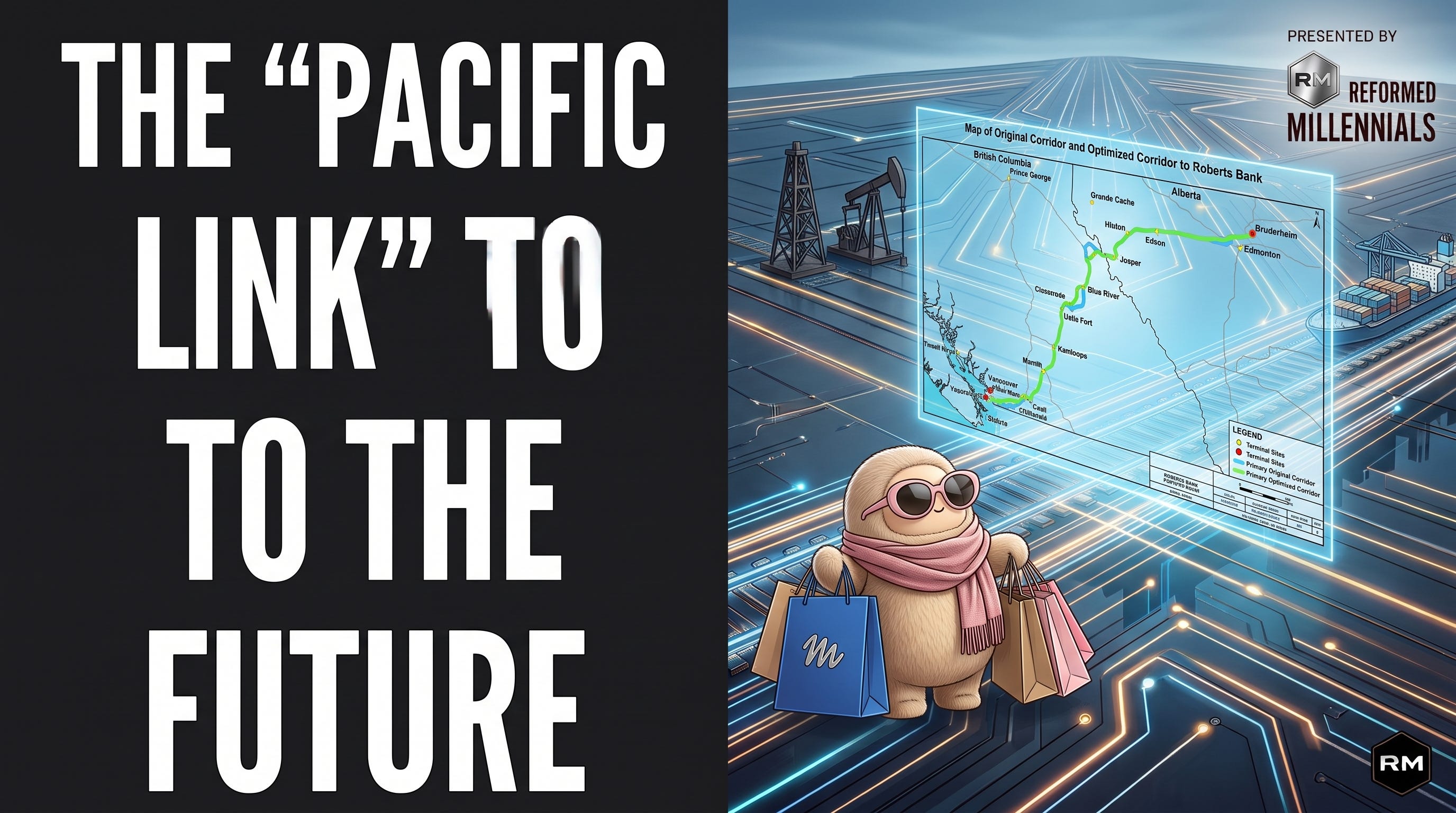
Alberta filed its application for a West Coast oil pipeline on July 2nd 2026... It was designated a project of national interest this morning in Fort Mac.
On Tuesday the Prime Minister stood in Vancouver and welcomed LNG Canada’s Phase 2 at Kitimat, a $33 billion final investment decision that doubles the facility and ranks as the second-largest single private investment in Canadian history. So inside one week this country said yes to a million barrels a day of oil heading south-west and a second helping of natural gas heading north-west.
Meanwhile the most downloaded app in America is a robot from Meta that comes with its own computer.
I called our Q3 client letter A Bridge to the Future, and after this week I think that should be changed to The Pacific Link to the future…
One bridge is being built out of software and it runs through Menlo Park. The other is being built out of steel and gas turbines, and it runs from Bruderheim Alberta to Vancouvers Delta Port.
MARKET Update:
The Fed went on September 16th, a 12-0 vote taking the funds rate to 3.75% to 4%. First hike since 2023. The 10-year hit 5% on the 14th and was through 5.1% by the 23rd, the highest in nineteen years.
That has done something strange to the market. The Nasdaq touched 27,000 this morning and sits roughly half a percent off all-time highs, but about 70% of its components are below their 50-day moving average. The equal-weight S&P, where Sherwin-Williams counts as much as Apple, is in a 17.5% drawdown.
When money costs more, the companies that can raise it at the lowest spread get a tailwind and everyone else gets re-rated. The index looks fine because eight companies are fine. Underneath it, the broader economy is being repriced.
I think we have a rough three or four weeks into the midterms and then a good finish to end the year…
Uncertainty parks capital on the sidelines, and midterms manufacture uncertainty. Earnings have run well ahead of expectations this year while multiples contracted, which means the market got cheaper in 2026 even as it went up. The seven to nine months after a midterm is historically the best stretch of the four-year cycle.
A bridge made of software
Until this quarter, an AI was something you talked to. Muse is something that does things for you.
The trick is simpler than it sounds. Meta gives every user their own computer, a real one running in Meta’s data centre, and the agent logs into it and works on your behalf with your calendar, your email, and your habits.
An agent is just an AI with access to a computer. Before this year the only people who had that were engineers willing to wire it up themselves. Meta handed one to everybody on September 8th, and Microsoft did roughly the same thing for office workers on the 25th with a persistent Copilot agent called Autopilot that gets its own identity, memory and workspace inside your company’s Microsoft 365.
An Anecdote from my life:
I was sitting in the sauna with Adrianna and typed “book me a hair appointment tomorrow at Parlor Barbra.” It read my email, already knew who cuts my hair, checked my calendar and booked 3:40. One prompt. A few days earlier I asked it to sort out airport parking for a Seattle trip and it had already pulled my WestJet booking, the ninety-minute buffer and my plate number. Two prompts, fifteen seconds, replacing fifteen minutes of form filling.
Then my son’s soccer registration failed on the league app. Muse flagged the email, I re-registered him, the schedule went into the calendar, and it sent the whole thing to Adrianna with a reminder to pack his socks and shoes. That last part matters more than the haircut. Mel made the point on the episode that the mental load of running a household has always been carried disproportionately by women, and the thing I noticed is that it didn’t get redistributed to me. It got lifted off both of us.
Ben Thompson’s version is better than mine.
He asked Muse to organize the recipes he’d saved on Instagram, and five minutes later he had a small custom app that categorized them. Nobody built that app. Nobody will ever sell it. It exists because one guy wanted it and the marginal cost of wanting is now about five minutes. His conclusion is that apps stop being destinations and become “mere suppliers,” and that the scarce thing moves from discovery to inspiration, which makes whoever owns the agent “the ultimate gatekeeper of not just user demand, but desire.”
Google and Meta built the two best advertising businesses in history by solving discovery. Getting things done is about to be abundant. What stays scarce is the desire part of getting things done.
Why Meta wins this even though its model isn’t the best. This is Clayton Christensen, straight out of the textbook. Once a product is good enough, the competition stops being about performance and starts being about convenience, and then distribution. Meta bet that a good-enough model inside a great product beats a great model inside a chat window. The labs with better models still do not have a consumer surface with this kind of lock-in, and there is almost nobody on earth with more distribution than Meta. It also finally explains the glasses, which were never a product so much as a delivery mechanism...
The adoption numbers are worth being precise about, because I got them slightly wrong on the recording. Muse crossed five million downloads in twenty-two days per Sensor Tower. ChatGPT took fifty-six days to the same mark, Grok took 103, Claude took 492. It has held the top of the US App Store free iPhone chart for twelve straight days. And Meta has been spending its own house ad inventory on it, up to half of its daily impressions in the two weeks ending September 27th, which it has essentially never done for anything but Threads. Companies don’t put their own megaphone behind something until the retention data says it’s working.
The tell that it’s real is that Amazon said no. On September 20th Amazon blocked Muse from shopping its site. Amazon’s advertising business did more than $68 billion last year, roughly double the profit of its retail operation, and an agent walking straight to checkout doesn’t look at a single sponsored placement. The next day Shopify opened checkout to Muse through Shop Pay. Walmart and Target have been backing an open agent-checkout standard with Google and Shopify.
The incumbent with the most to protect pulls up the drawbridge. The challengers hold the door. That’s the same pattern as the second-place carriers signing with the iPhone, and it tells you more about where this is going than any demo.
The distribution story is enormous.
The bridge made of steel
Pacific Link is 1,250 kilometres from Bruderheim to the coast near Delta, almost entirely along the Trans Mountain corridor, one million barrels a day, $35.2 to $43.7 billion.
It is the first project listed under Schedule 1 of the Building Canada Act.
Ownership lands at 45% Ottawa through Trans Mountain, 45% Alberta through the Alberta Petroleum Marketing Commission, and 10% Pembina through construction with an option on up to another 10% at commercial operation. Indigenous communities are being offered a minimum 10%, financed through the Indigenous Loan Guarantee Programs.
This is not a construction approval. Yet.
The Major Projects Office and the Canada Energy Regulator have until September 1, 2027 to finalize conditions covering ownership, benefits, Indigenous rights, environmental protection and local hiring.
The federal government is putting its own name and its own money on the timeline, which is a different thing from a press release.
Speed is the resource. Alberta is not out-competing Virginia or Texas on access to capital. Capital is the one thing the world has plenty of. What Alberta can compete on is the willingness to say yes quickly, and ninety-one days from application to designation is not a normal number on this continent. The metric to guard from here is months from application to shovel. If that number holds, everything else falls in line.
Egress is the oldest problem we have. Anyone who managed money through 2018 remembers what happens when production outruns pipe. The differential blows out, and royalties and cash flow evaporate into a discount that gets captured by somebody in Oklahoma. Pacific Link is roughly a 20% increase in Canadian crude export capacity pointed at Asia instead of Cushing.
Now add the gas. Coastal GasLink currently moves about 2.1 bcf a day, and its Phase 2 nearly doubles that with five new compressor stations on the existing 670-kilometre route, construction starting early 2027. LNG Canada goes from 14 million tonnes a year to 28. In the Alberta essay I argued that one gigawatt of data centre burns roughly 160 million cubic feet a day, and that five campuses would be about half an LNG Canada of brand new demand with no coastal pipe required at all.
This is the best demand picture western Canadian gas has had in my career.
The caveats.
* Indigenous consultation is the real risk. The equity piece is genuinely better than most expected: a minimum 10% stake with loan guarantees. But more than 130 communities sit along this route, several B.C. chiefs have said publicly that a two-month consultation window was not adequate, and the duty to consult is not satisfied by an ownership offer. That is where the court risk is, and an ownership stake and a legal challenge can absolutely coexist.
* Labour is the other one. Pacific Link, Pathways, the Kitimat expansion, the Meta campus and the Sturgeon County power build are all going to bid for the same electricians, welders, pipefitters and power engineers in the early 2030s. Wages in those trades are going to do what oilfield wages did in 2006. That’s wonderful if you’re on the tools and painful if you’re the one pricing a fixed-cost contract three years out.
* And the politics are not subtle. Alberta votes on independence October 19th, B.C. goes to the polls October 24th, and this landed on October 1st.
Where the money actually goes. The commodity gets the headlines, the infrastructure gets the early returns, and the services get the multiples. The people who win quietly are the lawyer, the appraiser, the electrician and the accountant in Edmonton, Fort Saskatchewan and Sturgeon County, because that is how a megaproject’s money actually reaches the people.
As a 36-year-old Albertan, the version of this I’m most interested in isn’t the barrel at all. It’s the part where we stop shipping the molecule away and start burning it here to make compute.
Sources And Links
* PMO: Pacific Link listed as a project of national interest
* Pembina Pipeline: Pacific Link listing and ownership terms
* Timeline for Pacific Link, including the July 2 application and cost range
* First Nations leaders on the consultation window
* Shell FID to double LNG Canada capacity
* TC Energy: Coastal GasLink Phase 2
* TechCrunch: Meta debuts Muse
* Muse download pace vs ChatGPT, Grok and Claude
* Amazon blocks Muse, Shopify opens checkout
* Ben Thompson, Apps, Agents, and Aggregation
* Microsoft’s Copilot revamp and the Autopilot agent
* Tech leaders sign the White House AI accord
* Fed raises rates to 3.75%-4%
* 10-year Treasury yield through 5%
* Arm, Intel and AMD rally on the Muse launch