In this episode of Five Rules for the Good Life, I sit down with Katie Parla, a Rome-based writer, guide, and one of the clearest voices on how Italy really works. Not the fantasy version, not the TikTok version, but the real one shaped by neighborhoods, side streets, long lunches, and very good food. Katie shares her Five Rules for Actually Connecting with Italian Culture, from skipping the obvious cities to renting a car to leaving space for meals you did not plan. We talk about how Romans really eat, why oxtail sauce explains more about Italy than most guidebooks, and how letting go of romantic expectations leads to better trips, better meals, and better stories.
I love this episode because it is advice you can trust. Katie lives this life. She is not visiting Italy, she is in it, navigating it, working within it, and loving it every day. That perspective changes everything. Her rules are practical, but they are also generous, because they permit you to travel differently, to slow down in the right moments, and to stop chasing someone else’s version of a perfect trip. Listening to her makes you want to book a flight, yes, but more importantly, it makes you want to travel better, with curiosity, humility, and a little bit of chaos, which is usually where the best meals live.
You can pick up her new book Rome: A Culinary History, Cookbook, and Field Guide to the Flavors that Built a City, which is available wherever books are sold.
Photo by Ed Anderson
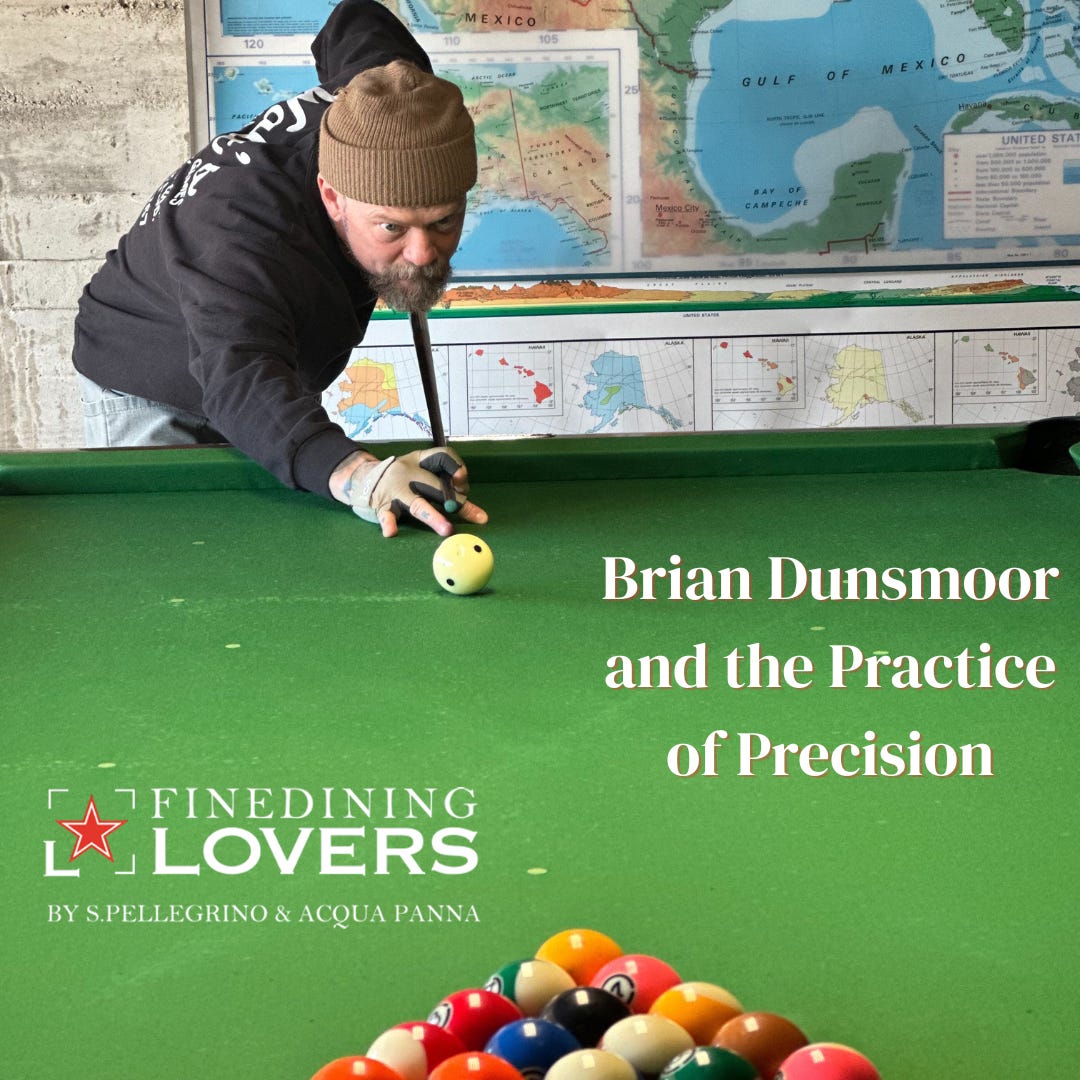
My latest piece for Pellegrino’s Fine Dining Lovers is out, and it’s a close look at how Brian Dunsmoor thinks about craft, control, and momentum. It moves from his garage pool table to the hearth at Dunsmoor, tracing how his intention and patience shape the way he cooks and leads. It’s about the small disciplines that add up to mastery, and why doing less, better, is often the whole point.
Transcript
Hello, and welcome to Five Rules for the Good Life.
I’m your host, Darin Bresnitz.
It is always a pleasure when I get to sit down with today’s guest, Katie Parla, whose new book, Rome, is out on Parla Publishing. You might know her for some of her incredible writing on the food and beverage of Rome, or been lucky enough to take one of her guided tours around the city. She shares her five rules for actually connecting with Italian culture and and talks about the importance of renting a car so you can make your way to lesser known cities, how to avoid the pitfalls of trusting everything you see on social media, and why leaving some room for unexpected meals is the best way to have an authentic adventure.
If you’re like me and so many other people, you know that Katie has her finger on the pulse of what’s going on in Italy today. So let’s get into the rules.
Katie, so good to see you. Thank you for making time, literally pulling over on the side of the road during your incredible book tour to chat with me for Five Rules. Welcome to the show.
Thanks so much for hitting me up. I’m stoked to talk to you.
I, like so many others, have hit you up when I was planning my first trip to Rome. And despite you knowing the city so well, do you still feel the pressure to pick the right recommendation for the person who’s hitting you up? Rome is definitely a place that is becoming expensive to visit. It’s becoming increasingly complicated because of social media, blowing up places that don’t do good food or care about their stuff or ingredients. I think it’s even more important to direct people to quote unquote the right places so that the people whose work I really appreciate and treasure are able to compete in that new economy.
It’s so tricky to navigate these major cities, especially with social media and all of these best of lists. And what I love about your new book, Rome, is that you say it’s not a best of Rome book. It’s about the real Rome. How would you define the real Rome and how long did it take for you to discover it?
I mean, I’ve been chipping away at it for almost a quarter century now.
Incredible.
There are many real Romes. Everyone who lives in Rome and obsesses over it has a reality shaped by what neighborhood they’ve lived in, where they work. And Rome is really dense and it’s gigantic. When I set about breaking down what I think is the real Rome, I was thinking about sharing with people the widest panorama that I could of how Romans eat, how they encounter their food system, where they shop, what they’re thinking about when they’re at a wine bar. And delivering, of course, recipes. But most of the book, as you’ve seen, not recipes. It’s culture, it’s history, it’s urbanism, all in the service of showing the full picture of Roman cuisine, which is not just at the trattoria. It’s not just at the pizzeria. It’s in homes. It’s in cafeterias. It’s in these small moments, Daniel and cobblestones, eating pizza, attempting not to stain your clothes.
I would say I have a couple of white linen pants from a summer in Rome that did not quite come back unscathed.
That’s on you. You got to think about patterns. Wear patterned clothes when you’re visiting.
I know, I know. But the heat, it’s a balance.
That’s real.
As you’ve done a deep dive into these homes and side streets in the city, what is the one dish that if you’re going to eat or learn to make that really connects you to the country world?
Something that always comes to mind that encapsulates a lot is rigatoni with sauce that oxtails have been simmered in. Oxtails are often written off as peasant food, when in reality, they were enticing to all classes. Popes ate them, peasants ate them. This is one of those myth-busting dishes that shows it’s really delicious, but it also has an ingredient that would be status-driven as well. What’s great about it is you can simmer oxtails for hours... serve the oxtail segments as your main and then just use the tomato based sauce to dress your rigatoni and it’s delicious it’s caloric it’s savory it’s practical and it’s pragmatic because we don’t have a lot of time anymore to hang out in rome and this like dolce farniente b******t that everyone lies about is not how we it’s not how we live everyone’s got a side hustle there’s no permanent work anymore and people have to really struggle to get by and when they cook they want it to have maximum impact and those one pot two meal situations are huge help
Understanding the best way to navigate Italy is something that takes a long time to master. It’s something that people want to master, which is why I’m so excited to chat about your five rules for actually connecting with Italian culture. Cutting through all the Instagram, cutting through all the AI nonsense, cutting through all of the lists and guides, really understanding that to travel a country and to dig in is such a rewarding process.
When you fly into Italy, you’re flying into Rome or Venice or Florence, one of the big cities. And your first rule talks about, while these places are great, and you’ve literally written the book on one of them, that you should explore other parts of the country. What’s your rule number one?
My number one rule, skip Rome, Venice, and Florence, and don’t sleep on the secondary or tertiary destinations. This is a rule that goes against my self-interest. I have a tour company, and so I lead tours in Rome and Venice. Florence isn’t really my vibe, so I don’t bother with it.
No, it sucks. I love Florence.
Are you scandalized?
A little scandalized.
I know. There are Florence people and there are Rome people. I’m a Rome people.
Now that I’ve turned the audience against me and the host.
There are places, Senigalia on the Adriatic coast, Ravenna a bit further north, Campo Basso in Molise. When you’re thinking about regions to visit, everyone says like, oh, I’m going to Emilia-Romagna. And they go to Parma, Modena, and Bologna. And those are all very, very busy and popular right now. But they’re in Emilia. Right. Why not ditch Amelia and go to Romania instead? It’s amazing. It’s coastal. There are delicious lard-based breads everywhere. It’s fantastic.
When you’re in these tertiary spaces, there’s a higher proportion of real live people who live and work there that you’re going to be encountering. They’re probably going to be less embittered. They’re going to speak less English, but you’ll still be able to have these experiences, whether it’s at the table or at your B&B or driving around and being at cafes where you’ll encounter the culture in a more profound way than when you’re on the well-worn tourist path.
Yeah. People get on this well-worn tourist path. They’re chasing what they saw on social media or trying to get the same shot. But it would be really exciting for you to be the first person to post something on social media that other people can follow. But it’s hard not to get caught up in what is your rule number two.
My rule number two is don’t believe TikTok. She lies. There’s so much bad information. The content creators who work in the Italy space, many of them have no idea what they’re talking about. Or they do know stuff, but they know that controversial takes are going to get the most views.
So people are always like, Katie Parla, what if I want a cappuccino after 1130? In Rome, you can have that. No one’s going to get mad at you as long as it’s not ordered at a restaurant or trattoria. Go to any cafe. Also, you don’t have to eat 25 maritotsi when you’re in Rome. I couldn’t even name 25 places that do really good leavened buns filled with whipped cream. But you should have one at Santa Palata, which never ends up on social media, unfortunately. That consequently means that there aren’t lines around the block. This is a shame. She’s the best. Sarah Ciccolini rules.
Be skeptical about what people say are the rules because there’s so many exceptions. And if you follow the social media rules and avoid eating cheese with fish, that means you’re going to miss out on one of Rome’s most delicious delicacies. Stuffed squash blossoms filled with mozzarella and salted anchovy. It is the best.
All those smaller delicacies, what people don’t realize who haven’t been to Italy is that it’s all regional specific. And so that by getting out of the main cities, you’re going to find more variations on some of the more famous cuisine, which is super exciting.
Getting there is pretty tricky unless you follow your rule number three.
My rule number three is rent a car. It makes all the difference.
Oh, 100%. Agreed.
I will caveat. You have to put full insurance on your car so you will have a consequence-free experience.
Yes. You can go anywhere in Italy. You can drive off an embankment as long as you bring... Actually, you don’t have to bring back even the steering wheel. You can destroy that car. It’ll cost you 50 bucks a day and it’s worth every penny, but it will take you to places, remote mountains, abandoned beach towns.
Mm-hmm.
gravel roads where the traffic jams are bovine based. You’ll just have all of this access to the landscapes and the nature of Italy. It will be a real game changer.
The first car we rented, we returned with the entire right side scraped off.
Love that energy.
Second on that insurance tip.
This fourth rule probably goes against everything that I stand for when it comes to planning a trip. And I say that as someone who has taken your information that you’ve given me and put it into an Excel grid with everything planned out. Your rule number four is heavily opposed to it.
Don’t plan your meals.
I don’t understand.
Also, I’m a hypocrite. I do plan my meals.
Yeah. Hear me out.
Okay.
When you plan your meals and you got the spreadsheet and you got your Santa Palato and your Armando Pantheon and your Trattoria da Cesare and you’re going here and you’re going there, the risk of having a real adventure, of getting lost, of finding something unexpected, of being uncomfortable, of meeting people, it’s a different game.
I can agree. People pay me money to build their itineraries. I always say, I will tell you where to eat, but will you trust me that we should leave a few things open so that you can have a real adventure the way that people used to travel hundreds of years ago in the 1990s before we all had computers in our pockets?
I don’t love having a bad meal. I don’t enjoy it. I do personally crave the pre-social media and pre-internet travel era. If anyone else is in that ship, I give you permission to not plan every single meal. I understand that sense of discovery and I understand sometimes you have to let go to have the best thing you’ve ever ate. It could happen. You could have the worst or best meal of your life by accident.
Letting go and having this carefree trip to Italy definitely falls into this romantic idealism, especially if you’re younger, to go out and say, I’m going to just fall in love with the country, the food and everything.
Your fifth and final rule, however, cautions putting so much pressure on your trip. What’s your rule number five?
Let go of your romantic stereotypes.
I understand we all want to live that hashtag spritz life, which you can now absolutely do in anywhere. 190 countries. Literally anywhere. If you’re just going on vacation to Italy, you don’t really care about actually learning the way that the culture works. Ignore what I’m saying. But if you want to get into the mindset of Italian reality, if you want to understand how the people around you are living their lives, know that 80% of food in Italy is industrial. That’s why it’s important to go to those farms or go to the wine bars that are sourcing cool biodynamic stuff. And so if we can just look at Italy with realism rather than this absolute fantasy tinting and manipulating our vision, we have a richer experience and a deeper experience with the country.
Having that richer and deeper experience is what you’ve really dedicated your life to. I appreciate it because I, for one, have benefited from that passion and love for Italy at large.
I just want to add that I will definitely take people’s money to plan their trips, but I also really want to have tons of free information. Almost everything that I write is out there. I don’t have secret spots. There isn’t a list that I send to friends that the general public doesn’t get, especially because the stereotypes about Italy are that everyone cares about ingredients and food and people are super chillaxed. Let’s be real. People who have restaurants and vineyards and are making cheese, they’re really hardworking. And I want the people who are doing things right to get as much attention and financial support as possible.
So you can buy my book. you can buy my tour but you can also go on my website katieparla.com for free and my eater 38 is updated quarterly you have access to all of this information so you can eat very delicious things drink very well and dive into the city katie
congratulations on the new book rome and for all of the tours you’re putting together if people want to get the book see where you’re going on tour book an eating trip with you or just slide into your dms for a recommendation where can they go how can they get in touch
I’m Katie Parla everywhere. Katie Parla on Instagram. DMs are open. I always respond. For events and cookbooks, katieparla.com. That’s where you’ll also find my tour offerings and city guides, which are mainly Italian, but a bit global free guides to eat and drink.
Thanks for having me.
Katie, safe travels, and I hope to see you soon.
Grazie.
Ciao.