Vladislav Davidzon has for almost a decade been one of the most acute observers of the Ukrainian–Jewish relationship and of the place of Ukrainian Jewry within a developing political nation. His stylish reportage has been invaluable for understanding the dynamics of the Jewish Ukraine in a historical moment. This volume will surely enter the canon as an important document for anyone who wishes to understand this moment.—Wolf Moskovich
A masterful chronicler of the real odyssey of the Ukrainian Jew amidst revolutionary times!—Simon Sebag Montefiore
Claire: Hi! This is Claire Berlinski with the Cosmopolicast. We have Vladislav Davidzon back again to discuss his new book, which I just read, and Vlad—I loved it. I loved it.
Vlad: Oh, wonderful! Thank you.
Claire: I have to say, I was sort of wondering, “Am I really going to enjoy reading this?” Yesterday evening, when I thought I was kind of under pressure to read it quickly and just wasn’t sure I was in the mood for a book about Jews and Ukraine and Ukraine and Jews—I couldn’t put it down. I loved it. It’s so … well, let me back up a little bit. Why don’t you introduce your book, and I’ll add a few comments after you’ve told people what it’s about?
Vlad: Hi, Claire. Thank you so much for having me on again. So. To my neighbor Claire and friend—we live close to each other in Paris, in an undisclosed neighborhood, although I’m sure every intelligence agency that wants to know where it is that we live already has our locations.
We are celebrating the publication of my second book. It’s called The Birth of a Political Nation. It’s about Jews and Ukrainians. It’s a selection of my best and most interesting pieces on this perennial theme between 2013 and 2023. So, ten years of my best pieces. I selected 20, 22 of my most interesting articles—the ones I think are most useful—and added new stuff, padded them out, and created a narrative.
Claire: Yeah, it all fits together. It fits together as a book.
Vlad: Absolutely, right? You can tell that it does, right? That’s the point.
Claire: I mean, it’s really linked—anyone who’s in any way interested in modern Ukraine, and who, because of the war, has heard a great deal about Ukraine but doesn’t really know what this country is like—this book will—well, I feel like I’ve been there now.
Vlad: No writer could get higher praise.
Claire: Oh, well, they could, actually. I mean the introduction from Bernard-Henri Lévy is pretty good.
Vlad: I love it. I rather love it, but some people might think I’m a bit of a character having read it.
Claire: I'm sorry, I interrupted you. You were telling people about the book.
Vlad: So the book, yes, the book is a collection of my thoughts. It is about …
It is about politics.
It is about memory politics.
It is about trauma.
It is about minority rights.
It is about politics with a big P and politics with a small p.
It is about history.
It is about Russian propaganda.
It is about Putin’s obsessiveness.
It is about the key to understanding this conflict, which is [that there are] two different conceptions of a multicultural, multi-ethnic, multi-confessional Slavic state, post-Soviet.
On the Russian side, you have a markedly totalitarian, authoritarian, centralized autarky that has difference—in terms of particularity—subsumed to an autarkic idea of the state.
On the other side, you have a liberal, democratic, very messy conception of a modern polity, in the middle of Europe, one of, actually the most liberal, in many ways, and one of the most multi-ethnic, certainly in the terraformed-after-Hitler lands of the bloodlands in Eastern Europe, whatever you want to call it, Timothy Snyder’s Bloodlands, right?
So you have two different conceptions of how to run a Slavic, post-Soviet state with a lot of different kinds of people living in it. That’s the same with Russia. Russia is also a multi-ethnic, multi-confessional, multi-racial, multicultural, multi-religious state.
And you have two different ideas of how to run it. And you have two different generations of people. One, a Soviet regime—the Putin regime in its sixties. And then you have the liberal, democratic Zelensky political regime, a liberal regime, which is in its forties.
So you have two different ideas and two different generations fighting over what the future of an Eastern European post-Soviet state will be. And the Jews, as people, as an idea, as an apparition, as a figure of speech, and a figure of image—of literature and history and propaganda—are in the middle of this. So you have, you know, even if you’re not interested in Jews, it’s a very interesting book about memory politics.
Claire: Absolutely. The central thesis of the book is that if you understand the story of Ukrainian Jewry over the last decade since the Maidan Revolution, you understand the development of Ukraine as a modern nation-state. And as I was reading it, I thought—
Vlad: —Absolutely. Well said. Thank you. I wish—can I actually have that? I'm sending the last proofs in to the editor today. I can actually get that on the back cover. Would you like that?
Claire: Yes, absolutely. Um—you’re sending the last proofs? Because I found some typos. I wasn’t going to mention them to you.
Vlad: Would you please send them now?
Claire: I didn’t realize. I thought it was too late. Yeah, I’ll send you a complete—
Vlad: —Please send me the typos immediately, Claire. Immediately.
Claire: —I didn’t realize that it wasn’t too late, so I just wasn’t going to tell you.
Vlad: You’re working with a pre-final edit PDF. We’re sending the last edit to—
Claire: But the draft I have is the one you’re working from?
Vlad: The draft you have is—yeah, indeed, it is the one that you’re working on. I mean, I copyedited it, my friends copyedited it. I mean, the people on the podcast don’t care about this.
Claire: —If you order this book today, how long will it take to get to you?
Vlad: The book will be out in a month. I imagine people will get it in six weeks, five or six weeks.
Claire: But they can pre-order it now.
Vlad: Totally, they should pre-order it right now.
Claire: They really should pre-order it. I just wanted to say something about that. It is not an inexpensive book. It’s US$42.
Vlad: Speaking of which, right before this, since we’re right in the final things, we are lowering the price.
Claire: Really?
Vlad: I think US$31 or US$30, because the people at the Columbia University Press decided that I’m just that cool, that I can sell—
Claire: And I think a book like this—the price is going to be very elastic. A lot more people will buy it if—
Vlad: Yeah, I mean that’s why we’re lowering the price. …. Come, step right up, step right up. We’re lowering the price. One time only. Come to Brooklyn, Brooklyn, Brooklyn. Home of the Dodgers. Home of Vladislav Davidzon. Home of Donald Trump and Frum Trump. Come, step right up, step right up—
Claire: Get your Jews, get your Ukrainians—
Vlad: Get your Jews, get your Jews, get your hot dogs—
Claire: I was just saying, for me, US$30 is still an expensive book. For me, that’s not an impulse purchase. An impulse purchase, for me, is five dollars. That’s how much I think a book should cost. But I’m aware that I’m—that this is completely out of step with with modern book publishing. Nonetheless, I’m going to tell people—
Vlad: —You could steal books, also, Claire. There are people who believe that—
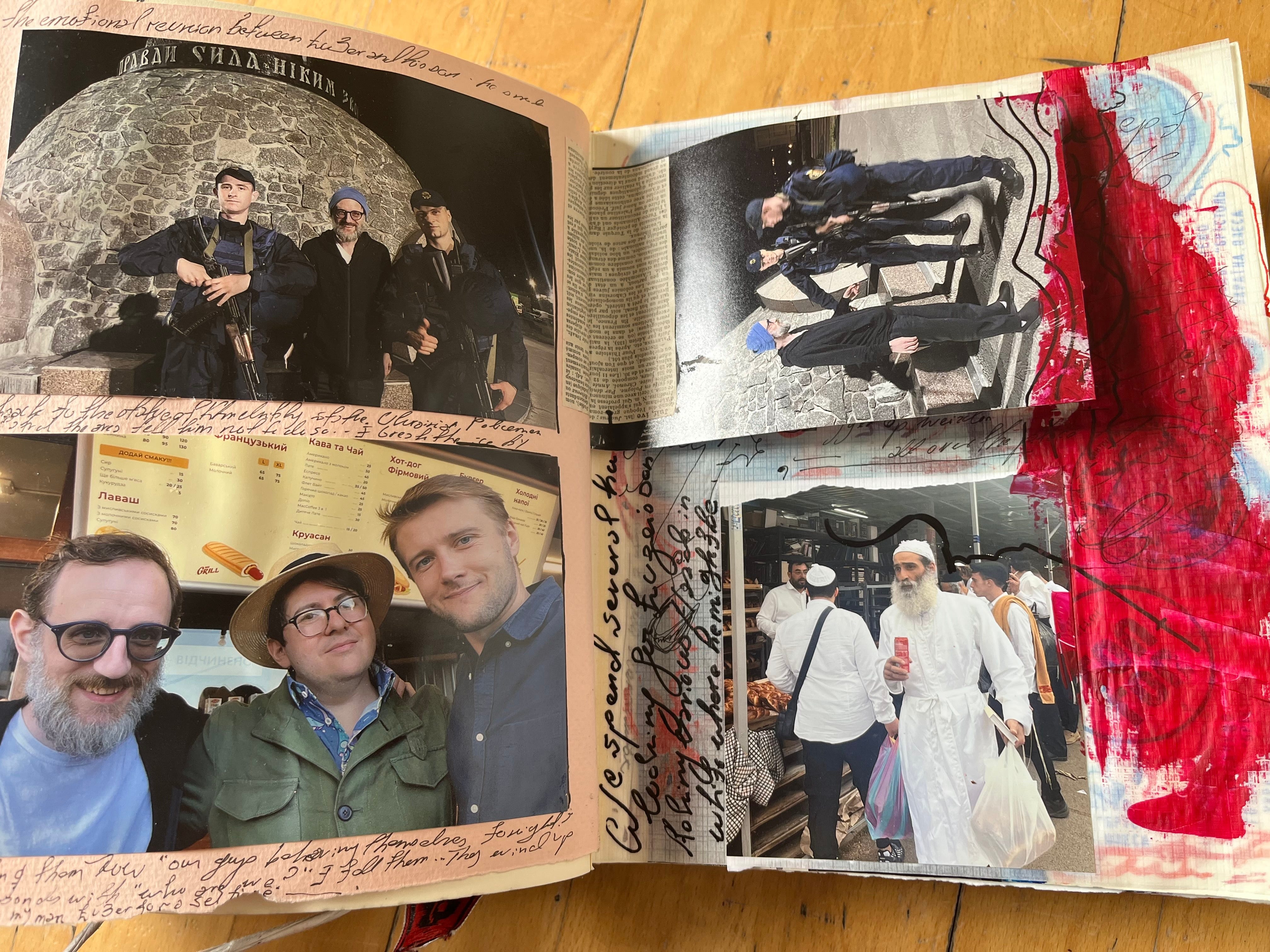
Claire: —Yeah, that’s grotesque. You should buy it because it’s a beautiful book, first. Because it’s got lots Vlad’s artwork in it, and it’s really worth it. I mean, most people will need to be convinced, a little bit. But I really think it’s worth US$30 to read this book. It’s given me a better insight into Ukrainian culture than any other book I’ve read. And I think that’s important, because people outside of Ukraine are connecting to Ukraine as a culture war totem, or an abstract idea. But this brought the people alive, and it brought the culture alive. And perhaps now I think o…