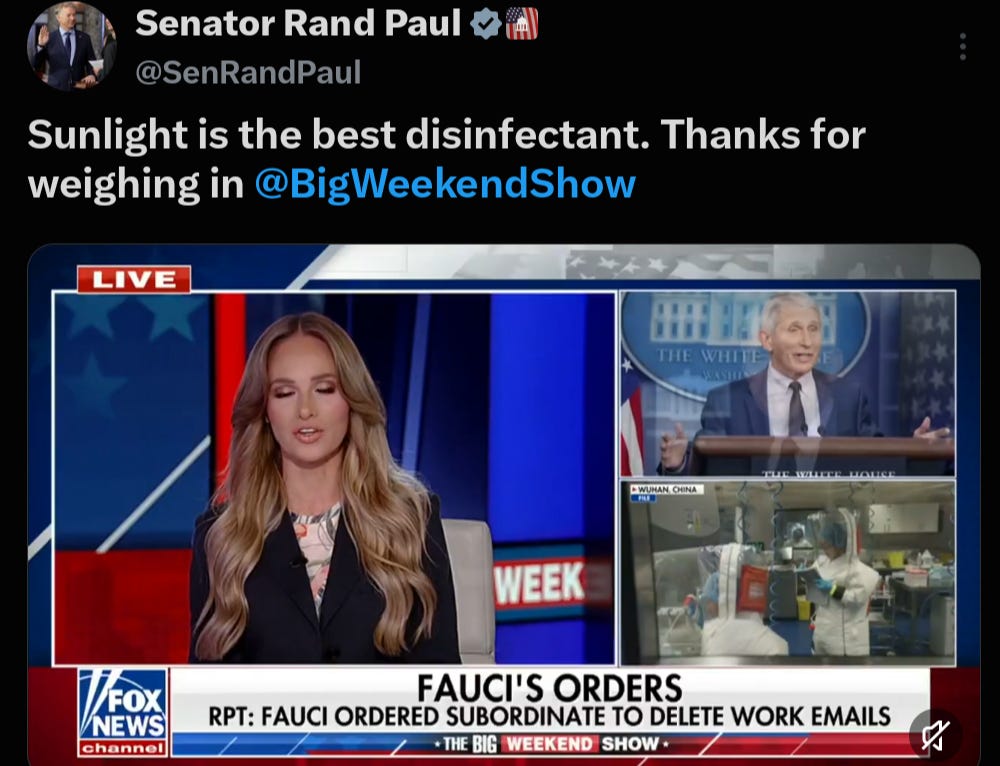
Newly released documents show Fauci repeatedly told staff to delete emails — including one instructing an aide to erase it from the deleted folder too.
Rand Paul kept his reaction brief after Fox News’s Big Weekend Show covered his committee’s latest document release. “Sunlight is the best disinfectant,” he wrote. “Thanks for weighing in @BigWeekendShow.”
Upgrade your subscription to the Rand Paul Substack — 60% off a full year.
“Please Delete This Email”
The documents, released by Paul’s committee, show a pattern stretching back over a decade. In message after message, Fauci asked recipients to delete emails once they’d read them.
One instruction went further than a simple delete request. In a 2012 email, Fauci reportedly wrote: “Please delete this e-mail and then delete from the deleted file” — a step that goes beyond routine inbox cleanup and starts to look like an effort to make sure a message couldn’t be recovered at all.
The dates on these emails span years, not weeks — September 2009, December 2011, March 2012, February 2020, and July 2020 among them, according to the documents. That range matters. This wasn’t a one-time lapse in judgment. It was a habit that persisted across more than a decade, through multiple different controversies.
A Flat Denial, Now on Record
The segment included a flashback graphic dated June 3, 2024, showing Fauci previously denying that he’d deleted any emails at all. Placed next to the document release, that denial reads very differently now than it likely did at the time.
Fox News senior medical analyst Dr. Marc Siegel also weighed in during the segment, addressing Fauci’s apparent frustration with a New York Times piece scrutinizing his research — a moment the segment’s on-screen text described simply as “hitting a nerve.”
Why the Timing Matters
The documents arrive years after Fauci’s public denial, and after multiple congressional appearances, including a July 29 Capitol Hill hearing referenced in the segment. For Paul, whose committee has spent years pressing for transparency around pandemic-era decision-making, the release fits a broader argument he’s made consistently: that the full record of what happened, and who tried to control that record, still hasn’t been made public.
Upgrade your subscription to the Rand Paul Substack — 60% off a full year.