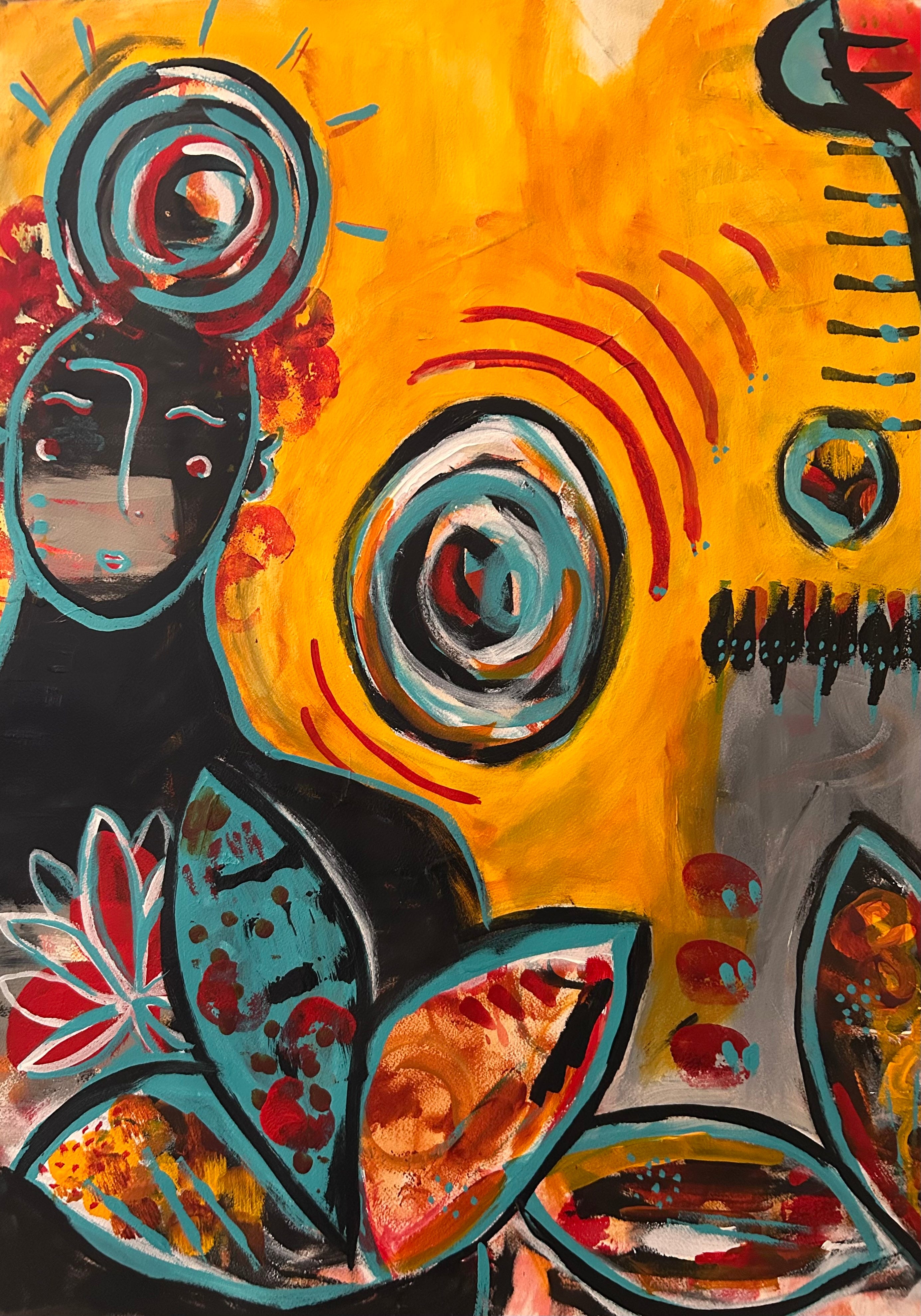
A lotus blooming in the fire is an image that comes from the Zen tradition. And before I write further on the symbolism of the image or the dharma teachings it evokes—I would like to invite us to just sit with the image of a lotus blooming in the fire.
For a moment, let yourself sense, imagine or feel into this image. Notice what you see, feel, hear, experience as you attempt to connect with the image of a lotus blooming in the fire.
Now, if you haven’t already bring the image closer in. Sit as, be a lotus blooming in the fire.
And stay with it for some time allowing associations, feelings, meanings, sensations to come and go. Returning simply to being a lotus in the fire.
When you are ready, you can let the image dissolve.
I am curious to hear what you noticed, what happened as you sat with or as a lotus blooming in the fire?
The Power of Embodied Imagination
To meditate with an image like this, is one form that koan practice can take in the Zen tradition. You sit with an image, becoming the image and learning about it through your direct experience. Notice how an image can contain seeming paradoxes. How can a lotus bloom in fire? Wouldn’t it burn? And yet, here it is.
On Wednesday, in Columbus we did this practice with my local sangha Mud Lotus. We sat as lotuses blooming in the fire. People noticed different things about this dynamic of fire and blooming. Someone pointed out that a lotus isn’t trying to stop the fire, yet it is blooming there. Another said that it seemed like the lotus bloomed because of the fire. Others saw the lotus as a reminder of their own nature that isn’t burned in the fires of life.
This image was popularized by the great Chan teacher of 11th Century China, Yuan-Wu. He used it to refer to the practice of what he called, Householder Bodhisattvas. Those of us whose practice-awakening happens in the fires of this world, in the challenges of our relationships, in our own inner conflicts or difficulties.
How to be a householder bodhisattva, it requires a stand that is solid and true and faith that is thoroughgoing…
When bodhisattvas who live a householder’s life cultivate the practices of deep meditation and insight, it is like a lotus blooming in the fire. It will always be hard to tame the will for fame and rank and power and position, not to mention all the myriad starting points of vexation and turmoil associated with the burning house of worldly existence. The only way is for you yourself to realize your fundamental, real wondrous wholeness and reach the stage of great calm, stability and rest. —Yuan-wu
Thich Nhat Hanh also used this image in his first book published in English, Vietnam: A Lotus in the Sea of Fire: A Buddhist Proposal for Peace.
What are the Fires in your Life?
Fire in the Buddhist tradition can be a symbol of suffering in all its manifestations. From the collective forms of suffering that appear as war, violence, injustice, conflict, misuse of power to the more personal forms of suffering that appear as anxiety, worry, terror, fear, shame, physical discomfort, pain.
Fire can also be a symbol of the instability of all experience, the changing nature of everyone and everything—in Buddhism we call this impermanence.
Suffering and impermanence are two of the marks of existence. A teaching the buddha gave about the nature of experience—basically reminding us that suffering and change are part of life.
In the Buddhist teachings, liberation or freedom from suffering is not the absence of pain, violence, fear, change, anxiety, etc. —but is found in the midst of these fires, or whatever fires we find ourselves in.
A Lotus Blooms in a Sea of Fire
Which brings us to the image of the lotus.
The lotus is a symbol of wholeness, it is an image of our true nature—which is always present, reliable, unbreakable yet soft—the blossoming of wisdom and compassion.
To realize our buddha nature does not make the fires of our lives go away, it doesn’t mean that the fires in the world stop burning.
Awakening is being the lotus blooming in the fire.
Its having this refuge of love unconditioned, of spacious awareness, unbreakable kindness in every situation—even as our heart’s break, even as we feel at times like we are falling apart.
The lotus of our true nature blooms— even here, even now.
Even without our noticing the lotus blooms. Part of what dharma practice is all about is training to recognize the lotus of our true nature, which at times may mean finding ways to nurture and care for our practice in the midst of these world fires.
Practicing with others whether it is in-person or online is a way to strengthen this refuge, to recognize for ourselves the lotus that doesn’t burn-up in the fires of stress, overwhelm, fear and all the other forms suffering can take in our lives and in this world.
Listen to the dharma talk for a more in-depth discussion of the Lotus in the Fire, and Yuan-wu’s teaching on How to be a Householder Bodhisattva.
I’m excited to be co-creating space this Spring and Summer for in-person sesshin/meditation retreats. As well as online immersions with Pause Meditation. See below for upcoming events!
Weekly Online Meditation Event
Monday Night Dharma — 6P PT / 9P ET Join weekly for drop-in meditation and dharma talk.
Feel free to join anytime. Event lasts about 1.5 hours. ZOOM LINK
Online Meditative Deep Dive with Pause Meditation
Beginner’s Mind Saturday March 7th from 10A PT/1P ET - 11:30A PT/2:30P ET
In-Person in Oregon
Light of the Ancestors Sesshin—May 11 - 17 at Great Vow Zen Monastery
Grasses, Trees and the Great Earth—
In-Person in Columbus, Ohio through Mud Lotus Sangha
Weekly Meditations on Tuesday, Wednesday and Thursday
Retreats, Meditation instruction and other events can be found on our website.
Upcoming Sesshins at Saranam Retreat Center in West Virginia
Mountains and Rivers Sesshin March 18 - 22 (Registration is now open!)
Mountains are high and wide. The movement of clouds and the inconceivable power of soaring in the wind comes freely from the mountains. —Dogen Zenji, Mountains and Waters Sutra
During this silent, Zen-style retreat we will practice with the mountains and waters, opening to our own mountain-stability and the flowing nature of all experience.
Meditation provides the opportunity for intimacy with self and world, recognizing the interconnectedness of this very life. Healing and transformation happen as we abide in the mystery of who we truly are.
This will be a silent meditation retreat. After an initial meal, set-up and orientation we will enter noble silence. Supporting each other in connecting with our own inner silence, stability and confidence. We will follow a rigorous daily schedule which includes roughly seven hours of seated meditation, interspersed with periods of walking meditation, chanting practice, dharma talks, opportunities to check-in with one of the practice leaders, outdoor meditation sessions, mindful eating practice during meals, a late morning care-taking practice and breaks where participants have the opportunity to rest, exercise and explore the beautiful grounds and nature.
Interdependence Sesshin June 29 - July 5 (save the date, registration opens soon!)
I’m Amy Kisei. I am a Zen Buddhist Teacher, Spiritual Counselor, Astrologer and Artist. I offer 1:1 Spiritual Counseling sessions using IFS and Hakomi (somatic mindfulness). I also offer astrology readings. Check out my website to learn more. I currently live in Columbus, OH and am a supporting teacher for the Mud Lotus Sangha.